Join us on a literary world trip!
Add this book to bookshelf
Grey
Write a new comment Default profile 50px
Grey
Subscribe to read the full book or read the first pages for free!
All characters reduced
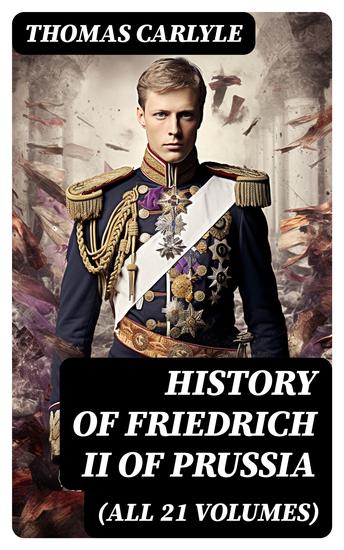
History of Friedrich II of Prussia (All 21 Volumes) - Biography of the Famous Prussian King Called Frederick the Great - cover

History of Friedrich II of Prussia (All 21 Volumes) - Biography of the Famous Prussian King Called Frederick the Great

Thomas Carlyle

Publisher: DigiCat

  • 0
  • 0
  • 0

Summary

In "History of Friedrich II of Prussia," Thomas Carlyle presents a monumental work that intricately chronicles the life and reign of Frederick II, portraying him not only as a sovereign but also as a complex individual entwined in the cultural and political fabric of 18th-century Europe. Written in a distinctive, elevating prose style that blends historical narrative with philosophical reflections, Carlyle's extensive 21-volume series delves into themes of power, art, and the interplay of destiny and free will. This ambitious project reflects Carlyle's deep engagement with German Romanticism and responds to the Enlightenment ideals that shaped his historical perspective, making it a rich tapestry of political and personal histories showcasing the fervor and challenges of the Prussian state during a tumultuous era. Thomas Carlyle, a Scottish philosopher and historian, was profoundly influenced by the socio-political upheavals of his time, particularly the industrial revolution and the complexities of modernity. His reverence for strong leadership and deep admiration for Frederick II are evident throughout the series. Carlyle's own struggles with faith, identity, and the power of the written word inform his portrayal of Frederick, positioning the King as a symbol of idealistic yet pragmatic governance amidst chaos. This exhaustive biography not only offers readers a fascinating historical account but also prompts them to ponder the greater philosophical questions surrounding authority, legacy, and the human condition. Scholars, history enthusiasts, and general readers alike will find Carlyle's narrative both enlightening and compelling, making this work an essential read for anyone drawn to the confluence of history and literature.
Available since: 11/19/2023.
Print length: 3599 pages.

Other books that might interest you

  • Three Dimensions of Learning - Where Resiliency and the Whole Child Rule - cover

    Three Dimensions of Learning -...

    Carolyn Nooks Teague

    • 0
    • 0
    • 0
    In "Three Dimensions of Learning," Nooks Teague offers a new enlightened approach to learning. It guides readers through the physical, mental, emotional and spiritual development of the child from life inside the womb to life in the school and provides tips that can help parents and educators recognize the symptoms that flag hidden disabilities. Hidden disabilities like vision dysfunction and sensory processing disorder can "make or break" a child's propensity to learn. Specific steps, illustrations, checklists, and exercises that parents and educators can use to empower the future of the child are included. Environmental and biological factors are identified with a clear explanation of how things like diet and even water affect the learning process. Strategies presented by Nooks Teague to help children self-regulate their emotions, as well as deal with issues concerning gender confusion, are included in this body of information.
    Show book
  • Influencing Hemingway - People and Places That Shaped His Life and Work - cover

    Influencing Hemingway - People...

    Nancy W Sindelar

    • 0
    • 0
    • 0
    Ernest Hemingway embraced adventure and courted glamorous friends while writing articles, novels, and short stories that captivated the world. Hemingway’s personal relationships and experiences influenced the content of his fiction, while the progression of places where the author chose to live and work shaped his style and rituals of writing. Whether revisiting the Italian front in A Farewell to Arms, recounting a Pamplona bull run in The Sun Also Rises, or depicting a Cuban fishing village in The Old Man and the Sea, setting played an important part in Hemingway’s fiction. The author also drew on real people—parents, friends, and fellow writers, among others—to create memorable characters in his short stories and novels.   In Influencing Hemingway: The People and Places That Shaped His Life and Work Nancy W. Sindelar introduces the reader to the individuals who played significant roles in Hemingway’s development as both a man and as an artist—as well as the environments that had a profound impact on the a
    Show book
  • Arthashastra or The Playbook of Material Gain - Pragmatic and amoral tips on how to gain defend and expand power from India’s greatest philosopher - cover

    Arthashastra or The Playbook of...

    Chanakya

    • 0
    • 0
    • 0
    Truly radical "Machiavellianism", in the popular sense of that word, is classically expressed in Indian literature in the Arthashastra of Kautilya (written long before the birth of Christ, ostensibly in the time of Chandragupta): compared to it, Machiavelli's The Prince is harmless.— Max Weber, Politics as a Vocation (1919)Chanakya's treatise, written while turning a farmhand into the emperor of the largest empire India had ever seen, focuses on how to manage an empire, covering everything from domestic policy and personal rights to assassination and the dirtier arts of politics. This is not, as with Plato’s Republic, a work of theory. Chanakya’s guidance is entirely practical, and is based on both his education and his experience building an empire. It lacks the philosophical ponderings and moralizing of its equivalent Western works (such as The Prince, The Republic or Leviathan) and instead focuses on how one deals with the messiness of the world in practice.People will occasionally refer to Chanakya as an Indian Machiavelli, but this does some discredit to Chanakya. The Prince is a satire, and focused around exposing the tactics and inhumanity of Cesare Borgia. Arthashastra is a manual for every aspect of statecraft, and while it deals in the unethical it does so only because that is, after all is said and done, one of the options available to a ruler.If you're after a totally pragmatic analysis of leadership, stripped of moralising and focused on what works and how to deal with real-world issues, this is the book for you.
    Show book
  • The Complete Works of Florence Scovel Shinn - The Game of Life and How to Play It Your Word Is Your Wand The Secret Door to Success The Power of the Spoken Word The Magic Path of Intuition - cover

    The Complete Works of Florence...

    Florence Scovell Shinn

    • 0
    • 0
    • 0
    Florence Scovel Shinn was a gifted teacher who shaped the fields of spiritual growth and New Thought. Her practical, straightforward style empowered countless people to trust their inner knowing and overcome their challenges.With an Introduction by self-help luminary Louise Hay, who credits Florence as one of her early inspirations, this simple yet poignant book—which contains original, previously unpublished text—can help you positively transform your life. Powerful affirmations will show you how to cultivate your intuition and release any resistance, fear, and doubt.Florence said, "You must live fully in the now to make your dreams come true." Are you ready to follow your own magic path, your Divine wisdom, and realize your dreams? Goals or wishes that seem far off or unattainable are just waiting for you to believe in your potential and innate ability to manifest your desires!Contents:The Game of Life and How to Play ItYour Word is Your Wand,The Secret Door to SuccessThe Power of the Spoken WordThe Magic Path of Intuition
    Show book
  • The Late Medieval Scottish Parliament - Politics and the three Estates 1424–1488 - cover

    The Late Medieval Scottish...

    Roland Tanner

    • 0
    • 0
    • 0
    In this ground-breaking study of the medieval parliament, Roland Tanner gives the Scottish Parliament a human face by examining the actions and motives of those who attended. In the past, the Scottish Parliament was seen as a weak and ineffective institution – damned because of its failure to be more like its English counterpart. But Roland Tanner shows that the old picture of weakness is far from accurate. In its very different way, the Scottish Parliament was every bit as powerful as the English institution. The ‘Three Estates’ (the clergy, nobility and burgh representatives who attended Parliament) were able to wield a surprising degree of control over the Crown during the fifteenth century. For instance, they threatened to lock James I’s taxation in a box to which he, the king, would have no access, made James II swear not to alter acts of Parliament, and prevented him from using his own lands and wealth as patronage for his supporters, and forbade James III to leave the country.  Roland Tanner has avoided a dry constitutional approach. Instead he has sought to bring Parliament to life through the people who attended, the reasons why they attended, and the complex interactions which occurred when all the most wealthy, powerful and ambitious people in the kingdom gathered in one place.
    Show book
  • Dostoevsky in Love - An Intimate Life - cover

    Dostoevsky in Love - An Intimate...

    Alex Christofi

    • 0
    • 0
    • 0
    Dostoevsky's life was marked by brilliance and brutality. Sentenced to death as a young revolutionary, he survived mock execution and Siberian exile to live through a time of seismic change in Russia, eventually being accepted into the Tsar's inner circle. Somehow, amidst all this, he found time to write short stories, journalism, and novels such as Crime and Punishment, The Idiot, and The Brothers Karamazov, works now recognized as among the finest ever written. 


    In Dostoevsky in Love Alex Christofi weaves carefully chosen excerpts of the author's work with the historical context to form an illuminating and often surprising whole. The result is a novelistic life that immerses the listener in a grand vista of Dostoevsky's world. Along the way, Christofi relates the stories of the three women whose lives were so deeply intertwined with Dostoevsky's: the consumptive widow Maria; the impetuous Polina who had visions of assassinating the Tsar; and the faithful stenographer Anna. 


    Christofi reconstructs the memoir Dostoevsky might have written had life—and literary stardom—not intervened. He gives us a new portrait of the artist as never before seen: a shy but devoted lover, an empathetic friend of the people, a loyal brother and friend, and a writer able to penetrate to the very depths of the human soul.
    Show book