Join us on a literary world trip!
Add this book to bookshelf
Grey
Write a new comment Default profile 50px
Grey
Subscribe to read the full book or read the first pages for free!
All characters reduced
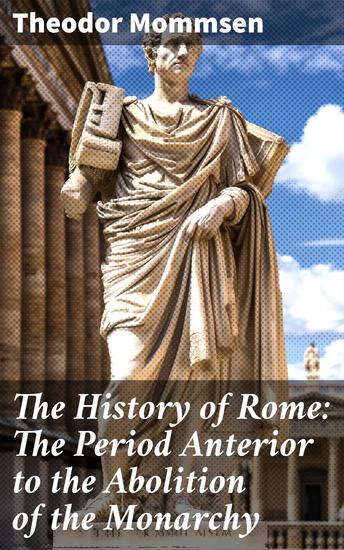
The History of Rome: The Period Anterior to the Abolition of the Monarchy - Unveiling the Dawn of Rome: Transitioning from Monarchy to Republic - cover

The History of Rome: The Period Anterior to the Abolition of the Monarchy - Unveiling the Dawn of Rome: Transitioning from Monarchy to Republic

Theodor Mommsen

Translator William P. Dickson

Publisher: Good Press

  • 0
  • 0
  • 0

Summary

In "The History of Rome: The Period Anterior to the Abolition of the Monarchy," Theodor Mommsen meticulously traces the evolution of Roman society from its foundation through the final vestiges of monarchy. With a distinctive blend of narrative history and critical analysis, Mommsen employs a scholarly yet engaging literary style, bringing to life the complex socio-political landscapes and the cultural nuances of early Rome. His work not only contextualizes the intricate interactions of power, philosophy, and governance but also delves into the ideological undercurrents that set the stage for the Republic's emergence. Theodor Mommsen, a prominent 19th-century German historian, was influenced by his experience in law, politics, and literature, which profoundly shaped his historiographical approach. His passion for antiquity and meticulous research into Roman history culminated in this seminal work, which reflects his belief in the importance of historical continuity and the lessons it imparts for contemporary society. Recognized with the Nobel Prize in Literature in 1902 for his historical scholarship, Mommsen remains an authoritative voice on Roman history. This book is an essential read for scholars and enthusiasts of ancient history alike, offering rich insights into the formative years of Rome. Mommsen'Äôs blend of narrative vigor and erudition allows readers to appreciate not only Rome's historical legacy but also its impacts on modern governance and civic responsibility.
Available since: 08/12/2023.
Print length: 278 pages.

Other books that might interest you

  • The Absent Father Effect on Daughters - Father Desire Father Wounds - cover

    The Absent Father Effect on...

    Susan E. Schwartz

    • 0
    • 0
    • 0
    The Absent Father Effect on Daughters investigates the impact of absent—physically or emotionally—and inadequate fathers on the lives and psyches of their daughters through the perspective of Jungian analytical psychology. This book tells the stories of daughters who describe the insecurity of self, the splintering and disintegration of the personality, and the silencing of voice. 


    Issues of fathers and daughters reach to the intra-psychic depths and archetypal roots, to issues of self and culture, both personal and collective. Susan E. Schwartz illustrates the maladies and disappointments of daughters who lack a father figure and incorporates clinical examples describing how daughters can break out of idealizations, betrayals, abandonments, and losses to move towards repair and renewal. The book takes an interdisciplinary approach, expanding and elucidating Jungian concepts through dreams, personal stories, fairy tales, and the poetry of Sylvia Plath, along with psychoanalytic theory, including Andre Green's 'dead father effect' and Julia Kristeva's theories on women and the body as abject. 


    Examining daughters both personally and collectively affected by the lack of a father, this book is highly relevant for those wanting to understand the complex dynamics of daughters and fathers to become their authentic selves.
    Show book
  • Thinking Historically - A Guide to Statecraft and Strategy - cover

    Thinking Historically - A Guide...

    Francis J. Gavin

    • 0
    • 0
    • 0
    It seems obvious that we should use history to improve policy. If we have a good understanding of the past, it should enable better decisions in the present, especially in the extraordinarily consequential worlds of statecraft and strategy. But how do we gain that knowledge? How should history be used? Sadly, it is rarely done well, and historians and decision-makers seldom interact. But in this remarkable book, Francis J. Gavin explains the many ways historical knowledge can help us understand and navigate the complex, often confusing world around us. Good historical work convincingly captures the challenges and complexities the decisionmaker faces. At its most useful, history is less a narrowly defined field of study than a practice, a mental awareness, a discernment, and a responsiveness to the past and how it unfolded into our present world—a discipline in the best sense of the word. Gavin demonstrates how a historical sensibility helps us to appreciate the unexpected; complicates our assumptions; makes the unfamiliar familiar and the familiar unfamiliar; and requires us, without entirely suspending moral judgment, to try to understand others on their own terms. This book is a powerful argument for thinking historically as a way for listeners to apply wisdom in encountering what is foreign to them.
    Show book
  • When Science Meets Power - 1st Edition - cover

    When Science Meets Power - 1st...

    Geoff Mulgan

    • 0
    • 0
    • 0
    Science and politics have collaborated throughout human history and science is repeatedly invoked today in political debates, from pandemic management to climate change. 


    Leading policy analyst Geoff Mulgan here calls attention to the growing frictions caused by the expanding—and unsolicited—authority being heaped upon science. As science increasingly competes with politics, a defined plan of cooperation is urgently needed. 


    Mulgan outlines science and politics as two distinct, imperfect forms of collective intelligence. Whereas science is ordered around what we know and what is, politics engages what we feel and what matters. Politics functions because it recognizes the limits of power, the need for delegation and expert advice. The intellectual logic of science, on the other hand, focuses on detail and depth, struggling to place its knowledge in wider contexts. The crux of the matter, Mulgan argues, is how can we ensure that crucial decisions taken in democracies are both well informed and legitimate? 


    Rooted in understanding that science and politics are not just fields of ideas but also fields of action, this book proposes ways to ensure that the two work effectively together.
    Show book
  • The Battle of Lepanto - The Last Great Naval Clash - cover

    The Battle of Lepanto - The Last...

    Nova Ashford

    • 0
    • 0
    • 0
    The Battle of Lepanto, fought on October 7, 1571, stands as one of the most significant naval engagements in history. A defining moment in the struggle between Christian Europe and the expanding Ottoman Empire, it marked the climax of a centuries-long clash for dominance in the Mediterranean. Lepanto not only shaped the balance of power in the region but also signaled the beginning of the decline of the Ottoman naval supremacy. As one of the last great fleet engagements in history, the battle is remembered as a pivotal moment in the defense of Christendom and the resistance to Ottoman expansion. 
    At the heart of the conflict was the Ottoman Empire, a rising superpower that had established itself as a dominant force in the Mediterranean by the 16th century. Under the leadership of Suleiman the Magnificent, the Ottomans expanded their reach into North Africa and into Europe, pushing towards the gates of Vienna. By the time of the Battle of Lepanto, the Ottomans controlled much of the eastern Mediterranean, and their navy was one of the largest and most powerful in the world. However, the rapid expansion of the empire also stirred fears among Christian nations, who saw their way of life threatened by the growing Ottoman presence. 
    In response to this looming threat, Pope Pius V initiated the formation of the Holy League, an alliance of Catholic maritime states including Spain, Venice, and the Papal States. This coalition sought to halt the Ottoman advance and safeguard Christian territories in the Mediterranean. The Holy League’s formation was both a religious and political reaction to the Ottoman Empire's imperial ambitions.
    Show book
  • Stories from Kathasaritasagara series -20 - From various sources - cover

    Stories from Kathasaritasagara...

    Anusha HS

    • 0
    • 0
    • 0
    The book Kathasaritsagara has been created by Soma Deva. It consists of 21,500 shlokas. 
    This book Kathasaritsagara has been divided into 18 lambakaas, and those 18 lambakaas are still more divided into 125 Tharanga's. 
    Some lambakaas are very big, while some are very small. 
    If there are 115 Shlokas in the 11th Lambaka, there are around 4925 Shlokas in 12th Lambaka. 
    During ancient times from the mouth of Lord Shiva, this story got birth. Those who listen to this story will experience all sorts of worldly pleasures. They will be blessed by Lord Shiva and at last reach jnana Loka by the blessings of lord Shiva.
    Show book
  • Key to the City - How Zoning Shapes Our World - cover

    Key to the City - How Zoning...

    Sara C. Bronin

    • 0
    • 0
    • 0
    In Key to the City, legal scholar and architect Sara C. Bronin examines how zoning became such a prevailing force and reveals its impact—and its potential for good. Outdated zoning codes have maintained racial segregation, prioritized cars over people, and enabled great ecological harm. But, as Bronin argues, once we recognize the power of zoning, we can harness it to create the communities we desire, and deserve. Drawing on her own experience leading the overhaul of Hartford's zoning code and exploring the efforts of activists and city planners across the country, Bronin shows how new codes are reshaping our cities—from Baltimore to Chicago, Las Vegas to Minneapolis, and beyond. In Boston, a law fought for by a passionate group of organizers, farmers, and beekeepers is transforming the city into a haven for urban farming. In Tucson, zoning codes are mitigating the impacts of climate change and drought-proofing neighborhoods in peril. In Delray Beach, Florida, a new code aims to capture and maintain the town's colorful spirit through its architecture. 


    With clarity and insight, Bronin demystifies the power of an inscrutable organizing force in our lives and invites us to see zoning as a revolutionary vehicle for change. In Key to the City, she puts forward a practical and energizing vision for how we can reimagine our communities.
    Show book