Rejoignez-nous pour un voyage dans le monde des livres!
Ajouter ce livre à l'électronique
Grey
Ecrivez un nouveau commentaire Default profile 50px
Grey
Abonnez-vous pour lire le livre complet ou lisez les premières pages gratuitement!
All characters reduced
Vedanta - The Science of Consciousness - cover

Vedanta - The Science of Consciousness

S. Omana

Maison d'édition: D.K. Printworld

  • 0
  • 0
  • 0

Synopsis

Sree Narayana Guru (1856–1928), an enlightened seer, represents VedÀnta as a Science of Consciousness or pure Epistemology. This book deals with Guru’s epistemology and shows how it can eliminate many of the problems in philosophy and life.The Guru conceives Consciousness or Arivu as the one all underlying Reality that assumes the form of everything in the world, both mind and matter.Epistemologists are usually either idealists or realists, but the Guru is neither. To him there is no need to place one above the other since they are two manifest forms of one Consciousness.Many eminent persons have tried to solve the problem of consciousness, but could not succeed because they were not ready to consider man as a pure being and the essence of the world as Consciousness.To the Guru, in every event of knowing there is the coming together of subject, object and also the function of knowing. These three are Consciousness in essence. What we really need is awareness of it. All kinds of divisiveness, conflicts and crises can be solved through an awakening of the inner consciousness of man which is non-different from the one all underlying Reality titled Brahman, °tman or Consciousness.
Disponible depuis: 22/03/2025.
Longueur d'impression: 398 pages.


D'autres livres qui pourraient vous intéresser

  • How to Talk About Love - An Ancient Guide for Modern Lovers - cover

    How to Talk About Love - An...

    Plato

    • 0
    • 0
    • 0
    What is love? In poetry, songs, fiction, movies, psychology, and philosophy, love has been described, admired, lamented, and dissected in endless ways. Is love based on physical attraction? Does it bring out our better selves? How does it relate to sex? Is love divine? Plato's Symposium is one of the oldest, most influential, and most profound explorations of such questions—it is even the source of the idea of "Platonic love." How to Talk about Love introduces and presents the key passages and central ideas of Plato's philosophical dialogue in a lively new translation. 


    The Symposium is set at a fictional drinking party during which prominent Athenians engage in a friendly competition by delivering improvised speeches in praise of Eros, the Greek god of love and sex. The aristocrat Phaedrus, the legal expert Pausanias, the physician Eryximachus, the comic playwright Aristophanes, and the tragic poet Agathon—each by turn celebrates different aspects of love before Socrates proposes not to praise love but to tell the truth about it. In the final speech, the politician and libertine Alcibiades argues that Socrates himself is the epitome of love. 


    Deftly capturing the essence and spirit of Plato's masterpiece, How to Talk about Love makes the Symposium more accessible and enjoyable than ever before.
    Voir livre
  • Escaping Madness - Eyewitness Accounts from World War II - cover

    Escaping Madness - Eyewitness...

    Klaus G. Förg

    • 0
    • 0
    • 0
    This fascinating collection of personal narratives challenges the view that all Germans knew of the crimes perpetrated by the Third Reich and were complicit. The five accounts recall the lives of individuals born in the 1920s who resisted joining the SS, were horrified by atrocities, or otherwise remained true to their principals. Spanning their early life during the rise of the Nazi Party, through their adolescence in the war, to the early post-war years, they offer a compelling perspective on the diverse experiences and beliefs of Germans of the wartime generation.From Wehrmacht infantrymen to a Luftwaffe officer and a young woman on the home front, the accounts range from the relative comfort of German-occupied territories to the harrowing front lines against the Soviets. Standout stories include Heinz Polke's haunting description of the Warsaw Ghetto Rising, and three accounts of the often-overlooked aspect of being a prisoner of war in the USSR, providing valuable insights into the post-war German experience.Skillfully compiled by journalist Klaus Förg and with additional commentary by historian Roger Moorhouse, this is a powerful and worthy addition to World War II literature.
    Voir livre
  • Commander in Chief - Partisanship Nationalism and the Reconstruction of Congressional War Powers - cover

    Commander in Chief -...

    Casey B. K. Dominguez

    • 0
    • 0
    • 0
    The constitutional balance of war powers has shifted from Congress to the president over time. Today, presidents broadly define their constitutional authority as commander in chief. In the nineteenth century, however, Congress was the institution that claimed and defended expansive war powers authority. This discrepancy raises important questions: How, specifically, did Congress define the boundaries between presidential and congressional war powers in the early republic? Did that definition change? 


    Casey Dominguez's Commander in Chief systematically analyzes the authority that members of Congress ascribe to the president as commander in chief and the boundaries they put around that authority. 


    Dominguez shows that for more than a century members of Congress defined the commander in chief's authority narrowly. But in a wave of nationalism during the Spanish-American War, members of Congress began to argue that Congress owed deference to the commander in chief. They also tended to argue that a president of their own party should have broad war powers, while the powers of a president in the other party should be defined narrowly. Together, these two dynamics suggest that the conditions for presidentially dominated modern constitutional war powers were set at the turn of the twentieth century, far earlier than is often acknowledged.
    Voir livre
  • The Cognitive Behavioral Therapy Workbook for Leaders - How Improving Your Mental Health Is Essential to Avoiding Burnout and Leading More Effectively - cover

    The Cognitive Behavioral Therapy...

    PsyD Simon A. Rego, PhD Julian...

    • 0
    • 0
    • 0
    Leaders are expected to be strong, dynamic, intelligent, and level-headed. As a leader, you may feel compelled to embody a "superhuman" standard or make personal sacrifices in order to get a project done well and on time. You might ignore the warning signs of mental health issues such as sleeplessness and fatigue. And, to make matters worse, you may rely on unhealthy behaviors such as consuming alcohol to deal with the overwhelming stress of daily life. So, how can you break this destructive cycle, prioritize your mental health, and optimize performance? 
     
    This workbook offers skills and strategies based in cognitive behavioral therapy (CBT), as well as dialectical behavior therapy (DBT) and acceptance and commitment therapy (ACT), to soothe stress, avoid exhaustion, and build the resilience required to show up as your best self. You'll gain a greater understanding of the specific psychological challenges inherent in leadership positions, the emotional toll it takes professionally and personally, and—most importantly—how to manage these challenges effectively. 
     
    As a leader, admitting that you are struggling can be difficult. You may have feelings of shame, or fears of being stigmatized. But when weighed against the increasing costs to your mental, physical, and emotional well-being, you simply can't afford to ignore it!
    Voir livre
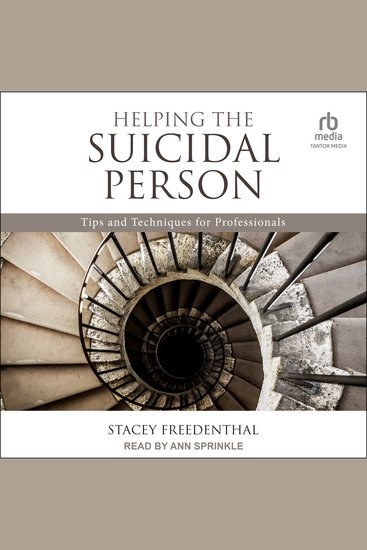
  • Helping the Suicidal Person - Tips and Techniques for Professionals - cover

    Helping the Suicidal Person -...

    PhD Stacey Freedenthal

    • 0
    • 0
    • 0
    Helping the Suicidal Person provides a highly practical toolbox for mental health professionals. The book first covers the need for professionals to examine their own personal experiences and fears around suicide, moves into essential areas of risk assessment, safety planning, and treatment planning, and then provides a rich assortment of tips for reducing the person's suicidal danger and rebuilding the wish to live. The techniques described in the book can be interspersed into any type of therapy, no matter what the professional's theoretical orientation is and no matter whether it's the client's first, tenth, or one-hundredth session.
    Voir livre
  • The Great Irish Famine - cover

    The Great Irish Famine

    Cathal Poirteir

    • 0
    • 0
    • 0
    This is the most wide-ranging series of essays ever published on the Great Irish Famine, and will prove of lasting interest to the general reader. Leading historians, economists and geographers – from Ireland, Britain and the United States – have assembled the most up-to-date research from a wide spectrum of disciplines including medicine, folklore and literature, to give the fullest account yet of the background and consequences of the Famine. Contributors include Dr Kevin Whelan, Professor Mary Daly, Professor James Donnelly and Professor Cormac Ó Gráda. The Great Irish Famine was the first major series of essays on the Famine published in Ireland for almost fifty years.
    Voir livre