Join us on a literary world trip!
Add this book to bookshelf
Grey
Write a new comment Default profile 50px
Grey
Subscribe to read the full book or read the first pages for free!
All characters reduced
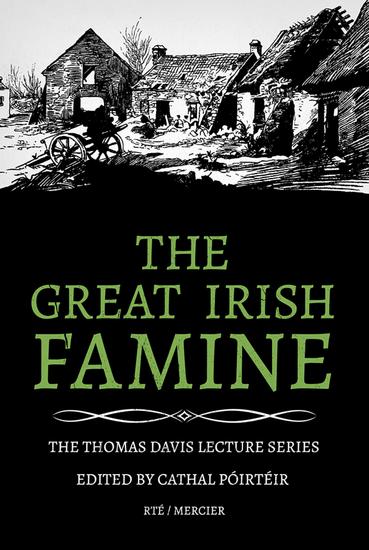
The Great Irish Famine - cover

The Great Irish Famine

Cathal Poirteir

Publisher: Mercier Press

  • 0
  • 0
  • 0

Summary

This is the most wide-ranging series of essays ever published on the Great Irish Famine, and will prove of lasting interest to the general reader. Leading historians, economists and geographers – from Ireland, Britain and the United States – have assembled the most up-to-date research from a wide spectrum of disciplines including medicine, folklore and literature, to give the fullest account yet of the background and consequences of the Famine. Contributors include Dr Kevin Whelan, Professor Mary Daly, Professor James Donnelly and Professor Cormac Ó Gráda. The Great Irish Famine was the first major series of essays on the Famine published in Ireland for almost fifty years.
Available since: 08/15/2023.
Print length: 283 pages.

Other books that might interest you

  • Give It A Home - cover

    Give It A Home

    Lizzy Co

    • 0
    • 0
    • 0
    What happens when a woman's life falls apart? 
    She builds a new one. 
    Take the journey, one sonnet at a time. 
    - 
    When she was 35, Lizzy Co lost everything that filled her heart. This is the story of how she filled it back up. 
    Give It A Home is a journey through a year of recovery, told through 100 sonnets. 
    Walk with Lizzy as she navigates the daily experience of grieving the loss of her father, her relationship, her job, and her sense of self. 
    (Spoiler alert: there's a happy ending.)
    Show book
  • Ancient Ways Modern Truths and Decoding the Heavens 2-in-1 Bundle - How Indigenous Wisdom Can Guide Us Forward Unlocking Ancient Astronomy's Greatest Mysteries - cover

    Ancient Ways Modern Truths and...

    PHILIP BEARD, MARY PARKER,...

    • 0
    • 0
    • 0
    Embark on a transformative journey of ancient wisdom and modern insights. This enlightening guide offers a captivating exploration of indigenous wisdom and ancient astronomy, providing essential tools for understanding our past, present, and future.What to Expect:Ancient Ways, Modern Truths: Explore the timeless wisdom of indigenous cultures from around the world and discover how their ancient teachings can illuminate our path forward in the modern age.Decoding the Heavens: Unlock the secrets of ancient astronomy and unravel the mysteries of the universe with groundbreaking research and discoveries.Connection and Understanding: Cultivate a deeper connection to the world around you and gain a greater understanding of humanity's place in the cosmos.Adaptation and Evolution: Embrace the wisdom of adaptation and evolution as you navigate the complexities of modern life and societal change. Discover how indigenous cultures and ancient astronomers adapted to their environments and thrived in harmony with nature, and learn how their insights can inform our approach to sustainability, resilience, and collective well-being.Personal Growth and Transformation: Harness the power of ancient wisdom and modern truths to unlock your full potential and embark on a journey of personal growth and transformation. 
    Embark on a journey of connection, discovery, and transformation. Whether you're drawn to indigenous wisdom, ancient astronomy, or the intersection of science and spirituality, this comprehensive guide offers a roadmap for exploring the depths of human experience and unlocking the mysteries of the universe.
    Show book
  • Lagertha - cover

    Lagertha

    History Nerds

    • 0
    • 0
    • 0
    Dive into the world of Norse legends and uncover the extraordinary life of Lagertha, the legendary shieldmaiden whose tale defies the conventions of her time. In "Lagertha," journey through the sagas and historical narratives that bring to life the fierce warrior known for her unparalleled bravery, strategic prowess, and indomitable spirit. 
    Lagertha's story is woven with valor and independence, setting her apart as a beacon of strength in a male-dominated Viking Age. Yet, her legend is not alone. This book delves deeply into the sagas of other remarkable Norse heroines such as Gudrun and Brynhildr, drawing vivid comparisons that highlight the unique qualities and enduring legacies of these powerful women. 
    Explore the contrasts and similarities between Lagertha, the resilient Gudrun, and the tragic Valkyrie Brynhildr. Understand how each navigated the complex dynamics of love, betrayal, honor, and vengeance within their respective narratives. Through detailed analysis and captivating storytelling, this book paints a comprehensive picture of the multifaceted roles and identities of Norse women. 
    "Lagertha" is more than a historical account; it's an exploration of myth, culture, and the timeless human spirit. Perfect for enthusiasts of Norse mythology, history buffs, and anyone fascinated by the tales of powerful women who have left an indelible mark on legend and lore. Embark on a journey that honors the valor and resilience of these legendary figures, whose stories continue to inspire and captivate.
    Show book
  • French History: An Enthralling Guide to Major Events and Figures in the Story of France and French Revolution - cover

    French History: An Enthralling...

    Billy Wellman

    • 0
    • 0
    • 0
    Two manuscripts in one audiobook:History of France: An Enthralling Overview of Major Events and FiguresThe French Revolution: An Enthralling Guide to a Major Event in World History 
    In the first part of this audiobook, you will discover:France’s origins and its prehistoryFrance’s relations with the Roman EmpireHow the French survived the Middle AgesThe French Revolution and the impact it had on societyThe Napoleonic Wars and the changes Napoleon made in France and its coloniesFrench colonialism and a look at some of the major French coloniesFrance during the world warsPostwar and Cold War FranceModern France and what its future might hold 
    In the second part of this audiobook, you will learn all about:The downfall of King Louis and Marie AntoinetteThe rise of the Jacobins and other political clubsThe Reign of Terror and the cult of RobespierreThe Thermidorian Reaction and what that meant for the FrenchThe Directory and other government bodiesNapoleon Bonaparte and his military genius and leadership styleAnd so much more! 
    Scroll up and click the “add to cart” button to begin learning about French History today!
    Show book
  • Sociology - Society Structures and Human Interaction - cover

    Sociology - Society Structures...

    Mike Crawford

    • 0
    • 0
    • 0
    Sociology is the scientific study of society, human behavior, and social interactions. It examines how individuals and groups influence one another, the structures that shape social life, and the cultural norms that govern behavior. Sociology provides insights into the complexities of human relationships, revealing patterns in how people interact, organize themselves, and respond to societal changes. By analyzing these patterns, sociologists seek to understand and explain the forces that shape societies, from historical developments to contemporary issues. 
    The importance of sociology lies in its ability to uncover hidden social mechanisms that influence daily life. It helps individuals understand how social structures—such as family, education, and politics—affect opportunities, behaviors, and beliefs. This field of study also provides tools for critically examining societal norms, questioning inequalities, and advocating for social change. In an increasingly interconnected world, sociology offers valuable perspectives on globalization, migration, and cultural diversity, highlighting both the challenges and benefits of social transformation. 
    Sociology encompasses various theoretical perspectives that guide its analysis. The functionalist perspective views society as a system of interconnected parts, each contributing to social stability. It emphasizes the roles institutions play in maintaining order and continuity. The conflict perspective, on the other hand, focuses on power struggles and social inequalities, arguing that societies are shaped by competition for resources and dominance between different groups. The symbolic interactionist perspective examines social interactions at the micro-level, emphasizing the meanings individuals attach to their experiences, symbols, and communication. Each of these perspectives offers a distinct way of understanding society and human behavior.
    Show book
  • Kill Caesar! - Assassination in the Early Roman Empire - cover

    Kill Caesar! - Assassination in...

    Rose Mary Sheldon

    • 0
    • 0
    • 0
    “Why were Rome’s first emperors—the good, the bad, and the ugly—so vulnerable to conspiracies and assassination? . . . an expert analysis . . . compelling.” —Adrienne Mayor, author of The Poison King: The Life and Legend of Mithradates and Rome’s Deadliest Enemy Exploring the history of internal security under the first Roman dynasty, this groundbreaking book answers the enduring question: If there were 9,000 men guarding the emperor, how were three-quarters of Rome’s leaders assassinated? Rose Mary Sheldon traces the evolution of internal security mechanisms under the Julio-Claudians, evaluating the system that Augustus first developed to protect the imperial family and the stability of his dynasty. Yet in spite of the intensive precautions taken, there were multiple attempts on his life.    Like all emperors, Augustus had a number of competing constituencies—the senate, the army, his extended family, the provincials, and the populace of Rome—but were they all equally threatening? Indeed, the biggest threat would come from those closest to the emperor—his family and the aristocracy. Even Roman imperial women were deeply involved in instigating regime change. By the fourth emperor, Caligula, the Praetorian Guards were already participating in assassinations, and the army too was becoming more politicized.    Sheldon weighs the accuracy of ancient sources: Does the image of the emperor presented to us represent reality or what the people who killed him wanted us to think? Were Caligula and Nero really crazy, or did senatorial historians portray them that way to justify their murder? Was Claudius really the fool found drooling behind a curtain and made emperor, or was he in on the plot from the beginning? These and other fascinating questions are answered as Sheldon concludes that the repeated problem of “killing Caesar” reflected the empire’s larger dynamics and turmoil.
    Show book