Rejoignez-nous pour un voyage dans le monde des livres!
Ajouter ce livre à l'électronique
Grey
Ecrivez un nouveau commentaire Default profile 50px
Grey
Abonnez-vous pour lire le livre complet ou lisez les premières pages gratuitement!
All characters reduced
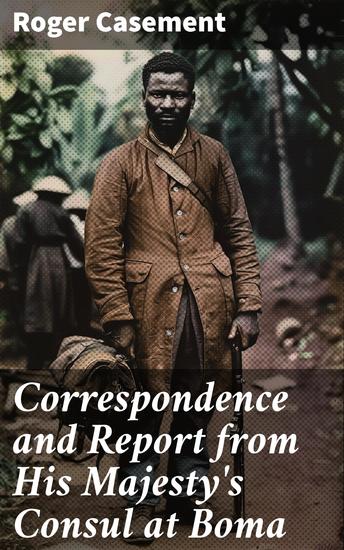
Correspondence and Report from His Majesty's Consul at Boma - Enriched edition Respecting the Administration of the Independent State of the Congo - cover

Correspondence and Report from His Majesty's Consul at Boma - Enriched edition Respecting the Administration of the Independent State of the Congo

Roger Casement

Maison d'édition: Good Press

  • 0
  • 0
  • 0

Synopsis

In "Correspondence and Report from His Majesty's Consul at Boma," Roger Casement offers a harrowing account of the atrocities committed in the Congo Free State during the late 19th century. This work is not only a vital historical document but also a poignant literary artifact that captures the stark realities of colonial exploitation. Casement employs a meticulous and direct style, blending detailed correspondence with passionate reporting, revealing the brutal human costs of imperial ambitions. His language evokes both the dread and urgency of the situation, making the report an essential primary source for understanding the moral implications of colonialism. Roger Casement was an Irish diplomat and humanitarian whose experiences in Africa and South America shaped his views on imperialism and human rights. As a witness to the chilling practices of the rubber trade in the Congo, he became a vocal advocate against abuses, using his position to alert the British government and the wider world. His commitment to social justice and his willingness to confront uncomfortable truths are palpable throughout this work, which serves as a testament to his character and ideals. This book is crucial for readers interested in colonial history, human rights advocacy, and ethical literature. Casement's work compels us to confront the darker dimensions of empire, making it an essential read for scholars, students, and anyone with a commitment to understanding the past and its implications on the present.

In this enriched edition, we have carefully created added value for your reading experience:
- A succinct Introduction situates the work's timeless appeal and themes.
- The Synopsis outlines the central plot, highlighting key developments without spoiling critical twists.
- A detailed Historical Context immerses you in the era's events and influences that shaped the writing.
- A thorough Analysis dissects symbols, motifs, and character arcs to unearth underlying meanings.
- Reflection questions prompt you to engage personally with the work's messages, connecting them to modern life.
- Hand‐picked Memorable Quotes shine a spotlight on moments of literary brilliance.
- Interactive footnotes clarify unusual references, historical allusions, and archaic phrases for an effortless, more informed read.
Disponible depuis: 26/10/2023.
Longueur d'impression: 328 pages.

D'autres livres qui pourraient vous intéresser

  • Feelings and Illusions - Selected Articles of Pabitra Adhikary - cover

    Feelings and Illusions -...

    Pabitra Adhikary

    • 0
    • 0
    • 0
    Beauty is a feeling. 
    Had we not looked at the rose would it have been beautiful? 
    Had the name of rose not been rose but instead it would have been something else then would we have loved it? 
    Nothing matters with the name. 
    If we look at the rose and say it's beautiful then it becomes beautiful. 
    Beauty lies in the eyes of the beholder. 
    Whatever creates happiness in our mind that is beautiful. 
    All the feelings are being controlled by hormones. So, the feeling of beauty, form, flavour, fragrance, touch, music every feeling is the creation of hormones. In one word we can say everything is illusion.
    Voir livre
  • Ancient Egypt: An Enthralling Overview of Egyptian History Starting from the Settlement of the Nile Valley through the Old Middle and New Kingdoms to the Death of Cleopatra VII - cover

    Ancient Egypt: An Enthralling...

    Billy Wellman

    • 0
    • 0
    • 0
    Did you know that cats were extremely sacred in ancient Egypt and those who killed one could be punished by death? 
    According to many Egyptologists, the ancient Egyptians never considered animals to be gods. Instead, they were considered the personification of their powerful deities, which explained why the Egyptians often depicted their ancient gods with animal heads. The same could also be said about cats; they were most certainly not worshiped but were held in high regard. Before becoming symbols of divinity and protection, cats were often adopted by the Egyptians since they were useful predators. Cats were used to protect households from pests and dangerous animals, such as rats and snakes.  
    The Persians took advantage of the Egyptians’ love of cats. In an effort to turn the tide in a certain battle, the Persians marched to the battlefield with a great number of cats, resulting in the surrender of the Egyptian troops. Of course, whether or not this was true remains disputed, especially when many of the ancient records were either exaggerated or biased—one of the reasons why curious readers might find it slightly difficult to explore the rise and fall of ancient Egypt. 
    Here’s just a small fraction of what you’ll discover:The mysterious identities of Narmer and Menes, the first pharaoh of EgyptHow the Great Pyramid of Giza was constructed with human handsThe dangerous journey into the realm of the deadA detailed process of mummificationHow Egypt was forced to bow down to its first foreign pharaoh The biggest chariot war in history between the Egyptians and the HittitesHow Egypt’s religious beliefs played a role in its governmentThe fall of Egypt after the death of Cleopatra VII 
    Scroll up and click the “add to cart” button to learn more about ancient Egypt!
    Voir livre
  • Happy Dreams of Liberty - An American Family in Slavery and Freedom - cover

    Happy Dreams of Liberty - An...

    R. Isabela Morales

    • 0
    • 0
    • 0
    When Samuel Townsend died at his home in Madison County, Alabama, in November 1856, the fifty-two-year-old white planter left behind hundreds of slaves, thousands of acres of rich cotton land, and a net worth of approximately $200,000. In life, Samuel had done little to distinguish himself from other members of the South's elite slaveholding class. But he made a name for himself in death by leaving almost the entirety of his fortune to his five sons, four daughters, and two nieces: all of them his slaves. 


    In this deeply researched, movingly narrated portrait of the extended Townsend family, R. Isabela Morales reconstructs the migration of this mixed-race family across the American West and South over the second half of the nineteenth century. Searching for communities where they could exercise their newfound freedom and wealth to the fullest, members of the family homesteaded and attended college in Ohio and Kansas; fought for the Union Army in Mississippi; mined for silver in the Colorado Rockies; and, in the case of one son, returned to Alabama to purchase part of the old plantation where he had once been held as a slave. In Morales's telling, the Townsends' story maps a new landscape of opportunity and oppression, where the meanings of race and freedom—as well as opportunities for social and economic mobility—were dictated by highly local circumstances.
    Voir livre
  • The Student - cover

    The Student

    Michael S. Roth

    • 0
    • 0
    • 0
    From the president of Wesleyan University, an illuminating history of the student, spanning from antiquity to Zoom 
     
    In this sweeping book, Michael S. Roth narrates a vivid and dynamic history of students, exploring some of the principal models for learning that have developed in very different contexts, from the sixth century BCE to the present. 
     
    Beginning with the followers of Confucius, Socrates, and Jesus and moving to medieval apprentices, students at Enlightenment centers of learning, and learners enrolled in twenty-first-century universities, he explores how students have been followers, interlocutors, disciples, rebels, and children becoming adults. There are many ways to be a student, Roth argues, but at their core is developing the capacity to think for oneself by learning from others, and thereby finding freedom. 
     
    In an age of machine learning, this book celebrates the student who develops more than mastery, cultivating curiosity, judgment, creativity, and an ability to keep learning beyond formal schooling. Roth shows how the student throughout history has been someone who interacts dynamically with the world, absorbing its lessons and creatively responding to them.
    Voir livre
  • Garden of Pleasure - The Tract Of The Quiet Way - cover

    Garden of Pleasure - The Tract...

    Yang Chu

    • 0
    • 0
    • 0
    Yang Chu's 'Garden of Pleasure' invites readers into an ancient Chinese philosophy of hedonism and individual fulfilment. Embracing a life of sensual pleasures, Yang Chu explores the pursuit of happiness through nature, pleasure, and self-indulgence. This philosophical classic encourages a harmonious existence with one's desires, challenging traditional norms and fostering a contemplative appreciation of life's simple joys. Read in English, unabridged.
    Voir livre
  • Leibniz' Anthology of Maimonides' Guide - cover

    Leibniz' Anthology of...

    Lloyd Strickland, Walter Hilliger

    • 0
    • 0
    • 0
    Maimonides’ Latin translation of Moreh Nevukhim Guide for the Perplexed, was the most influential Jewish work in the last millennia (Di Segni, 2019; Rubio, 2006; Wohlman, 1988, 1995; Kohler, 2017). It marked the beginning of scholasticism, a daughter of Judaism raised by Jewish thinkers, according to historian Heinrich Graetz (Geschichte der Juden, L. 6, Leipzig 1861, p. xii). 
    Printed by Gutenberg's first mechanical press, its influence in the West went as far as the Fifth Lateran Council (1512 — 1517) "where scholars were encouraged to remove the difficulties which seemed to divide the whole of theology and philosophy (Leibniz, Théodicée, 11)." 
    For centuries, the Guide revolutionized the curriculum of school instruction by reintegrating the natural laws of thought in the sphere of faith (the fourth of which became Leibniz’ Principle of sufficient reason). 
    This complete collection of notes expounds the ideas of the Guide and features all the passages selected and rewritten by Leibniz. This first complete annotated bilingual translation of the original manuscripts in Latin serves as an entry point to the faith in conformity with Reason. 
    Rabbi Moses Maimonides' excellent book, A Guide to the Perplexed, is more philosophical than I had imagined and worthy of careful reading. The author, distinguished by his intelligence in philosophy, was well-versed in mathematics, medical art, and also in the knowledge of the sacred Scriptures. — G.W. LEIBNIZ, 1685, Leibniz’ Anthology of Maimonides’ Guide, Chapter III. 
    Rabbi Moses Ben Maimon referred to by the initials of his name as RAMBAM, also known in the past as Moseh d’Egypto (Moses of Egypt) because of his long residence there, was born in Córdoba (Spain) in 1131 4891 and left this temporal world in 1204 4964. He is the most universal Rabbi of an eternal tradition.
    Voir livre