Begleiten Sie uns auf eine literarische Weltreise!
Buch zum Bücherregal hinzufügen
Grey
Einen neuen Kommentar schreiben Default profile 50px
Grey
Jetzt das ganze Buch im Abo oder die ersten Seiten gratis lesen!
All characters reduced
Correspondence and Report from His Majesty's Consul at Boma - Enriched edition Respecting the Administration of the Independent State of the Congo - cover

Correspondence and Report from His Majesty's Consul at Boma - Enriched edition Respecting the Administration of the Independent State of the Congo

Roger Casement

Verlag: Good Press

  • 0
  • 0
  • 0

Beschreibung

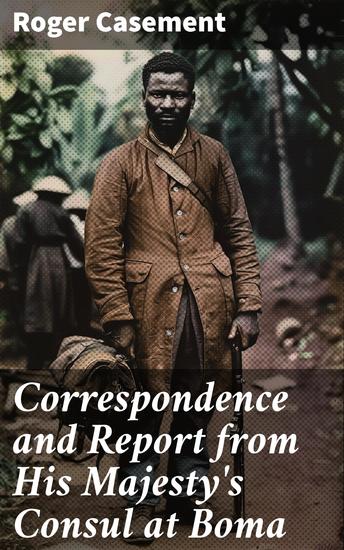
In "Correspondence and Report from His Majesty's Consul at Boma," Roger Casement offers a harrowing account of the atrocities committed in the Congo Free State during the late 19th century. This work is not only a vital historical document but also a poignant literary artifact that captures the stark realities of colonial exploitation. Casement employs a meticulous and direct style, blending detailed correspondence with passionate reporting, revealing the brutal human costs of imperial ambitions. His language evokes both the dread and urgency of the situation, making the report an essential primary source for understanding the moral implications of colonialism. Roger Casement was an Irish diplomat and humanitarian whose experiences in Africa and South America shaped his views on imperialism and human rights. As a witness to the chilling practices of the rubber trade in the Congo, he became a vocal advocate against abuses, using his position to alert the British government and the wider world. His commitment to social justice and his willingness to confront uncomfortable truths are palpable throughout this work, which serves as a testament to his character and ideals. This book is crucial for readers interested in colonial history, human rights advocacy, and ethical literature. Casement's work compels us to confront the darker dimensions of empire, making it an essential read for scholars, students, and anyone with a commitment to understanding the past and its implications on the present.

In this enriched edition, we have carefully created added value for your reading experience:
- A succinct Introduction situates the work's timeless appeal and themes.
- The Synopsis outlines the central plot, highlighting key developments without spoiling critical twists.
- A detailed Historical Context immerses you in the era's events and influences that shaped the writing.
- A thorough Analysis dissects symbols, motifs, and character arcs to unearth underlying meanings.
- Reflection questions prompt you to engage personally with the work's messages, connecting them to modern life.
- Hand‐picked Memorable Quotes shine a spotlight on moments of literary brilliance.
- Interactive footnotes clarify unusual references, historical allusions, and archaic phrases for an effortless, more informed read.
Verfügbar seit: 26.10.2023.
Drucklänge: 328 Seiten.
Weitere Bücher, die Sie mögen werden

  • The Unknown Maroons - Bakbukiah and the Unknown Maroons - cover

    The Unknown Maroons - Bakbukiah...

    Anonym

    • 0
    • 0
    • 0
    This audiobook is narrated by an AI Voice.   
    Bukia Chalvire's tome weaves a rich tapestry of human struggle and hope, connecting the spirit of Haiti's heroes with global tales of resistance. Through the "Konch of Liberty," Chalvire calls for unity, threading ancestral adversity with timely wisdom and personal insight. This book is not just a narrative, but a healing journey and a tribute to the power of collective memory and the potential for a united, peaceful future.
    Zum Buch
  • Summary of Thomas C Foster's How to Read Novels Like a Professor - cover

    Summary of Thomas C Foster's How...

    Falcon Press

    • 0
    • 0
    • 0
    Buy now to get the main key ideas from Thomas C. Foster's How to Read Novels Like a Professor 
      
    When novels became a thing around the seventeenth century, it was all thrilling. It wasn't possible for readers to say, “This is unoriginal, this has been done before, this is a good or bad novel.” Every novel was an innovation. As time progressed, a framework for the conventional novel emerged: a linear narrative, stories about people growing up or falling apart, compelling characters, and definite conclusions that provide emotional satisfaction. 
    In How to Read Novels Like a Professor (2008), Thomas C. Foster dives deep into each of these elements, using his own set of laws for the novel to help readers increase their understanding. He backs up his explanations with a wealth of vivid literary examples that will make you want to read every novel he mentions.
    Zum Buch
  • The Socratic Dialogues - Alcibiades and Other Attributed Dialogues - cover

    The Socratic Dialogues -...

    Plato

    • 0
    • 0
    • 0
    The influence of Plato, his Dialogues and his ‘Academy’, cast a long shadow. Around 35 Dialogues, almost all featuring Socrates as the principal figure, are generally ascribed to Plato and form one of the most important threads in Western philosophy  These four Dialogues may fall into the ‘Attributed Texts’ category, but they are of sufficient interest to warrant study in our time and when set against the principal canon.  
     
    The recording opens with Alcibiades I. Socrates’ interlocuter is well known as a young, charismatic figure of the time, and appears in the Symposium and Protagoras. The subject under discussion is justice and injustice. Socrates questions the over-confident Alcibiades about his understanding of these issues, which is crucial for someone about to play an active role in public life. It is the longest Dialogue of the four. 
     
    Hippias is another young man. A Sophist, brimming with the confidence of youth to the extent of being vain and boastful. He appears in two Dialogues on this recording, the Lesser Hippias and the Greater Hippias. The Lesser Hippias is a witty and lively conversation in which Hippias is keen to display his abilities only to be shaken by patient questioning by the astute Socrates. The Greater Hippias, a discussion about beauty, contains some interesting elements, while also showing how the form became diluted in the hands of lesser followers of Plato.  
     
    The final Dialogue, Menexenus is a special case. It was an important form in Athenian society and this is a rare surviving example. It has been included here in a new recording so it can be listened to in the context of ‘Attributed Dialogues’, rather than a fully accepted work by Plato. The background to each Dialogue is set by Benjamin Jowett. David Rintoul continues his persuasive characterisation of the masterful Socrates.
    Zum Buch
  • Unlocking Scots - The Secret Life of the Scots Language - cover

    Unlocking Scots - The Secret...

    Clive Young

    • 0
    • 0
    • 0
    The Scots language is the hidden treasure of Scottish culture. For many of us it is still how we speak to each other, how we express our feelings, our humour, even our Scottishness. It not only connects us to our communities at an emotional level but also links us to our past. Scots was created by millions of voices coming together to share words, phrases and jokes; to understand, act on (and often laugh at) the world around them.
    
    Aye, but what exactly is 'Scots' anyway?
    Usually spoken in a mix with Scottish English, at least nowadays, is it really a language at all?
    Was it ever?
    And what about its future?
    
    Dr Clive Young embarks on a quest to learn about the secret life of the language he spoke as a bairn. Along the way, he encounters centuries of intense argument on the very nature of Scots, from the first dictionaries, through MacDiarmid, The Broons, Trainspotting and on to present-day Twitter rammies. (And of course, endless stushies about how to spell it.) Some still dismiss Scots as 'just' a dialect, slang or bad English.
    
    Behind this everyday disdain Dr Young uncovers a troubling history of official neglect and marginalisation of our unique minority language, offset only by a defiant and inspiring linguistic loyalty.
    
    A refreshing counterbalance to the usual gloomy prognosis of Scots' supposedly 'inevitable' demise, Dr Young sketches out a practical roadmap to revitalise Scotland's beleaguered tongue and simple ways we can all keep it 'hale an hearty' for future generations.
    
    Acause if you dinna dae it, wha wull?
    Zum Buch
  • The Wealth of Nations Book 3 - cover

    The Wealth of Nations Book 3

    Adam Smith

    • 0
    • 0
    • 0
    "The Wealth of Nations" by Adam Smith is a groundbreaking economic treatise that explores the principles of capitalism, free markets, and wealth creation. Smith argues that self-interest, guided by an "invisible hand," drives innovation and prosperity, benefiting society as a whole. He critiques mercantilism, advocating for division of labor, competition, and minimal government intervention in trade. Through detailed analysis, Smith examines productivity, wages, profits, and taxation, laying the foundation for modern economics. His insights into human behavior and market dynamics remain influential, shaping theories on commerce, ethics, and societal progress.
    Zum Buch
  • Well Beings - How the Seventies Lost Its Mind and Taught Us to Find Ourselves - cover

    Well Beings - How the Seventies...

    James Riley

    • 0
    • 0
    • 0
    James Riley, author of the cult hit The Bad Trip: Dark Omens, New Worlds and the End of the Sixties, returns with another incisive and thought-provoking cultural history, turning his trenchant eye to the wellness industry that emerged in the 1970s.
    
    Concepts such as wellness and self-care may feel like distinctly twenty-first century ideas, but they first gained traction as part of the New Age health movements that began to flourish in the wake of the 1960s. Riley dives into this strange and hypnotic world of panoramic coastal retreats and darkened floatation tanks, blending a page-turning narrative with illuminating explorations of the era's music, film, art and literature.
    Well Beings delves deep into the mind of the seventies - its popular culture, its radical philosophies, its approach to health and its sense of social crisis. It tells the story of what was sought, what was found and how these explorations helped the 'Me Decade' find itself. In so doing, it questions what good health means today and reveals what the seventies can teach us about the strange art of being well.
    Zum Buch