Rejoignez-nous pour un voyage dans le monde des livres!
Ajouter ce livre à l'électronique
Grey
Ecrivez un nouveau commentaire Default profile 50px
Grey
Abonnez-vous pour lire le livre complet ou lisez les premières pages gratuitement!
All characters reduced
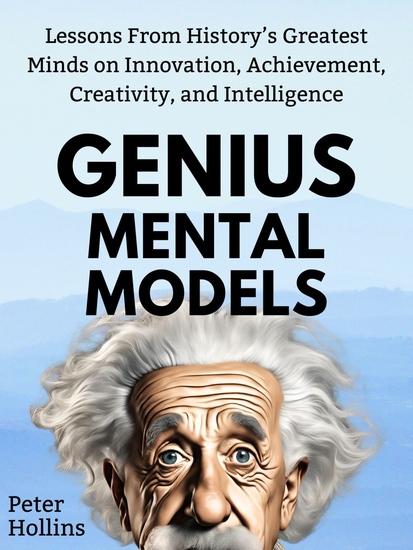
Genius Mental Models - Lessons From History’s Greatest Minds on Innovation Achievement Creativity and Intelligence - cover

Genius Mental Models - Lessons From History’s Greatest Minds on Innovation Achievement Creativity and Intelligence

Peter Hollins

Maison d'édition: Publishdrive

  • 0
  • 0
  • 0

Synopsis

Learn from some of the greatest thinkers in history. Study their patterns and stand on the shoulders of giants.How does one think like a genius? Is there a set definition for this? Well, no. But if you study the greats, you’re bound to learn something.
 
Learn the five “genius mental models” and how to apply them in your daily life.GENIUS MENTAL MODELS is a look through time and history. We climb into a time travel machine and examine flashpoints in the lives of famous geniuses. They are all household names, and now you can better understand what made them tick.Learn their traits, absorb their techniques, and forge your own path of genius to accomplish whatever you set your mind to.
 
Walk away with a framework of how to simply think better.Peter Hollins has studied psychology and peak human performance for over a dozen years. This book represents the scientifically proven methods he has used to become an expert in multiple domains.
 
The most helpful mental models directly from their sources.•How Einstein’s hobbies helped his genius.•Napoleon's key to conquering nations and cementing his legacy•What Descartes had to say about demons.•Darwin’s Golden Rule and how it changed his life.•Tesla, Edison, and the battle of approaches and philosophies.•Copernicus, Galileo, and the values of non-convention.•Sun Tzu's imagination of wartime strategies to daily life•Mozart and the value of being an empty pitcher to be filled to the brim•The unique team that Abraham Lincoln surrounded himself with.
Disponible depuis: 30/10/2024.
Longueur d'impression: 194 pages.

D'autres livres qui pourraient vous intéresser

  • Humbleness - The Quiet Strength: Embracing a Modest and Unpretentious Attitude - cover

    Humbleness - The Quiet Strength:...

    Esther Jameson

    • 0
    • 0
    • 0
    Humbleness is often misunderstood as weakness or submissiveness, yet it is one of the greatest strengths a person can possess. True humbleness is not about diminishing oneself or pretending to be less than what one is. Instead, it is about recognizing one’s worth without the need for validation or superiority over others. It allows a person to remain grounded, open to learning, and free from the constant pressure to prove themselves. 
    Unlike false modesty, which seeks attention through downplaying achievements, genuine humbleness comes from self-awareness. A humble person does not feel the need to boast or seek recognition. They understand that their value does not depend on external praise. This mindset fosters quiet confidence, enabling individuals to navigate life with grace, even in challenging situations. 
    Humbleness is a trait admired across cultures and philosophies. Many religious and philosophical teachings emphasize its importance, highlighting how humility leads to wisdom and deeper connections with others. It allows people to embrace mistakes, learn from experiences, and grow without being hindered by pride. When one acknowledges their limitations, they become more receptive to new ideas and perspectives. This ability to listen and learn creates a path toward continuous self-improvement.
    Voir livre
  • Nanoelectronics: Pioneering The Future of Healthcare - cover

    Nanoelectronics: Pioneering The...

    Neetu Prasad

    • 0
    • 0
    • 0
    Nanoelectronics: Pioneering the Future of healthcare 
    https://amzn.to/4fAdMnI 
    In "Nanoelectronics: Pioneering the Future of Healthcare," readers will embark on a journey through the transformative potential of nanoelectronics in healthcare. From biosensors capable of detecting diseases at the molecular level to wearable devices that monitor health in real-time, this book illuminates the groundbreaking innovations that are reshaping the landscape of medicine. 
    Whether you are a researcher, healthcare professional, policymaker, or simply curious about the future of healthcare technology, this book offers insights into the convergence of nanoelectronics and healthcare and its profound implications for society.
    Voir livre
  • HowExpert Guide to NaNoWriMo - 101 Tips to Learn How to Develop Characters Plots and Storylines to Write a Novel in a Month - cover

    HowExpert Guide to NaNoWriMo -...

    HowExpert, Abby Jaquint

    • 0
    • 0
    • 0
    If you want to learn how to develop characters, plots, and storylines to write a novel in a month, then check out HowExpert Guide to NaNoWriMo. If you’ve always wanted to write a novel but have never been able to find the time, then HowExpert Guide to NaNoWriMo is the how to guide for you.  
    NaNoWriMo is a worldwide event where authors come together online to write a 50,000 word novel in a single month. While the event itself is a challenge, this guide covers 101 tips and tricks on how you can write the best novel possible in just thirty days. Uncover the secrets and tricks of the trade to writing a full-length novel, the best way to develop your story, and how to write thousands of words every day with ease. If you’re ready to learn how to: 
    - Understand the basics of NaNoWriMo 
    - Develop characters and a unique plot 
    - Learn the basics of description, setting, and storytelling 
    - Write quickly and efficiently 
    - Reach your writing goals 
    - Write a novel in just one month 
    HowExpert Guide to NaNoWriMo is the only guide you’ll need. Filled with tips, anecdotes that end in success, and step-by-step chapters to help you improve your writing in the most efficient way possible, this guide will lead you to the end of NaNoWriMo with confidence so that you can write the novel you’ve always dreamed of. Check out HowExpert Guide to NaNoWriMo to learn how to develop characters, plots, and storylines to write a novel in a month. 
    Abby Jaquint is a full-time student and author. She spends her time writing, re-watching the same TV shows, listening to intensely specific playlists, and staying up too late reading. Abby is the author of several published novels in several different genres. She believes including topics like mental health, queer issues, and the impact of found family in their books to be one of the best parts of their job. 
    HowExpert publishes how to guides by everyday experts.
    Voir livre
  • The Moral Sayings of Publius Syrus - cover

    The Moral Sayings of Publius Syrus

    Publius Syrus

    • 0
    • 0
    • 0
    The Moral Sayings of Publius Syrus, A Roman Slave is a collection of proverbs and aphorisms pulled from the many mimes and plays of Publius Syrus. Enslaved by the Romans in his youth, this witty man went on to conquer the Roman stage. These maxims, believed to have been collected in the 1st century AD, are all that remain of the great playwright’s work. Born in Syria in the 1st century BC, Publius Syrus was enslaved and brought to Rome by an army officer after the Romans conquered his native country. It was in Rome that he was given the name of Syrus, for his place of origin. He was then around 12 years old.This soldier had a patron who was delighted with the boy and requested that the soldier give Syrus to him. The soldier complied. Syrus’ new master found the boy witty and bright and was often entertained with his commentary. With such promise, the master provided Syrus with an education and later freed him. Syrus was immensely grateful and remained friends with his former master for the rest of his life. He took the surname Publius, which was probably the surname of his master.Newly free, Syrus traveled to Italy and began composing mimes—comical farces often used to “represent the failings and eccentricities of the higher classes, and the vulgar language and solecisms of the lower.” This combination of humor and moralism was widely popular among the Romans of the time, and Syrus earned great acclaim as a poet and actor. None of the great master’s plays have survived the ensuing centuries. But fortunately, many of his pithy maxims were collected from his plays, probably in the 1st century AD, and gathered into a single volume. This collection was translated from the Latin and first published in 1856.Included among the 1,087 proverbs are some that appear to be the foundation—or at least an early version—of sayings we still use today. While additional context regarding these quotes would be useful, they still have value on their own. These 1,087 proverbs
    Voir livre
  • Passwords - cover

    Passwords

    Sally Cook

    • 0
    • 0
    • 0
    This story tells the frustrating but sometimes humorous journey of the author's interactions with the virtual world where she combats chat bots, racks her withering brain for passwords, almost has a hissyfit at the supermarket checkout, accidentally buys online goods she doesn't want and gets all scrambled  regarding pins, passwords and cyber theft. She used to have a childhood toffee stall to raise money for Freedom From Hunger. Now emails remind her to help save the world, the planet, combat animal cruelty and the climate crisis. Some days it takes nerves to turn on her social devices.
    Voir livre
  • Age of Reason - The Crucial Time in Which the Renaissance and Transformation in Knowledge Took Place (3 in 1) - cover

    Age of Reason - The Crucial Time...

    Kelly Mass

    • 0
    • 0
    • 0
    This is a 3 in 1 combo, with the following topics: 
    1 - Age of Enlightenment: Finally… finally, humanity began to wake up. Finally, they decided to take science, knowledge, politics, development, multiple angles and perspectives, and the details of our everyday lives a bit more seriously. For centuries, raw and primal urges and principles had taken hold of conquerors, officials, and governments. But there was a light at the end of the tunnel. Humanity just needed to acknowledge knowledge. It needed to value the art of studying phenomena and learning, not just spiritual notions and religion. Welcome to the book about how this happened. Welcome to a glimmer of hope in humanity’s realization of what this world is and what lies in the elements yet to be discovered. 
    2 - Renaissance: The Renaissance is a time in European history marking the shift from the Middle Ages to modernity and covering the 15th and 16th centuries, identified by an effort to restore and exceed ideas and accomplishments of classical antiquity. It happened after the Crisis of the Late Middle Ages and was related to great social change. Aside from the basic periodization, advocates of a "long Renaissance" might put its start in the 14th century and its end in the 17th century. 
    3 - Dutch East India Trading Company: Did you know that the Dutch were some of the first who came up with stocks? They were also known for their gigantic fleet, their ships, their colonies, and so much more. The 17th century was a golden age, a golden century for the Dutch, who discovered how to go to the new world in Asia, America, and other continents to transport spices, minerals, and other materials. 
    The Dutch East India Company, officially the United East India Company (Dutch: Vereenigde Oost Indische Compagnie; VOC), was a megacorporation created in the early 17th century by a government-directed merger of many competing Dutch trade services.
    Voir livre