Rejoignez-nous pour un voyage dans le monde des livres!
Ajouter ce livre à l'électronique
Grey
Ecrivez un nouveau commentaire Default profile 50px
Grey
Abonnez-vous pour lire le livre complet ou lisez les premières pages gratuitement!
All characters reduced
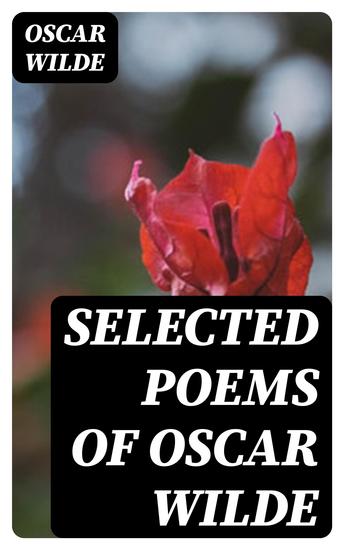
Selected Poems of Oscar Wilde - cover

Selected Poems of Oscar Wilde

Oscar Wilde

Maison d'édition: DigiCat

  • 0
  • 0
  • 0

Synopsis

In "Selected Poems of Oscar Wilde," readers are introduced to the lyrical brilliance and aesthetic sensibilities of one of the most celebrated figures of the Victorian era. This collection showcases Wilde's unique ability to weave themes of beauty, love, and existential angst into a tapestry of rich imagery and poignant language. His poetic style fluctuates between the ornate and the concise, embodying the intricacies of the Decadent movement, where art is both an escape from and a reflection of societal constraints. The poems reflect his deep engagement with philosophical inquiry and an emerging modern sensibility that questions conventional morality and celebrates individualism. Oscar Wilde, renowned for his flamboyant wit and compelling prose, moved through European literary circles with an eye for beauty and an ear for rhythm. His experiences as a leading figure in the Aesthetic movement profoundly influenced his poetic voice, leading him to explore the depths of human emotion and societal critique. The poignant reflections present in his poetry stem from a life marked by both social triumph and personal tragedy, including his eventual imprisonment, which would later color the themes of suffering and longing in his work. "Selected Poems of Oscar Wilde" is an essential read for anyone seeking to appreciate the fusion of beauty and intellect prevalent in Wilde's poetry. It invites readers to delve into the soul of a man who lived artfully, urging reflections on love, loss, and the human condition. Wilde's mastery of language and emotion will captivate not only poetry enthusiasts but also those who appreciate the complexities of life and art.
Disponible depuis: 15/09/2022.
Longueur d'impression: 29 pages.
D'autres livres qui pourraient vous intéresser

  • Proof of Life on Earth - cover

    Proof of Life on Earth

    Degna Stone

    • 0
    • 0
    • 0
    You live and then you die. That's the only certainty there is, right? Using love as its guide, Proof of Life on Earth, the debut poetry collection by Degna Stone, looks at all the stops between our arrival and our departure. These poems examine matters of the heart (both the metaphorical and medical kind), of race and discrimination, of the body, mind and self – each in forensic detail, attentive and curious of what moves, shapes, and makes us alive.
    In between are the landmarks which populate the rich terrain of this collection; not only of our lives through youth to adulthood, but of history, of the long shadows of empire, and of landscapes themselves - especially those of the northeast of England, evocative, rugged and monumental. Stone's deft and scalpel-sharp poetry explores human existence shaped by mortality and experience, and asks what it means to do more than survive – to live in defiance, openness and awareness.
    Voir livre
  • Raging: Embargo - The War of Independence - cover

    Raging: Embargo - The War of...

    Deirdre Kinahan

    • 0
    • 0
    • 0
    Part of Deirdre Kinahan's trilogy of landmark plays commemorating seven years of warfare in Ireland, Embargo focuses on a pivotal moment during the Irish War of Independence.
    It is September 1920. Dockers and railmen are refusing to transport armed troops or handle any weapons arriving from Britain. Three characters are caught up in the whirl of historical events in a poetic, bloody and heroic tale of industrial action and civic resistance.
    Embargo was first staged by Fishamble: The New Play Company, in association with Iarnród Éireann and Dublin Port Company, in October 2020, streamed live online from the Pumphouse in Dublin Port, as part of the Dublin Theatre Festival.
    Deirdre Kinahan's Raging trilogy tells powerful stories drawing on a tumultuous period of conflict in Irish history, from the 1916 Easter Rising to the Civil War which began in 1922. Each of the three plays – Wild Sky, Embargo and Outrage – was first performed a century after the event which it depicts, and they were commissioned and performed by companies including Fishamble: The New Play Company, Meath County Council Arts Office, Dublin Port Company and Iarnród Éireann.
    
    Together, they challenge the historical narrative, mixing true-life testimonies with powerful drama to create a theatrical hurricane of empathy, action and truth.
    'Unashamedly humanistic... impressive layers of nuance' - Irish Times
    Voir livre
  • Tuesday - With a Welsh-language translation Un Bore Mawrth - cover

    Tuesday - With a Welsh-language...

    Alison Carr

    • 0
    • 0
    • 0
    'I've been waiting for something like this to happen. I'm surprised it's taken so long. The signs have been building up for a while.'
    An ordinary Tuesday turns really, really weird when the sky over the school playground suddenly rips open. Pupils and teachers are sucked up to a parallel universe, whilst a new set of people start raining down from above. 'Us' and 'Them' must come together to work out what is going on, and how they can get things back to how they were.
    Alison Carr's play Tuesday is funny and playful, with a little bit of sci-fi and a lot of big themes: friendship, family, identity, grief, responsibility – and what happens when an unexpected event literally turns the world upside-down.
    Written specifically for young people, the play formed part of the 2020, 2021 and 2023 National Theatre Connections Festivals and was premiered by youth theatres across the UK. It offers opportunities for a large, flexible cast of any size, age and mix of genders.
    This bilingual edition includes the original English play with a Welsh-language translation, Un Bore Mawrth, by playwright Daf James.
    Set Text >> Tuesday is a set play on WJEC's GCSE Drama specification.
    Un Bore Mawrth
    ''Wi 'di bod yn aros i rywbeth fel hyn ddigwydd. 'Wi'n synnu'i fod e 'di cymryd mor hir. Ma'r arwyddion 'di bod 'ma ers sbel.'
    Dydd Mawrth digon cyffredin yw hi, ond yn sydyn mae'n troi'n ddiwrnod rhyfedd iawn pan mae'r awyr uwch ben yr ysgol yn rhwygo'n agored. Caiff disgyblion ac athrawon eu sugno i fyny i fydysawd cyfochrog wrth i garfan newydd o bobl arllwys i lawr oddi uchod. Rhaid i 'Ni' a 'Nhw' ddod ynghyd i ddeall beth sy'n digwydd ac i ddatrys sut i gael pethau'n ôl fel yr oedden nhw.
    Mae'r ddrama wreiddiol hon gan Alison Carr, Tuesday, yn ddoniol ac yn chwareus, gyda phinsiad o ffugwyddoniaeth a thomen o themâu mawr: cyfeillgarwch, teulu, hunaniaeth, galar, cyfrifoldeb – a beth sy'n digwydd pan fydd digwyddiad annisgwyl yn llythrennol yn troi'r byd wyneb i waered.
    Wedi'i hysgrifennu ar gyfer pobl ifanc, roedd y ddrama'n rhan o Ŵyl National Theatre Connections yn 2020 a 2021, a chafodd ei llwyfannu am y tro cyntaf gan theatrau ieuenctid ar draws y DU.
    Mae'n cynnig cyfleoedd i gastiau mawr, hyblyg o unrhyw faint, oedran a rhywedd.
    Mae Tuesday yn waith gosod ar fanyleb TGAU Drama CBAC. Yn y gyfrol ddwyieithog hon, fe welwch y ddrama wreiddiol Saesneg ynghyd â chyfieithiad Cymraeg y dramodydd Daf James, Un Bore Mawrth.
    Voir livre
  • Time For My Generation To DIE - cover

    Time For My Generation To DIE

    E.D. Evans

    • 0
    • 0
    • 0
    Imagine finding a dusty, water-stained journal in an abandoned subway station before realizing it was written 20 years in the future. No robot maids or air cars, just capital L, “Life,” through X-ray specs, and don’t hold the band-aid ripping or bemused outrage. There are a thousand novels herein. (Buddy Woodward) Time for My Generation to DIE from poet and balladeer E.D. Evans takes no prisoners. Evans uses her sparkling, prickly verse to pluck out mournful, bleak, and violent tableaus. Each of her poems—Ballad or not—Is deserving of a hard-strummed guitar and some harmonica across the bridge. This is distilled country and southwestern, sans redemption, sans chaser.(Sean McCollum) Here we will find necessary truths—Honest evidence of a transformative journey, amusing and disturbing, disarming with a hip, wry wit of personal insight. A reminder of poetry as event, where you will find your lips mouthing the vowels. A nod, and a wink never too far behind, Evans’ artistry holds your hand through the odyssey and the rhyme.(Henry Long) Pssssst! Hey, You, Yes… YOUR Generation (whichever that may be). Are you looking for:Saccharin love sonnets? Maudlin two-line musings? Droning co-opted hip hop lyrics? - You won't find that here. Do you desire:Trite overbaked sentiment? Foolish masturbatory banter? Inscrutable word salad? - You won't find that here. What you WILL find here is an epitaph, of sorts, laced with:Dark humor, Snide observations, Stark realism, Morbid landscapes, Gamblers and junkies & Punks and thugs. An epitaph for MY forgotten generation - Generation Jones - who:Relish obscure banalities, Prefer pencil on paper, Revel in audacious irony and Eschews ‘the good old days’. It’s no longer time for any of these things.It’s simply:… Time for my Generation to Die. E.D. Evans is a lifelong poet. Having spent time in both London and New York during Punk’s original heyday in the late ‘70s and early ‘80s...
    Voir livre
  • Makeshift Nothings "Poetry Scrolls" Vol 1 - cover

    Makeshift Nothings "Poetry...

    Sweetness Godgiben

    • 0
    • 0
    • 0
    This unique book is a collection of fiction slam-like poetry. Showcasing various adult topics, fantasy or realistic-like scenarios.
    Voir livre
  • The Divine Comedy Paradise - cover

    The Divine Comedy Paradise

    Dante Alighieri

    • 0
    • 0
    • 0
    Paradiso (Italian: [paraˈdiːzo]; Italian for "Paradise" or "Heaven") is the third and final part of Dante's Divine Comedy, following the Inferno and the Purgatorio. It is an allegory telling of Dante's journey through Heaven, guided by Beatrice, who symbolises theology. In the poem, Paradise is depicted as a series of concentric spheres surrounding the Earth, consisting of the Moon, Mercury, Venus, the Sun, Mars, Jupiter, Saturn, the Fixed Stars, the Primum Mobile and finally, the Empyrean. It was written in the early 14th century. Allegorically, the poem represents the soul's ascent to God.While the structures of the Inferno and Purgatorio were based around different classifications of sin, the structure of the Paradiso is based on the four cardinal virtues (Prudence, Justice, Temperance, and Fortitude) and the three theological virtues (Faith, Hope, and Charity).
    Voir livre