Begleiten Sie uns auf eine literarische Weltreise!
Buch zum Bücherregal hinzufügen
Grey
Einen neuen Kommentar schreiben Default profile 50px
Grey
Jetzt das ganze Buch im Abo oder die ersten Seiten gratis lesen!
All characters reduced
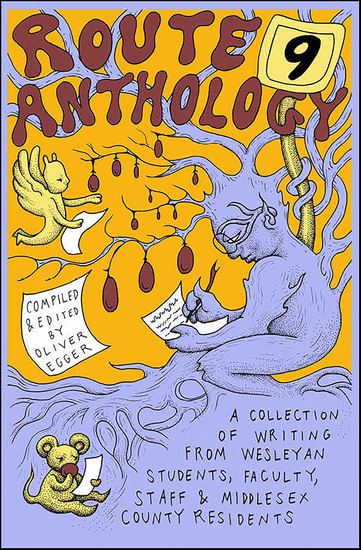
The Route 9 Anthology - A Collection of Writing from Wesleyan Students Faculty Staff & Middlesex County Residents - cover

The Route 9 Anthology - A Collection of Writing from Wesleyan Students Faculty Staff & Middlesex County Residents

Oliver Egger

Verlag: Wesleyan University Press

  • 0
  • 0
  • 0

Beschreibung

The Route Nine Anthology is a collection of poetry and prose from Wesleyan students, faculty, staff, and Middlesex County residents. It is the first collection of prose dedicated specifically to bridging the literary divide between the Wesleyan and Middlesex County communities.
Verfügbar seit: 05.09.2022.
Drucklänge: 62 Seiten.

Weitere Bücher, die Sie mögen werden

  • Southern Fried Shakespeare - A Dramatic Musical Comedy Experience - cover

    Southern Fried Shakespeare - A...

    Robert James

    • 0
    • 0
    • 0
    Welcome y'all! This project was created for those who think they don't like Shakespeare. It is a completely unsanctioned and unconventional interpretation of some of the works of William Shakespeare. If you are a purist be forewarned! I have always been fascinated with the written works of Shakespeare since I was a child trying to decipher the giant volume of his works I discovered in my father's library. I knew it was important historically but the language had me often running to a dictionary in those pre-Google days. Understanding a live performance was an equally challenging task as the British accents combined with the lambic pentameter rhythm left me struggling to understand the meaning. But once you figure what he's saying you realized these timeless stories of dysfunctional families and political intrigue are just as relevant today as 400 years ago. Every actor in training experiences the works of William Shakespeare to some degree. While memorizing lines I would try various characters and accents. For Richard III's famous opening monologue I settled on a genteel aristocrat from the Southern United States. I shared with my instructor and after some initial eye rolls he had to admit it was easier to understand. Eventually I created a one man show around the idea and wrote original songs that I believe express the emotion and underlying intentions of the pieces. And of course what's a variety show without an MC or two. In this case two squabbling siblings Auntie Bella and her twin brother Beauregard to bring a small respite to the drama. During the COVID pandemic I decided to record an audio version of the show. I hope you enjoy my family of misfits as much as I did creating them. But hey, to thine own taste be true. Cousin Willy must have had a sense of humor to write some of this stuff!
    Zum Buch
  • Coriolanus - cover

    Coriolanus

    William Shakespeare

    • 0
    • 0
    • 0
    Embark on a captivating journey through the political turmoil and personal struggles of "Coriolanus" by William Shakespeare with our enthralling digital audiobook. Set against the backdrop of ancient Rome, the story follows the formidable military leader Coriolanus as he grapples with the complexities of power, pride, and public opinion. 
     
    Driven by his unwavering sense of honor, Coriolanus finds himself entangled in a web of political intrigue, navigating a society rife with manipulation and betrayal. As tensions escalate, the play delves into the intricacies of leadership, loyalty, and the consequences of unchecked ambition. The digital audiobook version brings Shakespeare's characters to life with compelling narration, allowing you to immerse yourself in the intense emotions and moral dilemmas that unfold. Whether you're a Shakespeare aficionado or a newcomer, this digital audiobook promises a gripping experience that vividly captures the essence of "Coriolanus" and its timeless exploration of the human condition.
    Zum Buch
  • The Poetry of Rainer Maria Rilke - Collection from the hugely celebrated Austrian poet - cover

    The Poetry of Rainer Maria Rilke...

    Rainer Maria Rilke

    • 0
    • 0
    • 0
    René Karl Wilhelm Johann Josef Maria Rilke was born into a troubled marriage on the 4th December 1875 in Prague, then part of the Austro-Hungarian Empire.  His mother, having previously lost a baby girl, would dress the young boy up in girl’s clothing.   
    Later his father dispatched him to a military academy at age 10 but after a miserable 5 years the young Rilke left due to illness and instead entered first Prague and then Munich and finally Berlin university to study art history, philosophy and literature. 
    His initial forays into literature was in poetry.  His intense, mystical and lyrical style was much admired and over time inspired many in succeeding generations.    
    His short prose collection ‘Stories of God’, written in an impassioned burst over several nights was published in 1900 and offers a beguiling view of much of Rilke’s influences and outlook.  
    The following year he married the pioneering sculptor and artist Clara Westhoff.  The union produced one child, a daughter Ruth.   
    He lived in Paris for most of the Century’s first decade where he mixed with many great minds of the time.  Although he continued to write he also worked as a secretary to the sculptor, Rodin.   
    It was only after they settled in Switzerland in 1919 that his writing output was in full flow.  Here he wrote profusely in both German and French, which included much on his previous travels, his left-wing sympathies, his religious and existential thoughts, all part of a unique and consummate style. 
    From 1923 on, Rilke increasingly struggled with his health which was now in constant decline and often spent time rehabilitating at a sanatorium.   
    Rainer Maria Rilke died of leukaemia on the 29th December 1926 in Montreux, Switzerland.  He was 51.
    Zum Buch
  • Comedie Hell - cover

    Comedie Hell

    Dante Alighieri

    • 0
    • 0
    • 0
    Dante Alighieri's*Inferno*, here titled *Hell*, is the first canticle of his great narrative poem *Commedìa* (1314-1321), considered by many to be the foundation of modern vernacular literature, which consigned to the past the literary use of Latin. Dante's visionary description of the afterlife and the profound humanity of his characters have been admired by many generations of readers and writers, and the beauty of its verse has never been surpassed. The translation presented here is by Leon Stephens, who is also the reader.
    Zum Buch
  • The Carrying - Poems - cover

    The Carrying - Poems

    Ada Limón

    • 1
    • 1
    • 0
    NBCC Award Winner: “The narrative lyrics in this remarkable collection . . . could stand as compressed stories about anxiety and the body.” —The New York Times Vulnerable, tender, acute, these are serious poems, brave poems, exploring with honesty the ambiguous moment between the rapture of youth and the grace of acceptance. A daughter tends to aging parents. A woman struggles with infertility—“What if, instead of carrying / a child, I am supposed to carry grief?”—and a body seized by pain and vertigo as well as ecstasy. A nation convulses: “Every song of this country / has an unsung third stanza, something brutal.” And still National Book Award finalist Ada Limón shows us, as ever, the persistence of hunger, love, and joy, the dizzying fullness of our too-short lives. “Fine then, / I’ll take it,” she writes. “I’ll take it all.” “Gorgeous, thought-provoking . . . simple, striking images.” —Publishers Weekly (starred review) “Exquisite.” —The Washington Post “Pitch-perfect . . . full of poems to savor and share . . . She writes with remarkable directness about painful experiences normally packaged in euphemism and, in doing so, invites the readers to enter a world where abundant joy exists alongside and simultaneous to loss.” —Minneapolis Star-TribuneWinner of the National Book Critics Circle Award for Poetry
    Zum Buch
  • The Poetry of Algeron Charles Swinburne - Trailblazing writer whose worked often touched on taboo topics of Victorian times - cover

    The Poetry of Algeron Charles...

    Algernon Charles Swinburne

    • 0
    • 0
    • 0
    Algernon Charles Swinburne was born on April 5th, 1837, in London, into a wealthy Northumbrian family.  He was educated at Eton and at Balliol College, Oxford, but did not complete a degree.  
    In 1860 Swinburne published two verse dramas but achieved his first literary success in 1865 with Atalanta in Calydon, written in the form of classical Greek tragedy. The following year "Poems and Ballads" brought him instant notoriety. He was now identified with "indecent" themes and the precept of art for art's sake.  
    Although he produced much after this success in general his popularity and critical reputation declined. The most important qualities of Swinburne's work are an intense lyricism, his intricately extended and evocative imagery, metrical virtuosity, rich use of assonance and alliteration, and bold, complex rhythms.  
    Swinburne's physical appearance was small, frail, and plagued by several other oddities of physique and temperament. Throughout the 1860s and 1870s he drank excessively and was prone to accidents that often left him bruised, bloody, or unconscious. Until his forties he suffered intermittent physical collapses that necessitated removal to his parents' home while he recovered.  
    Throughout his career Swinburne also published literary criticism of great worth. His deep knowledge of world literatures contributed to a critical style rich in quotation, allusion, and comparison. He is particularly noted for discerning studies of Elizabethan dramatists and of many English and French poets and novelists. As well he was a noted essayist and wrote two novels. 
    In 1879, Swinburne's friend and literary agent, Theodore Watts-Dunton, intervened during a time when Swinburne was dangerously ill. Watts-Dunton isolated Swinburne at a suburban home in Putney and gradually weaned him from alcohol, former companions and many other habits as well.  
    Much of his poetry in this period may be inferior but some individual poems are exceptional; "By the North Sea," "Evening on the Broads," "A Nympholept," "The Lake of Gaube," and "Neap-Tide."  
    Swinburne lived another thirty years with Watts-Dunton. He denied Swinburne's friends access to him, controlled the poet's money, and restricted his activities. It is often quoted that 'he saved the man but killed the poet'.  
    Swinburne died on April 10th, 1909 at the age of seventy-two. 
     This volume comes to you from Portable Poetry, a specialized imprint from Deadtree Publishing.  Our range is large and growing and covers single poets, themes, and many compilations.
    Zum Buch