

Join us on a literary world trip!
Add this book to bookshelf
Grey
Write a new comment Default profile 50px
Grey
Subscribe to read the full book or read the first pages for free!
All characters reduced
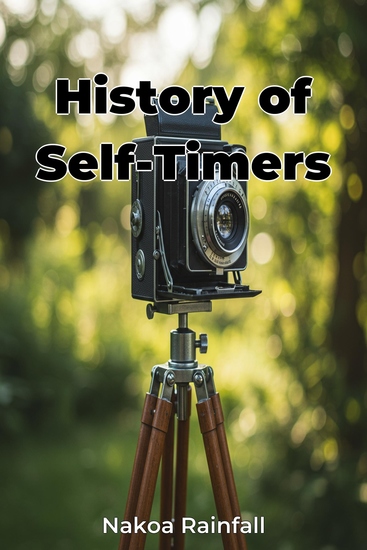
History of Self-Timers - cover

History of Self-Timers

Nakoa Rainfall

Translator A AI

Publisher: Publifye

  • 0
  • 0
  • 0

Summary

History of Self-Timers explores the fascinating evolution and impact of a seemingly simple device on photography and society. The book traces the self-timer's journey from early mechanical designs to its ubiquitous presence in digital cameras and smartphones, revealing its profound influence on portrait photography, group shots, and self-portraiture. Interestingly, it explores how the self-timer not only changed photographic technology, but also democratized image-making, empowering individuals to control their own representation and fostering new forms of social connection. 

 
The book examines the social impact of self-timers, particularly its role in family portraits and amateur photography, and analyzes its artistic impact on self-portraiture and contemporary art. Organized chronologically, the book begins with the introduction of mechanical self-timers and progresses through their social and artistic implications in the 20th century, culminating in a discussion of their current state and future implications in digital photography. 

 
By studying vintage camera catalogs, photographic journals, and even design patents, the book paints a vivid picture of how the self-timer became a catalyst for social empowerment and creative expression.
Available since: 02/26/2025.
Print length: 91 pages.

Other books that might interest you

  • Supporting Student Executive Functions - Insights and Strategies for Educators - cover

    Supporting Student Executive...

    Lisa Carey, Alexis Reid

    • 0
    • 0
    • 0
    In Supporting Student Executive Functions, two clinical and classroom experts deliver an insightful and accessible guide to executive functioning skills. Lisa Carey, Ed.D., and Alexis Reid, M.A., explain how these skills develop, how executive functioning challenges show up in the classroom, and how, if unaddressed, those challenges interfere with student learning. 
    Part I builds an understanding of the science of executive functioning and how it develops during the K–12 years. Part II offers a practical, example-rich approach to help educators develop and support students’ executive functions with tips, suggestions, and action steps.  
    Building on the research-backed Universal Design for Learning (UDL) Guidelines, the authors pay special attention to the Guideline “Provide options for Executive Functions” to show which types of supports are most meaningful at different stages of a student’s K–12 journey. 
    Educators—but also medical professionals, caregivers and parents, and students themselves—will gain a deeper understanding of the latest science on executive functioning as well as valuable, easy-to-implement strategies to use in the classroom today.
    Show book
  • Summary: Endgame - Inside the Royal Family and the Monarchy’s Fight for Survival: Key Takeaways Summary and Analysis - cover

    Summary: Endgame - Inside the...

    Brooks Bryant

    • 0
    • 0
    • 0
    DISCLAIMER: THIS IS NOT THE OFFICIAL BOOK. 
    This is a summary, and it does not accompany the official 
    'Endgame: Inside the Royal Family and the Monarchy’s Fight for Survival' by Omid Scobie examines the challenges facing the British monarchy following the death of Queen Elizabeth II. Scobie, a seasoned royal reporter, uses his extensive experience and access to insider sources, including Palace staff, royal acquaintances, and the royals themselves, to provide a detailed account of the institution's struggles. The book highlights the monarchy's issues with outdated views on race, class, and finance, set against the backdrop of a world that is rapidly evolving. Scobie's analysis questions whether the monarchy can adapt and make necessary changes to remain relevant and survive in the modern era, presenting a critical look at an institution facing a pivotal moment in its history.
    Show book
  • Marine Pollution - What Everyone Needs to Know(r) - cover

    Marine Pollution - What Everyone...

    Judith S. Weis

    • 0
    • 0
    • 0
    For millennia, human societies have viewed the ocean as a dumping ground for waste products of all kinds. The sources of marine pollution are extensive, including oil spills, sewage, fertilizers, pesticides, industrial wastes, heavy metals, ocean acidification, plastics, and even invasive species, considered biological pollution. Yet, the solutions are not as clear. 
     
    Updated to reflect recent research, this book discusses the sources of marine pollutants, their effects on marine organisms and humans, and how to reduce or eliminate them. Weis covers the aftermath of oil spills in addition to "emerging" topics like flame retardants, pharmaceuticals, noise pollution, and PFAS. A new chapter examines the prevalence of microplastics and how they rise through the food chain into human beings, along with their associated toxic chemicals. Additional chapters address the deadly effects of climate change in the ocean but also focus on actions that all people can take, citing recent environmental improvements as a cause for hope.
    Show book
  • Journey Into Your Rainforest Mind - A Field Guide for Gifted Adults and Teens Book Lovers Overthinkers Geeks Sensitives Brainiacs Intuitives Procrastinators and Perfectionists - cover

    Journey Into Your Rainforest...

    Paula Prober

    • 0
    • 0
    • 0
    Selected posts from the popular blog Your Rainforest Mind along with specific strategies and resources to guide your journey back to authenticity, purpose, love, and to finally deciding what color to paint your living room. Have you been told that you’re too sensitive, too dramatic, too verbal, too smart, too curious, and too intense? Do you feel like not enough and too much at the same time? Do you ask yourself: If I’m so smart, why am I so dumb? Yes? Then, chances are, you have a rainforest mind. A mind that runs faster, wider, and deeper than most. A personhood that is highly sensitive, perceptive, and empathetic. Like the tropical rainforest, you’re extremely complex, full of life, and misunderstood. You have the ability to make a significant contribution to society but you’re being cut down before you can find your way. Let this book help you find your way. Take a journey into your rainforest mind.
    Show book
  • The Holodomor - Stalin's Famine Genocide - cover

    The Holodomor - Stalin's Famine...

    Sarah Willards

    • 0
    • 0
    • 0
    The Holodomor, one of the most tragic events in Ukrainian history, refers to the man-made famine that devastated Ukraine from 1932 to 1933. The name "Holodomor" itself is derived from two Ukrainian words: "holod," meaning hunger, and "moryty," meaning extermination. This term emphasizes the belief that the famine was deliberately engineered by Joseph Stalin's Soviet government as part of a broader effort to suppress Ukrainian nationalism and enforce Soviet control. 
    The historical context of the Holodomor is deeply intertwined with the policies of Soviet Russia during the early 20th century. Under Stalin’s rule, the Soviet Union sought rapid industrialization and forced collectivization of agriculture, a process that involved the consolidation of individual farms into large collective ones. These policies were highly disruptive and led to widespread resistance, especially in Ukraine, where peasants valued their land and traditional agricultural practices. 
    In response to this resistance, Stalin imposed harsh measures on Ukraine, including the confiscation of grain, livestock, and other foodstuffs, which were sent to feed other parts of the Soviet Union. This created a devastating shortage of food in Ukraine, which was compounded by the harsh climate and poor harvests. Despite the widespread suffering and starvation, the Soviet government did little to alleviate the crisis and instead imposed strict controls on food distribution. In some cases, officials even enforced internal borders, preventing starving people from fleeing to neighboring regions in search of food.
    Show book
  • Paddleways of Mississippi - Rivers and People of the Magnolia State - cover

    Paddleways of Mississippi -...

    Ernest Herndon, Patrick Parker

    • 0
    • 0
    • 0
    Mississippi rivers and creeks have shaped every aspect of the state's geology, ecology, economy, settlement, and politics. Mississippi's paddleways—its rivers, rills, creeks, and streams—are its arteries, its lifeblood, and the connective tissues that tie its stories and histories together and flood them with a sense of place and impel them along the current of time. The rivers provide structure for the telling of stories. In Paddleways of Mississippi: Rivers and People of the Magnolia State, listeners will discover flowing details of virtually every waterway in the state—the features, wildlife, vegetation, geology, hydrology, and specific challenges to be expected—alongside many wonderful historical and social accounts specific to each system. 


    Interviews and oral histories enliven these waterways with evocative scenery, engaging anecdotes, interesting historical tales, and personal accounts of the people and communities that arose along the waterways of Mississippi. Part natural history, part narrative nonfiction, Paddleways of Mississippi will appeal to outdoor enthusiasts, anglers, naturalists, campers, and historians, and is suitable for novices as well as experts. Told together, the pieces included are a social and ecological history that exposes and deepens the connection coursing between the people and the rivers.
    Show book
