Begleiten Sie uns auf eine literarische Weltreise!
Buch zum Bücherregal hinzufügen
Grey
Einen neuen Kommentar schreiben Default profile 50px
Grey
Jetzt das ganze Buch im Abo oder die ersten Seiten gratis lesen!
All characters reduced
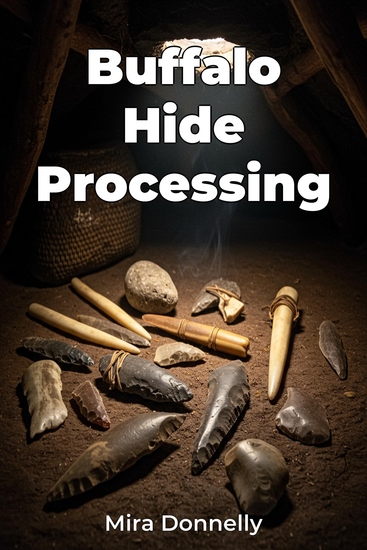
Buffalo Hide Processing - cover

Buffalo Hide Processing

Mira Donnelly

Übersetzer A AI

Verlag: Publifye

  • 0
  • 0
  • 0

Beschreibung

Buffalo Hide Processing explores the intricate relationship between Indigenous peoples and the American bison, focusing on the sophisticated and sustainable technology of hide preparation. It highlights how processing buffalo hides was not just a practical skill, but a deeply cultural and spiritual practice. The book reveals that the tanning process, involving physical and chemical transformations, produced a diverse range of vital products, from clothing and shelter to tools and ceremonial objects.

 
The book adopts a multidisciplinary approach, drawing on ethnographic accounts, archaeological findings, and historical records to present a holistic view. It challenges conventional understandings of technology by showcasing Indigenous ecological knowledge and sustainable resource management. Buffalo Hide Processing begins by establishing the historical context and then systematically details each step of hide preparation, before exploring the diverse applications and cultural significance of the resulting materials. The book emphasizes how the sophisticated methods employed by Indigenous communities reflect a profound understanding of both the environment and material culture.
Verfügbar seit: 29.03.2025.
Drucklänge: 65 Seiten.

Weitere Bücher, die Sie mögen werden

  • Starting a World War: The History of the Events and Battles that Began World War I and World War II - cover

    Starting a World War: The...

    Editors Charles River

    • 0
    • 0
    • 0
    By the 20th century, warfare was nothing new to the European powers, especially when it came to fighting each other. Conflicts had been a mainstay on the European continent for over two millennia. Even after the Napoleonic wars had enveloped Europe in large scale war for nearly 20 years in the 19th century, the Europeans’ imperialism continued unabated. It would take the devastation of World War I to shock Europe and jolt the world’s superpowers out of their imperialistic tendencies.  
    	With Europe anticipating a potential war, all that was missing was a conflagration. That would start in 1908, when Austria-Hungary annexed Bosnia-Herzegovina in the Balkan Peninsula, drawing it into dispute with Russia. Moreover, this upset neighboring Serbia, which was an independent nation. From 1912-1913, a conflict was fought in the Balkans between the Balkan League and the Ottoman Empire, resulting in the weakening of the Ottoman Turks. After the First Balkan War, a second was fought months later between members of the Balkan League itself. The final straw came June 28, 1914, when a Serbian assassinated Archduke Franz Ferdinand, the heir to the throne of Austria-Hungary, in Sarajevo, Bosnia.   
    The Munich Agreement is widely reviled today and is held up as the epitome of appeasement, but historians still debate its effects on the Second World War, as well as Neville Chamberlain's character and motivations. Some believe the attempted appeasement of Nazi Germany hastened, or even caused, the mayhem occupying the next seven years. Others believe that the pact merely failed to alter war's inevitable arrival in either direction.  
    Of course, as most people now know, the invasion of Poland was merely the preface to the Nazi blitzkrieg of most of Western Europe, which would include Denmark, Belgium, and France by the summer of 1940
    Zum Buch
  • Mr Vic’s X-Rated Television: Last Man Standing - X-Rated Baxter Day ay the Spa - cover

    Mr Vic’s X-Rated Television:...

    VIC VITALE

    • 0
    • 0
    • 0
    "Baxter Day At The Spa!" 
    When an exhilarated Mandy Baxter comes home from the spa, she has a very exciting story to tell.  
    The only thing is, she isn't quite sure how her two straight siblings will take hearing what she's going to tell them.  
    Mandy is somewhat reluctant to tell her also shapely sisters that she engaged in a heated sixty-nine with another woman and that she liked it so much, she wants her two sisters joining her for a second time. 
     
    Zum Buch
  • Gateway for Kids: Say Hello! Greetings from Africa and Europe - cover

    Gateway for Kids: Say Hello!...

    Ken Lou

    • 0
    • 0
    • 0
    Say 'hello" and meet your international friends from 21 cultures across Africa and Europe! 
     
    Know how your friends greet and dress, and learn about their favorite festivals, costumes, food, music, dance, arts, folktales and traditional houses. As you take steps to appreciate and respect one another's way of life, you will become a well-loved friend. and grow as an ambassador of peace. 
     
    Don't put this book away until you know how to say thank you and 'I love you' in their languages. Then count the smiles that greet you when you say those nice words.  
     
    After all, friendship begins when you say 'hello'!
    Zum Buch
  • Escaping the Gulags: The History of the Most Famous Attempts to Escape the Soviet Union’s Notorious Labor Camps - cover

    Escaping the Gulags: The History...

    Editors Charles River

    • 0
    • 0
    • 0
    One of the most idiosyncratic horrors of Soviet Russia was the Gulag system, an extensive network of forced labor and concentration camps. Part of the rationale behind this system was that it could serve as slave labor in the drive for industrialization, while also serving as a form of punishment. The name Gulag is in fact an acronym, approximating to “Main Administration of Camps” (in Russian: Glavnoe Upravlenie Lagerei) and operated by the Soviet Union’s Ministry of the Interior.[1] The Gulag consisted of internment camps, forced labor camps, psychiatric hospital facilities, and special laboratories, and its prisoners were known as zeks. Such was the closed and secretive nature of the Soviet state that to this day, knowledge of the Gulag system comes mainly from Western studies, firsthand accounts by prisoners such as Aleksandr Solzhenitsyn, and some local studies after the fall of communism. 
    	The most recognisable version of the Gulag, a term that was never pluralized in Russia itself, existed from the 1930s-1950s, a period in which a huge network of camps and prisons was established across the vast Soviet federation. Prisoners were often used as forced labor, made to do physically arduous and soul-destroying tasks. Some workers helped to build large infrastructure projects, and indeed the system was partly rationalized in terms of economics.  
    	By the early 1960s, Gulags were synonymous with various forms of punishments, including house arrest, imprisonment in isolated places, or confinement to a mental hospital where a prisoner would be declared insane or diagnosed with a “political” form of psychosis. In its later years, the Gulags held a particular place in the public’s imagination, both within the USSR and in the outside world. They could mean exile, brutal punishment, or simply being banished to Siberia.
    Zum Buch
  • Can the Brain Free Itself From All Self-Delusion? - cover

    Can the Brain Free Itself From...

    Jiddu Krishnamurti

    • 0
    • 0
    • 0
    "Can the brain free itself from all self-delusion? - 11 October 1975 
    • Thought and the brain. 
    • Can the brain free itself from all self-delusion? 
    • Why has the self become important? 
    • Can there be only sensation, thought, and no desire? 
    • Can desire - which brings illusion, self-deception and all the complications of 
    changing desires – can the root of desire be dissipated? 
    • What prevents one from having a real insight? That is, seeing the truth of desire 
    and therefore end it. Is it that we have never asked this question? 
    • When there is no desire whatsoever then there is a total revolution, and that will 
    affect the consciousness of man. 
    • Is there a movement, an action that keeps the brain pure, uncontaminated?"
    Zum Buch
  • Common Sense Economics - What Everyone Should Know About Wealth and Prosperity Fourth Edition - cover

    Common Sense Economics - What...

    Tawni Hunt Ferrarini, James D....

    • 0
    • 0
    • 0
    The fully revised and updated fourth edition of the classic Common Sense Economics. 


    As the global economy recovers from the COVID-19 pandemic and debates over the future of work challenge our long-held preconceptions about what careers and the market can be, learning the basics of economics has never been more essential. Principles such as gains from trade, the role of profit and loss, and the secondary effects of government spending, taxes, and borrowing risk continue to be critically important to the way America's economy functions, and critically important to understand for those hoping to further their professional lives—even their personal lives. Common Sense Economics discusses these key points and theories and more, using them to show how any listener can make wiser personal choices and form more informed positions on policy. 


    Now in its fourth edition, this classic from James D. Gwartney, Dwight R. Lee, Tawni Hunt Ferrarini, Joseph P. Calhoun, and Jane Shaw Stroup has been fully updated to include commentary on the effects of the pandemic on the global economy and the workplace; it offers insight into political processes and the many ways in which economics informs policy, illuminating our world and what might be done to make it better.
    Zum Buch