Rejoignez-nous pour un voyage dans le monde des livres!
Ajouter ce livre à l'électronique
Grey
Ecrivez un nouveau commentaire Default profile 50px
Grey
Abonnez-vous pour lire le livre complet ou lisez les premières pages gratuitement!
All characters reduced
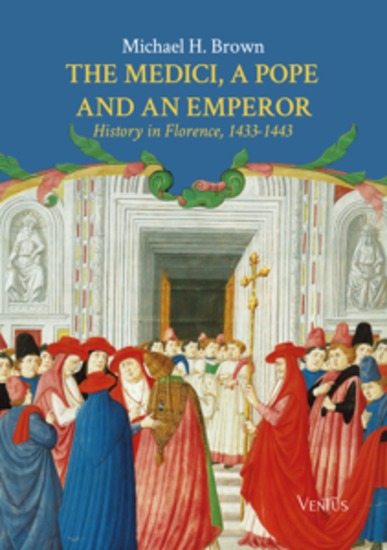
The Medici a Pope and an Emperor: History in Florence 1433-1443 - cover

The Medici a Pope and an Emperor: History in Florence 1433-1443

Michael H. Brown

Maison d'édition: Ventus

  • 0
  • 0
  • 0

Synopsis

During a seminal decade (1433–1443), Florence became a crossroads of cultural, political, and ecclesiastical significance, hosting an exiled pope and a desperate Roman emperor while embracing the rise of Cosimo de’ Medici as de facto prince. The Medici, a Pope and an Emperor traces the historical arcs of the Commune of Florence, the Medici, the Catholic Church and Byzantium. The intersection of these histories transformed Florence into a unique stage upon which occurred some of the most important events of the early Italian Renaissance.
Disponible depuis: 25/03/2025.
Longueur d'impression: 190 pages.


D'autres livres qui pourraient vous intéresser

  • Credit Score - The Beginners Guide for Building Repairing Raising and Maintaining a Good Credit Score Includes a Step-by-Step Program to Improve and Boost Your Bank Rating - cover

    Credit Score - The Beginners...

    Jordan Riches

    • 0
    • 0
    • 0
    If you want to improve your credit rating, then keep reading. 
    The credit score is a fundamental aspect in your financial life. 
    Having a good rating means being able to raise capital at your will, with low interest rates and at your own terms. 
    Life is easier if your credit score is good: need money to buy an house or a new investment? Just go and get them. 
    But, unluckily, life is not always fair and sometimes your credit score can be lower than you deserve. 
    No worries: there are precise methods and techniques to improve your rating and gain access to first-class financial treatment. 
      
    With this book you will discover... 
    ▸ What is credit score and how it's measured 
    ▸ The basics of FICO and VantageScore ratings 
    ▸ How does credit score work for businesses? 
    ▸ What are the benefits of a good rating 
    ▸ What factors are affecting your credit score 
    ▸ How to check your records for free 
    ▸ How to build a good credit score - even from zero! 
    ▸ Techniques to maximize your rating 
    ▸ Mistakes that will break your credit score in no time! 
    ▸ How to work with counselors and advisors
    Voir livre
  • Claimed by the Aliens (Gay Hucow Erotica) - cover

    Claimed by the Aliens (Gay Hucow...

    Archer Vale

    • 0
    • 0
    • 0
    Humans produce what the aliens crave. They keep us on factory farms. They pump us full of glorious hormones. 
    It began with a physical exam. They probed and explored my body while making me watch a terrifying video. 
    Then they put me in a holding cell with my new companion—a computer that can read my mind. 
    It doesn’t matter what I say, it knows how to influence and manipulate me. It’s designed to milk me dry. That’s why I’m here—I’m livestock. 
    Day by day, I can feel my body morphing. The need to be milked grows stronger and stronger. I’m no longer a man. 
    I’m a hucow. 
    --- 
    CONTAINS EXPLICIT GAY SEXUAL CONTENT. 
    For exclusive stories, visit www.ArcherVale.com.
    Voir livre
  • The Public Purpose of Art - cover

    The Public Purpose of Art

    Arlene Goldbard

    • 0
    • 0
    • 0
    We’re on the cusp of a paradigm shift, a radical change in worldview that will thrust art and culture onto center stage. What does that mean? How will the world be different? What is the rising spirit of the times and how is it being expressed in art? Arlene Goldbard says, “I have this overwhelming image of energy gathering force and taking shape.” She likens this force to a wave and says, “No one masterminds a wave, ordering all the drops of water into line. Many independent forces operate simultaneously – wind, gravity, disturbances of all kinds – and somehow, the wave mounts.” In this dialogue we explore this mounting force and what’s opposing this rolling tide. (hosted by Justine Willis Toms)
    Voir livre
  • Day That Will Live in Infamy A: The History and Legacy of Japan’s Initial Attacks against the United States at Pearl Harbor Wake Island and the Philippines on December 7 1941 - cover

    Day That Will Live in Infamy A:...

    Editors Charles River

    • 0
    • 0
    • 0
    All Americans are familiar with the “day that will live in infamy.” At 9:30 a.m. on Sunday, December 7, 1941, Pearl Harbor, the advanced base of the United States Navy’s Pacific Fleet, was ablaze. It had been smashed by aircraft launched by the carriers of the Imperial Japanese Navy. All eight battleships had been sunk or badly damaged, 350 aircraft had been knocked out, and over 2,000 Americans lay dead. Indelible images of the USS Arizona exploding and the USS Oklahoma capsizing and floating upside down have been ingrained in the American conscience ever since. In less than an hour and a half the Japanese had almost wiped out America’s entire naval presence in the Pacific. 
    Less than 24 hours earlier, Japanese and American negotiators had been continuing their diplomatic efforts to stave off conflict in the region, but as they did, President Roosevelt and his inner circle had seen intelligence reports strongly suggesting an imminent attack - though they did not know where. The U.S. rightly believed that Japan would take action to prevent the Americans from interfering with their military activities in Southeast Asia, and American military forces in the Philippines were already bracing for a potential attack. However, as the negotiations were ongoing, the powerful Japanese carrier fleet had been surging southwards through the Pacific while maintaining radio silence, preparing to strike the blow that would ignite war in an area spanning half the globe. 
    Posted on the other side of the world, it was early on the morning of December 8 in the Philippines when American general Douglas MacArthur received news of the Japanese attack on Pearl Harbor hours earlier. With that, it could only be a matter of time before the Japanese attacked the Philippines. Although MacArthur and Allied forces tried to hold out, they could only fight a delaying action, and the Japanese managed to subdue all resistance by the spring of 1942.
    Voir livre
  • Moscow State University Address - cover

    Moscow State University Address

    Ronald Reagan

    • 0
    • 0
    • 0
    On May 31, 1988, at the request of General Secretary Mikhail Gorbachev, and standing below a bust of Lenin, Reagan spoke to and answered questions from a large audience of students and teachers at Moscow State University.  
    Reagan says “I wish you success” in Russian to the students on their upcoming exams. Reagan brings “a message of peace and good will and hope for a growing friendship and closeness between our two peoples.”  
    An information revolution is sweeping the globe that will transform our lives with robots, genetic coding, spacecraft, and other technologies. The key to progress is economic freedom. Entrepreneurs with the courage to take risks “are responsible for almost all the economic growth in the United States.”  
    The Republic of Korea, Singapore, Taiwan, India, and China are seeing the power of economic freedom. Freedom “is the continuing revolution of the marketplace.”  
    Nations “must renounce, once and for all, the right to an expansionist foreign policy.” “People do not make wars; governments do.” “Americans seek always to make friends of old antagonists”, for example, Britain, Germany, and Japan.  
    Nothing would please me more than to see “a growing, exuberant, exporting Soviet Union that had opened up to economic freedom”. In this Moscow spring of May 1988, we hope for a new world of reconciliation, freedom, and peace. 
    Following the speech, Reagan fields questions from the audience on a variety of topics: the START ballistic missile treaty, how young people have changed since he was a student, conflicts in Namibia and Nicaragua, the return of missing Soviet soldiers from Afghanistan, what’s unique about the U.S. Constitution, Reagan’s speaking plan on the mashed-potato circuit after retiring, American Indians, and Soviet dissidents. 
    Audio recording courtesy of the Ronald Reagan Presidential Library. 
    AspenLeafMedia.com
    Voir livre
  • American Naval Mission in the Adriatic - 1918-1921 - cover

    American Naval Mission in the...

    A. C. Davidonis

    • 0
    • 0
    • 0
    "American Naval Mission in the Adriatic, 1918-1921" by A. C. Davidonis offers an in-depth analysis of the United States naval forces' occupation of central Dalmatia, spanning from November 1918 to September 1921. This occupation, encompassing over 100 miles of the Dalmatian coast, is notable for its duration and territorial extent. The book details various incidents and measures, such as the establishment of inter-Allied patrols and the handling of rumored Italian troop movements, showcasing the complexity of the American naval governor's role in the region. These episodes illustrate the intricate dynamics of military governance and diplomacy during this period. Overall, Davidonis' book provides a comprehensive account of this unique episode in American naval history, shedding light on the challenges and strategies employed during the American Naval Mission in the Adriatic.
    Voir livre