Begleiten Sie uns auf eine literarische Weltreise!
Buch zum Bücherregal hinzufügen
Grey
Einen neuen Kommentar schreiben Default profile 50px
Grey
Jetzt das ganze Buch im Abo oder die ersten Seiten gratis lesen!
All characters reduced
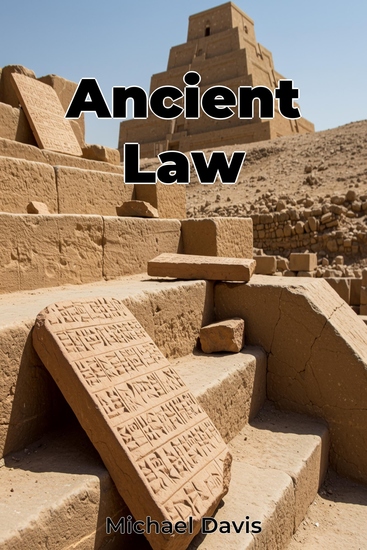
Ancient Law - cover

Ancient Law

Michael Davies

Übersetzer A Ai

Verlag: Publifye

  • 0
  • 0
  • 0

Beschreibung

"Ancient Law" explores the historical origins of modern legal systems by examining the legal codes, court systems, and concepts of justice in ancient civilizations like Mesopotamia, Egypt, Greece, and Rome. It argues that fundamental legal principles such as fairness and the rule of law, often taken for granted today, have roots in these early societies. The book uniquely compares different ancient legal systems, revealing common themes and divergent approaches, and providing a broader understanding of legal evolution.

 
The book traces the evolution of legal principles from rudimentary retribution to more sophisticated justice notions and examines the development of legal institutions from informal dispute resolutions to formalized court systems. For instance, the Code of Hammurabi, one of the earliest known legal codes, reveals much about ancient societal values and punishments.

 
Understanding the social, political, and economic contexts of these ancient laws is crucial, as it sheds light on the assumptions embedded within our current legal structures. The approach taken in "Ancient Law" is academic, utilizing both primary and secondary sources to ensure a comprehensive analysis.

 
The book is structured in three parts, beginning with an introduction to basic concepts such as offenses and punishments, moving to the evolution of court systems, and concluding with an analysis of the lasting influence of ancient law on modern legal systems. This historical and political exploration is intended for those interested in legal history or political science.
Verfügbar seit: 21.03.2025.
Drucklänge: 64 Seiten.


Weitere Bücher, die Sie mögen werden

  • Horatio Nelson - His Life His Service His Death and His Legacy - cover

    Horatio Nelson - His Life His...

    Kelly Mass

    • 0
    • 0
    • 0
    Horatio Nelson can be seen as one of the most courageous, strategic, valiant British generals in history. His tactics in the navy have led their empire to glorious victories in the 18th and beginning of the 19th century. During the wars against Napoleon, the Scandinavians, and in the West Indies, he was an exemplary leader, strategists, and combatant. The British Empire stretched all the way from the Caribbean to Egypt and beyond. Needless to say, much help was needed in various areas in the world. 
    Learn more about this brave warrior, someone who fit exactly into that time frame to keep their empire afloat, through their navy ships, their battles, and their victories.
    Zum Buch
  • Corpse Care - Ethics for Tending the Dead - cover

    Corpse Care - Ethics for Tending...

    Mikeal C. Parsons, Cody J. Sanders

    • 0
    • 0
    • 0
    Corpse Care relates the history of death care in the US to craft robust, constructive, practical ethics for tending the dead. It specifically relates corpse care to economic, environmental, and pastoral concerns. 


    Death and the treatment of the dead body loom large in our collective, cultural consciousness. The authors explore the materiality and meaning of the dead body and the living's relationship to it. All the biggest questions facing the planetary human community relate in one way or another to the corpse. Surprisingly, Christian communities are largely missing in the discussion of the dead, having abdicated the historic role in care for the dead to the funeral industry. Christianity has stopped its reflection about the body once that body no longer bears life. Corpse Care stakes a claim that the fact of embodiment, this incarnational truth, this process of our bodily becoming, is a practical, ethical, and theological necessity.
    Zum Buch
  • A Letter From Aldous Huxley to George Orwell Regarding 1984 - cover

    A Letter From Aldous Huxley to...

    Aldous Huxley

    • 0
    • 0
    • 0
    In October of 1949, a few months after publication of George Orwell‘s masterpiece, Nineteen Eighty-Four, he received a letter from fellow author Aldous Huxley, a man who, 17 years previous, had seen his own nightmarish vision of society published in the form of the classic, Brave New World. What begins as a letter of praise soon becomes a brief comparison of the two novels, and an explanation as to why Huxley believes his own earlier work to be a more realistic prediction. It should be noted that in 1917, long before he wrote this letter, Aldous Huxley briefly taught Orwell French at Eton College in Berkshire.
    Zum Buch
  • The End of America? - A Guide to the New World Disorder - cover

    The End of America? - A Guide to...

    Allan Friedman

    • 0
    • 1
    • 0
    America was the shining city on a hill. It was the country at the forefront of the world democratic order, the global policeman, the might of its military matched only by the depth of its financial reserves. America was the one the world listened to, whether it wanted to or not. So, what happened?
    Well, a lot of things. In this searing account, Alan Friedman shows how, from the disastrous Vietnam War to Barack Obama's bungled response to the Arab Spring, American intervention has ceased to be the decisive action it once was. And now, with the rise of China and Russia, coupled with America's prostration of itself following the election of Donald Trump, the decline of its authority is only hastening.
    We move now, Friedman argues, into the New World Disorder. In this dangerous and unstable world, the Washington-enforced liberal order is receding, and a new set of alliances and anxieties are in ascendence. What is America's place in this? Which powers are going to emerge as the leaders? Will the European Union count at all? One thing is for sure: the effects of the New World Disorder will challenge our Western values to breaking point.
    Zum Buch
  • On Disinformation - How to Fight for Truth and Protect Democracy - cover

    On Disinformation - How to Fight...

    Lee McIntyre

    • 0
    • 0
    • 0
    The effort to destroy facts and make America ungovernable didn't come out of nowhere. It is the culmination of seventy years of strategic denialism. In On Disinformation, Lee McIntyre shows how the war on facts began, and how ordinary citizens can fight back against the scourge of disinformation that is now threatening the very fabric of our society. Drawing on his twenty years of experience as a scholar of science denial, McIntyre explains how autocrats wield disinformation to manipulate a populace and deny obvious realities, why the best way to combat disinformation is to disrupt its spread, and most importantly, how we can win the war on truth. 


    McIntyre goes through the history of strategic denialism to show how we arrived at this precarious political moment and identifies the creators, amplifiers, and believers of disinformation. On Disinformation lays out ten everyday practical steps that we can take as ordinary citizens—from resisting polarization to pressuring our Congresspeople to regulate social media—as well as the important steps our government (if we elect the right leaders) must take. 


    On Disinformation empowers us to save our republic from autocracy before it is too late.
    Zum Buch
  • Heedfulness - cover

    Heedfulness

    Bhikkhu Khantipālo

    • 0
    • 0
    • 0
    This is an audiobook of Bodhi Leaves No. 98 by Bhikkhu Khantipālo, 'Heedfulness' found in the Pariyatti Edition of Collected Bodhi Leaves Vol. IV, narrated by Shelina Hetherington. 
     
    Excerpt: 
    ...The quality of heedfulness has been praised many times by the Exalted Buddha, just as the opposite, heedlessness, has been condemned. In this Dhamma, there is much to be practised and there is practice suitable for every posture of the body and every minute of the day. There is practice to be done concerning the stream of thoughts racing in the mind, there is more practice connected with the thousands of words spoken every day, and there is Dhamma-practice for the body, whatever it is doing. Now none of this can be accomplished without heedfulness, without making effort, without employing mindful awareness, or without wisdom. Heedfulness implies the conscious cultivation of these three aspects of Dhamma: effort, mindfulness and wisdom....
    Zum Buch