Join us on a literary world trip!
Add this book to bookshelf
Grey
Write a new comment Default profile 50px
Grey
Subscribe to read the full book or read the first pages for free!
All characters reduced
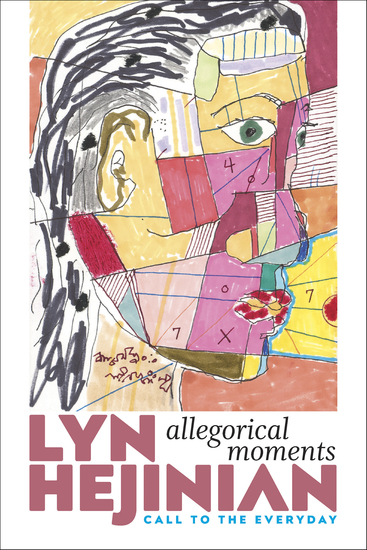
Allegorical Moments - Call to the Everyday - cover

Allegorical Moments - Call to the Everyday

Lyn Hejinian

Publisher: Wesleyan University Press

  • 0
  • 0
  • 0

Summary

Allegorical Moments is a set of essays dedicated to rethinking allegory and arguing for its significance as a creative and critical response to sociopolitical, environmental, and existential turmoil affecting the contemporary world. Traditionally, allegorical interpretation was intended to express an orthodoxy and support an ideology. Hejinian attempts to liberate allegory from its dogmatic usages. Presenting modern and contemporary materials ranging from the novel to poetry to painting and cinema to activist poetry of the Occupy movement, each essay in the book "begins again" with different materials and from different perspectives. Hejinian's generative scholarship looks back to experimental modernism and forward into a future for a vital, wayward poetry resistant to the crushing global effects of neoliberalism.
Available since: 11/07/2023.
Print length: 456 pages.

Other books that might interest you

  • Freedom For All - cover

    Freedom For All

    Neville Goddard

    • 0
    • 0
    • 0
    Freedom For All by Neville Goddard is a profound exploration of the principles of spiritual freedom and the power of human imagination. In this concise yet impactful work, Goddard delves into the idea that true freedom is achieved through the conscious control of one's thoughts and beliefs, which in turn shape one's reality.Central to Goddard's teachings is the concept that the imagination is a divine tool that can transform circumstances and bring about personal liberation. He posits that every individual has the innate ability to create their desired life through focused imagination and faith. By aligning one's inner beliefs with the feeling of the wish fulfilled, Goddard asserts that external conditions will inevitably conform to these inner convictions.The book is structured to guide readers through the key steps to attaining spiritual and personal freedom:Understanding the Creative Power of Imagination:Goddard explains how imagination is the driving force behind all creation and how it can be harnessed to bring about desired changes in one's life.The Law of Assumption:This principle is about assuming the feeling of the wish fulfilled. Goddard emphasizes that by living in the state of the wish already realized, one sets the stage for its manifestation in reality.Faith and Belief:Goddard highlights the importance of unwavering faith in the process of manifestation. He teaches that belief in the unseen and persistence in the feeling of the desired state are crucial for achieving freedom.Practical Application:Throughout the book, Goddard provides practical exercises and meditations designed to help readers internalize and apply these principles in their daily lives.Freedom For All is not just a theoretical exposition but a practical guide that empowers readers to take control of their mental and emotional states. By doing so, they can break free from limiting beliefs and circumstances, achieving true freedom and fulfillment.Neville Goddard's teachings in this book continue to inspire and empower individuals seeking to unlock their creative potential and live a life of freedom and abundance. Through clear and accessible language, Goddard offers timeless wisdom on the transformative power of the human mind and spirit.
    Show book
  • Loki - An Illustrated Guide to the Trickster God - cover

    Loki - An Illustrated Guide to...

    L. Dean Lee

    • 0
    • 0
    • 0
    Loki: mischief-maker, shapeshifter, and father to monsters. Explore the enigmatic god of Norse mythology in this richly illustrated guide.   This authentic introduction to the Norse god Loki Laufeyjarson delves into his history, enduring legacy, and impact on the Norse pantheon. Revered in Norse paganism as the god of chaos, Loki is audacious, conniving, and wildly cunning, constantly causing all kinds of mischief and using his various magical powers to manipulate situations to his advantage.  Loki: An Illustrated Guide to the Trickster God provides an overview of Loki’s origins, personality, significance, powers, and associations in a comprehensive, accessible, and beautifully designed hardcover. Included are the most important folklore and mythological tales involving Loki, such as the birth of Sleipnir, the stealing of Thor’s hammer, the death of Balder, and Ragnarök. This book not only covers Loki in ancient times, but also through the ages, sharing how Loki became an icon throughout the world.   With Loki: An Illustrated Guide to the Trickster God, you will delve into the depths of Norse mythology and understand the true nature of Loki. Expert practicing Norse heathen L. Dean Lee shares how to properly venerate and incorporate Loki into your spiritual practice.
    Show book
  • Ordinary Equality - The Fearless Women and Queer People Who Shaped the US Constitution and the Equal Rights Amendment - cover

    Ordinary Equality - The Fearless...

    Kate Kelly

    • 0
    • 0
    • 0
    Ordinary Equality digs into the fascinating and little-known history of the ERA and the lives of the incredible—and often overlooked—women and queer people who have helped shape the U.S. Constitution for more than 200 years. Based on author Kate Kelly’s acclaimed podcast of the same name, Ordinary Equality recounts a story centuries in the making.
    Show book
  • On Benefits - cover

    On Benefits

    Lucius Annaeus Seneca

    • 0
    • 0
    • 0
    The original Latin name of this important essay by Seneca, written around 60 CE, was De Beneficiis, which is why it is generally translated as ‘On Benefits’. However, it is more usefully titled ‘On Favours’, because this is what it is essentially about: the giving and receiving of favours, with all the implications of such transactions. Seneca is concerned with demonstrating that while such exchanges can be straightforward and beneficial to both parties, often there are pitfalls and hidden complications that, sooner or later, result in problems. Though some centuries later Shakespeare summed it up concisely with Polonius’s warning: ‘Neither a borrower nor a lender be,’ Seneca is well aware that in all levels and activities of society, benefits or favours play an undoubtedly crucial role. This was certainly true of Roman society, but little has changed since. Seneca deals with the subject in detail, considering the purposes of role of the giver, of which ‘kindness’, he says, is an important aspect – but not the only one by any means. Similarly, the role and attitude of the receiver, plays its part – and ‘gratitude’ is again only one response. Seneca’s background as a Stoic underpins his approach, so he warns against the inappropriate giving and receiving of benefits, which extend far beyond just material goods: it includes influence, wives, patronage and all manner of vice and immorality. In short, Seneca points out that the giving and receiving of favours can be, and often is a pernicious and dangerous affair, resulting in later disaster. Something to be exercised with caution.
    Show book
  • Edward I: A Captivating Guide to the Life and Death of the Hammer of the Scots and His Impact on the History of England - cover

    Edward I: A Captivating Guide to...

    Captivating History

    • 0
    • 0
    • 0
    Who was King Edward I of England? And why should we learn about him? 
    King Edward I was the first of three Edwards who reigned in perfect succession. He was one of the most important kings in English history, but he was also one of the most controversial. This was the king who subdued Wales and fought Scotland to a standstill for much of his reign. He battled leading Scottish figures that are recognizable to even novice history students. Both William Wallace and Robert the Bruce butted heads with this English ruler.  
    Edward engaged in harsh crackdowns, yet he also confirmed the statutes of the Magna Carta and helped strengthen ties to parliament. Edward often behaved as an absolutist dictator with a penchant for reform. He has been described as a “great and terrible” king, whose equal parts of greatness and terribleness can easily be seen throughout his tenure as an English monarch.  
    In this book, you will learn about:Edward’s early days as prince and the impact of his childhoodThe Welsh revolts and Edward’s eventual conquest of WalesEdward’s Holy Land CrusadeScotland’s crisis of succession and Edward’s long war with the ScotsThe rise of William Wallace and Robert the BruceEdward’s final days as kingAnd much more! 
    Scroll up and click the “add to cart” button to learn more about King Edward I of England!
    Show book
  • Self-knowledge is the beginning of wisdom - Fourteen Public Meetings Ojai USA 1949 - cover

    Self-knowledge is the beginning...

    Jiddu Krishnamurti

    • 0
    • 0
    • 0
    Seven Public Talks 1. Does self-knowledge come through searching? - 16 July 1949 Duration: 59 minutes • What is it that most of us are seeking? • Does clarity come through searching and trying to find out what others say? • Can incessant search and longing give you the extraordinary sense of reality or creative being that comes when you really understand yourself? • Without knowing your background and the substance of your thought, where it comes from, surely your search is utterly futile and your action has no meaning. • The responsibility for any action depends on ourselves, not on others. • Q: Do I have to be at any special level of consciousness to understand you? • Q: The movement of life is experienced in relationship to people and to ideas. 2. Relationship has significance only when it is a process of self-revelation - 17 July 1949 Duration: 37 minutes • Where there is authority there can be no discovery of something new. • Relationship based on an idea cannot be a self-revealing process. • Self-knowledge is understood, uncovered and its process revealed through relationship. • Is it possible to love without the interference of the mind? • When the mind becomes supreme, all-important, then there can be no affection. • Q: What is that thinking that must come to an end? What do you mean by thinking and thought? 3. If we had no belief what would happen to us? - 23 July 1949 Duration: 39 minutes • Without self-knowledge we cannot go beyond the self-projected illusions of the mind. • It's only in relationship that one can know oneself as one is. • A mind that is filled with beliefs, dogmas, assertions and quotations is an un creative, repetitive mind. • Can we look at ourselves without beliefs? • A mind that is quiet because it understands fear and understands itself is creative. • Q: Our mind knows only the known. What is it in us that drives us to find the unknown, reality, or God? 4. Simplicity cannot be found unless one is free inwardly - 24 July 1949 Duration: 57 minutes • Only when the mind and heart are really simple is one able to solve the many problems that confront us. • A religious man is he who is inwardly simple. • Q: I have been a member of various religious organizations but you have destroyed them all. I am utterly bored and work because hunger forces me to it. I am afraid to commit suicide. What on earth am I to do? • Q: What have you to say to a person who, in quiet moments, sees the truth of what you say, who has a longing to keep awake but who finds himself repeatedly lost in a sea of impulse and small desires? 5. How is one to be aware? - 30 July 1949 Duration: 64 minutes • Does the understanding of ourselves demand a specialization? • What is it that we need capacity for? • How is one to be capable of meeting life as a whole? • How are we aware of something? • To understand relationship there must be an awareness which is not aggressively positive. • Q: All religions have insisted on some kind of self-discipline to moderate the instincts of the brute in man. You seem to imply that such disciplines are a hindrance to the realization of God. Who is right in this matter? 6. What is true religion? - 31 July 1949 Duration: 47 minutes • Is religion a matter of sensation? • Religion is not ceremony, dogma nor the continuation of tenets or beliefs inculcated from childhood. • Belief in God does not make you a religious person. • Self-knowledge is the beginning of wisdom. • Q: Will you please carefully explain what is true meditation? 7. To understand 'what is' there must be no prejudice - 6 August 1949 Duration: 40 minutes • To understand reality, or for that immensity to come into being, one must understand the process of one's own thinking. • How is it possible to go into the deeper layers of consciousness? • If we do not name then perhaps it's possible to go into the deeper layers of consciousness.
    Show book