Rejoignez-nous pour un voyage dans le monde des livres!
Ajouter ce livre à l'électronique
Grey
Ecrivez un nouveau commentaire Default profile 50px
Grey
Abonnez-vous pour lire le livre complet ou lisez les premières pages gratuitement!
All characters reduced
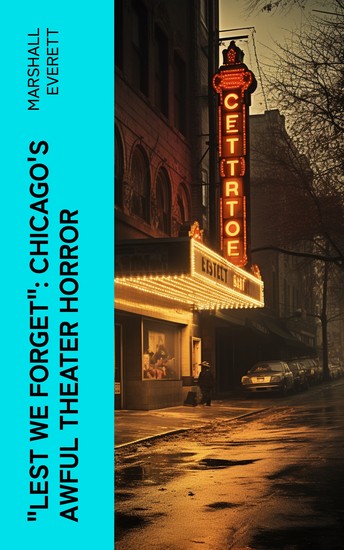
"Lest We Forget": Chicago's Awful Theater Horror - cover

"Lest We Forget": Chicago's Awful Theater Horror

Marshall Everett

Maison d'édition: e-artnow

  • 0
  • 0
  • 0

Synopsis

This book tells about the Iroquois Theatre fire that occurred on December 30, 1903, at the Iroquois Theatre in Chicago, Illinois, United States. The fire resulted in more than 600 deaths and was the deadliest theater fire and single-building fire in U.S. history. This book is a tribute to the tragedy that left a deep trace in the memory of past generations and is also horrifying to a modern reader.
Disponible depuis: 25/11/2023.
Longueur d'impression: 2296 pages.

D'autres livres qui pourraient vous intéresser

  • Of Consolation - To Marcia To Helvia To Polybius - cover

    Of Consolation - To Marcia To...

    Seneca the Younger

    • 0
    • 0
    • 0
    These three ‘Consolations’, written by Seneca to his mother and two friends, have been described as ‘the crowning achievement in the canon of ‘consolation letters’. But sentimental they are not, for they emerge from the writer’s deep-seated commitment to Stoicism, where individuals are exhorted to inhabit qualities of virtue, positivity, resilience, and indifference. This recording opens with Seneca’s consolatory letter to Marcia, who, after three years, was still mourning the death of her son. He recognises her exceptional personal qualities and what benefits she has brought to her family, having rescued her father’s legacy as a historian following his death. He cites other noble Roman mothers who lost their sons, and enjoins her to adopt a more Stoic attitude of mind: we are all destined to die, he declares.  
    The second letter is to his mother sent after he had been exiled to Corsica by Emperor Caligula. He counsels Helvia not to mourn his absence – not least because he himself does not feel grief at the prospect of his own exile. He acknowledges the trials of his mother during her life, remarking ‘ill-fortune has given you no respite’. But her grief at the absence of her son may be put to one side in the knowledge that as he has ‘never trusted in Fortune,’ she can be comforted that her son is not discommoded. And history points to far harsher separations.  
    The final letter is to Polybius, Emperor Claudius’s Literary Secretary, who was mourning his brother.  Written while in exile, Seneca’s unwavering commitment to Stoic philosophy is again in evidence. One of Seneca’s principal suggestions is for Polybius to distract himself from grief by an increasing involvement in work.  
    These ‘Consolations’ have been widely admired from Classical times to the present, but are periodically questioned for their emphasis on a somewhat detached approach to grief and bereavement. Not all can manage imperturbability in such circumstances. Nevertheless, there is a steadiness and emotional calm in these missives, which Seneca himself displayed when ordered to commit suicide by Emperor Nero.
    Voir livre
  • Constantinople - History of the Byzantine Empire’s Gigantic Capital - cover

    Constantinople - History of the...

    Kelly Mass

    • 0
    • 0
    • 0
    Constantinople, a city that witnessed the rise and fall of empires, served as the capital for three significant civilizations: the Roman/Byzantine Empire (330–1204 and 1261–1453), the Latin Empire (1204–1261), and the Ottoman Empire (1453–1922). Following the Turkish War of Independence, the capital was moved to Ankara, marking a new chapter in Turkish history. In 1930, the city was officially renamed Istanbul, which remains the Republic of Turkey’s largest city and financial center today. It is also the largest city in Europe. 
    In 324 AD, Emperor Constantine the Great made the fateful decision to transform the old city of Byzantium into a grand new capital, naming it "New Rome" and consecrating it on May 11, 330 AD. This strategic move solidified the city’s place in history, becoming the heart of the Eastern Roman Empire, later known as the Byzantine Empire. 
    Constantinople became a symbol of Orthodox Christianity, often referred to as the "cradle of Orthodox Christian civilization." The city's religious and cultural significance cannot be overstated; it was home to some of the most iconic architectural and religious sites in the Christian world. From the mid-fifth to the early-thirteenth century, Constantinople was Europe's largest, most affluent metropolis, a center of commerce, culture, and intellectual activity.
    Voir livre
  • Real World 101 - Student Guide - cover

    Real World 101 - Student Guide

    Alcott Germany II

    • 0
    • 0
    • 0
    Real World 101: Student Guide is a fun discussion between you the reader and the innovative prowess of Alcott Germany II. While reading through this quick and thought-provoking dialogue, you will understand how to seize control of your own life by learning how to make those unpopular school subjects work for you. “The more you educate yourself, the fewer parents you will have in your future.” A great read for aspiring young adults, containing great lessons that will last a lifetime.
    Voir livre
  • Rise of Fascism in Europe The: The History of the Fascist Takeovers in Nazi Germany Italy and Spain during the 20th Century - cover

    Rise of Fascism in Europe The:...

    Editors Charles River

    • 0
    • 0
    • 0
    It’s easy to forget how young Italy was when Benito Mussolini was born on July 29, 1883. It is hard to conceive a territory with such a long and ancient history was once young and troubled with constant conflict and instability. Similar to Germany, Italy was unified in 1861, but contrary to its northern cousin, its previous history was one of separation. Italy had no great romantic idea of a “Great Germany,” keeping it unified even during the wars between city-states. Benito Mussolini was born and raised in a highly volatile environment where ideas already considered extreme by most contemporary observers, such as Socialism, would undergo a deep and violent transformation.	Mussolini would ride that wave to power, and he would hold it for decades as he opportunistically tried to strengthen Italy's position and empire. That would lead him to foreign interventions in Africa, and eventually an alliance with Nazi Germany's Adolf Hitler, ultimately costing him everything and devastating his country throughout World War II. 
    	It is often claimed that Adolf Hitler rose to power in Germany through democratic means, and while that is a stretch, it is true that he managed to become an absolute dictator as Chancellor of Germany in the 1930s through a mixture of politics and intimidation. Ironically, he had set such a course only because of the failure of an outright coup attempt known as the Beer Hall Putsch about a decade earlier. 
    	The Spanish Civil War has exerted a powerful impact on the historical imagination. Without question, the conflict was a key moment in the 20th century, a precursor to World War II, and an encapsulation of the rise of extremist movements in the 1930s, but it was also a complex narrative in and of itself, even as it offered a truly international theatre of war. 	Ultimately, the forces of reaction, led by General Francisco Franco, triumphed, and after his victory in 1939, Franco ruled Spain with an iron fist for 36 years.
    Voir livre
  • Reality and the Arts - cover

    Reality and the Arts

    Albert A. Anderson

    • 0
    • 0
    • 0
    Art is the creative manifestation of essences. In order to understand the relation between art and reality, we need a philosophical guide. The best way to comprehend how the creative act of imagining enables the mind to seek reality is to employ the kind of dialectical thinking that Plato used in his dialogues. Beginning with the shadows on the wall of the cave in which each person dwells, that process gradually enables us to grasp the essences that are manifested in individual works of art.
     
    Without a philosophical guide, we are likely to encounter only a blur of images in the visual arts, a cacophony of sounds in music, a whirl of activity in the theater, and chaos in the building of cities. It is too much to expect a set of final answers to any serious question about what is true, good, or beautiful. If we abandon the quest for reality we settle for too little. Plato’s dialectical approach offers a path between Scylla and Charybdis.
    Voir livre
  • Living That Matters - Honest Conversations for Men of Faith - cover

    Living That Matters - Honest...

    Steve Thomas, Don Neufeld

    • 0
    • 0
    • 0
    Conversations that matter for menDo you wonder what it means to be a man? Do you desire to grow? Want something more? Long for a life that matters? Seek to make a difference in the world? If so, Living That Matters may be for you or your group. This practical handbook is a guide to help individuals and groups engage in honest conversations on what matters most for men—with a focus on following Jesus, forming community, and building peace.With over 60 years of combined experience in pastoral ministry and social work geared toward men, authors Steve Thomas and Don Neufeld offer many short reflections to help individuals and groups deepen relationships with one another, with ourselves, with our families and communities, and with God as we seek to live into God’s shalom—a peaceable order with abundance, security, and justice for all and well-being throughout creation.
    Voir livre