Rejoignez-nous pour un voyage dans le monde des livres!
Ajouter ce livre à l'électronique
Grey
Ecrivez un nouveau commentaire Default profile 50px
Grey
Abonnez-vous pour lire le livre complet ou lisez les premières pages gratuitement!
All characters reduced
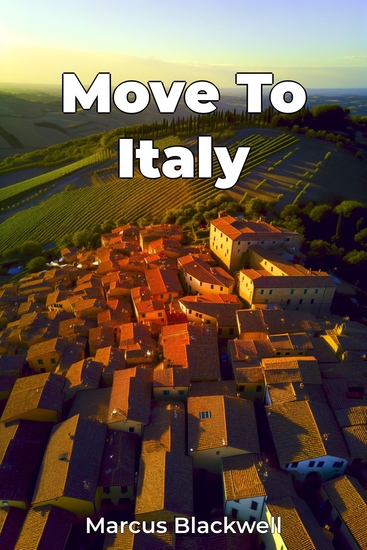
Move To Italy - cover

Move To Italy

Marcus Blackwell

Maison d'édition: Publifye

  • 0
  • 0
  • 0

Synopsis

"Move to Italy" stands as an indispensable guide for retirees and expatriates planning to establish a new life in Italy, offering a unique blend of practical information and cultural insights. The book expertly navigates readers through three essential aspects of relocation: legal requirements, cultural integration, and lifestyle adaptation, making complex processes accessible while maintaining the authenticity of the Italian experience.

 
Beginning with comprehensive coverage of residency requirements and visa processes, the guide progresses naturally into exploring Italy's rich regional diversity and social customs. Readers gain valuable insights into varying cultural norms across Italy's twenty regions, from business etiquette to dining customs, while learning practical aspects of daily life such as healthcare navigation and property regulations.

 
The book's approach is particularly noteworthy for its use of real expatriate experiences, government data, and cultural expertise to provide current, actionable information. What sets this guide apart is its holistic approach to Italian relocation, combining step-by-step procedural guidance with deep cultural understanding. Through case studies, templates, and checklists, readers receive practical tools for managing their transition while gaining essential context about Italian society and customs.

 
The guide addresses modern considerations like digital nomad visas and post-pandemic changes, making it relevant for contemporary relocators while maintaining its core focus on successful long-term integration into Italian life.
Disponible depuis: 08/01/2025.
Longueur d'impression: 138 pages.

D'autres livres qui pourraient vous intéresser

  • Mughal Empire - The Taj Mahal Legacy - cover

    Mughal Empire - The Taj Mahal...

    Rolf Hedger

    • 0
    • 0
    • 0
    The Mughal Empire emerged as one of the most powerful and influential dynasties in Indian history, leaving a lasting impact on culture, architecture, and governance. Its foundation was laid by Babur, a descendant of both Timur and Genghis Khan, who established Mughal rule in the early 16th century. Babur's military prowess and strategic vision enabled him to defeat the Delhi Sultanate in the First Battle of Panipat in 1526. This victory marked the beginning of Mughal dominance in the Indian subcontinent. However, Babur’s reign was short-lived, and it was his grandson, Akbar, who truly solidified the empire’s foundation. 
    Akbar ascended the throne at a young age and quickly proved himself to be an exceptional leader. His reign, which lasted from 1556 to 1605, was marked by territorial expansion, administrative reforms, and a commitment to cultural and religious harmony. Unlike previous rulers, Akbar recognized the diversity of India and sought to integrate different communities into his empire. He abolished the jizya tax on non-Muslims, promoted interfaith dialogue, and appointed talented individuals from various backgrounds to key positions in his administration. His policy of religious tolerance and inclusive governance earned him the loyalty of many, contributing to the stability and prosperity of the empire. 
    One of Akbar’s most remarkable achievements was the establishment of an efficient administrative system. He divided his empire into provinces, each governed by appointed officials who reported directly to the central authority. This system ensured effective governance and facilitated tax collection, trade, and law enforcement. Additionally, Akbar introduced a standardized revenue system that helped regulate the economy and promote agricultural growth. His emphasis on merit-based appointments created a well-organized bureaucracy that endured long after his reign.
    Voir livre
  • She Rides - Chasing Dreams Across California and Mexico - cover

    She Rides - Chasing Dreams...

    Alenka Vrecek

    • 0
    • 0
    • 0
    AT FIFTY-FOUR, Alenka Vrecek’s life was spiraling out of control—and she was running out of time to follow through on a long-forgotten dream. 
    She Rides is Alenka’s deeply personal memoir of her 2,500-mile solo bikepacking pilgrimage along the spine of the snow-covered Sierra Nevada and into  
    the hostile desert mountains and plains of Mexico’s Baja Peninsula. Stripped of self-pity and infused with a good dose of humor, her account of her journey 
    —a voyage across emotional, physical, and cultural boundaries—is a galvanizingwake-up call for anyone who wants to follow their own deeply buried  
    dreams . . .and reclaim their life. 
    A gripping account of small-scale adventure and self-discovery.” 
    —Kirkus reviews 
    “Alenka Vrecek invites us to sit side-saddle as she rides from Tahoe to the tip of Baja, battling headwinds and heartache, illness and injury, and others’ ideas of who and how a fifty-four-year-old woman should be. Gripping, wise, and snort-coffee-out-your-nose funny, She Rides will make you want to drop everything, get good and lost, and find your way back home.” 
    —Brian Benson, author of Going Somewhere 
    “A universal story of healing, hope, grit, and determination. Alenka’s bike trip from Tahoe to Baja is a heroine’s journey that will hold you in its grip. But it’s also a love story—about knowing what matters most and finding your way back home.” 
    —Valerie Andrews, editor of Reinventing Home and author of A Passion for this Earth
    Voir livre
  • The Race to the South Pole – Scott vs Amundsen - The Epic Battle for Antarctic Supremacy and the Price of Victory - cover

    The Race to the South Pole –...

    Jake Wood

    • 0
    • 0
    • 0
    In 1911, two legendary explorers set out on the most dangerous race in history—to become the first humans to reach the South Pole. Robert Falcon Scott, leading the British expedition, relied on tradition and sheer grit. Roald Amundsen, the Norwegian, used innovative techniques and calculated precision. 
    This audiobook takes you through the frozen wastelands of Antarctica, revealing the true story of courage, endurance, and sacrifice. Discover: 
    ✅ The tactics and technology that determined success or failure 
    ✅ The grueling conditions faced by both expeditions 
    ✅ How Amundsen’s strategic genius led to victory 
    ✅ Why Scott’s tragic end became one of the most legendary stories of heroism 
    The Race to the South Pole – Scott vs. Amundsen is a must-listen for history lovers, adventure enthusiasts, and anyone fascinated by the limits of human endurance.
    Voir livre
  • The Art of Egyptian Papyrus - Writing and Illustrations in Ancient Times - cover

    The Art of Egyptian Papyrus -...

    Omar Khalil

    • 0
    • 0
    • 0
    Papyrus, one of the most important inventions of ancient Egypt, was central to the development of writing and documentation in the ancient world. The history of papyrus dates back to the early dynastic periods of Egypt, around 3000 BCE, when the first examples of papyrus usage were recorded. This plant, which grew abundantly along the Nile River, was harvested for its stalks, which were then processed into sheets that served as a writing surface. The creation of papyrus revolutionized communication in the ancient world, providing a portable, durable, and practical alternative to other materials like stone or clay tablets. 
    The origins of papyrus as a writing material can be traced to the need for a flexible and lightweight medium that could be used for documentation, record-keeping, and artistic purposes. Ancient Egyptians discovered that the inner pith of the papyrus plant could be cut into strips and laid in a crisscross pattern, pressed together, and dried to form sheets. These sheets were then smoothed and polished, making them suitable for inscribing with hieroglyphs, hieratic script, or later, the demotic script. Over time, the process of papyrus production became more refined, and its use spread to neighboring regions, influencing other ancient civilizations. 
    Early uses of papyrus were predominantly for religious and administrative purposes. Royal decrees, religious texts, and tomb inscriptions were often written on papyrus scrolls. As Egyptian society advanced, the role of papyrus expanded to include personal letters, legal documents, and works of literature, cementing its place as the primary medium for writing in the ancient world. The papyrus scroll became the preferred format for long documents, with scrolls of varying lengths used to record everything from medical texts to astronomical observations.
    Voir livre
  • Cuba Travel Guide: Cuba Libre! Let the Cultural History of Cuba Guide You Through the Authentic Soul of the Country - cover

    Cuba Travel Guide: Cuba Libre!...

    Carlos Fernando Alvarez

    • 0
    • 0
    • 0
    Discover the Majestic World of Cuba. Find Out Everything You Need to Know Before Packing Your Suitcase! 
    Cuba; the place of the infamous Cohiba cigars, the delicious Havana Club rum, the special Cubita or Serrano black coffee, and the birthplace of the well-known Rumba, Mambo, and Salsa dances! But there’s so much more one has to know before visiting Cuba. 
    Whether you’re a seasoned backpacker or newbie tourist with a few trips under your belt wondering about a new location for your next trip, Cuba Travel Guide is the best companion you could possibly hope for in a country like Cuba. 
    Unwrap the daily subtleties and nuances of daily Cuban life by staying in casa particulares, the Airbnb-like system for tourist coming into Cuba on a budget; lose yourself in the comfort of choice Cuba’s luxury hotels and resorts if you have the cash to splurge; enjoy the antique architecture of Old Havana, a UNESCO World Heritage Site; bathe in the sun on the ivory white beaches of Varadero; Revel in the natural scenery and explore the cave systems of Vinales; walk the cobbled streets of Trinidad and swim under the waterfalls of the Topes De Collantes National Park, enjoy authentic Cuban dishes… and more! 
    Other practical things you’ll learn:What kind of currency are you going to need?Where are the best traditional and affordable places to eat?Which are the most mesmerizing destinations and interesting attractions? 
    Order Now!
    Voir livre
  • The Complete History of Ancient Egypt - cover

    The Complete History of Ancient...

    Omar Khalil

    • 0
    • 0
    • 0
    The story of Ancient Egypt begins along the fertile banks of the Nile River, where geography shaped the destiny of one of the world’s most iconic civilizations. The Nile provided more than just water—it was the lifeline that enabled agriculture, transportation, and trade, making permanent settlement possible in an otherwise arid desert. As early as 5000 BCE, small communities began to emerge, relying on the predictable flooding of the river to support grain cultivation. Over time, these settlements evolved into more complex societies, each developing distinct cultural and political practices. 
    The predynastic period saw the rise of two major regions: Upper Egypt in the south and Lower Egypt in the north. These regions were marked by different customs, burial practices, and artistic expressions, yet both shared a reverence for the Nile and its central role in life and death. Villages grew into city-states ruled by local chieftains, and as competition and alliances formed, a gradual move toward centralization began. Archaeological evidence, including pottery styles and tomb construction, shows increasing social stratification and technological innovation during this period. 
    The unification of Upper and Lower Egypt around 3100 BCE marks the beginning of pharaonic rule and the dynastic era. Traditionally attributed to a ruler named Narmer (also known as Menes), this event was not just a political milestone but also a cultural one. Narmer’s unification is immortalized on the Narmer Palette, a ceremonial artifact that symbolically represents the king’s authority over both lands. With unification came the birth of a centralized administration, standardized religious practices, and a single ruler who was seen not only as a political leader but also as a divine intermediary between the gods and the people.
    Voir livre