Join us on a literary world trip!
Add this book to bookshelf
Grey
Write a new comment Default profile 50px
Grey
Subscribe to read the full book or read the first pages for free!
All characters reduced
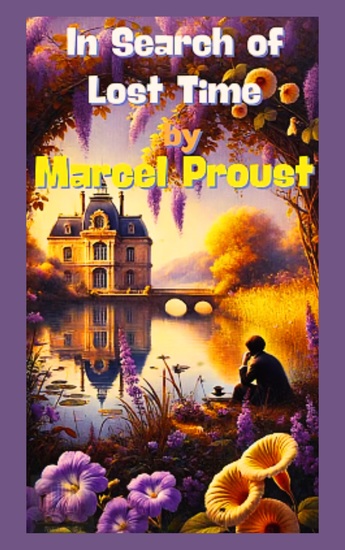
In Search of Lost Time - Marcel Proust's Masterpiece of Memory and Identity - cover

In Search of Lost Time - Marcel Proust's Masterpiece of Memory and Identity

Marcel Proust, Zenith Crescent Moon Press

Publisher: Zenith Crescent Moon Press

  • 0
  • 0
  • 0

Summary

Immerse yourself in In Search of Lost Time (À la recherche du temps perdu), Marcel Proust's monumental work that explores memory, love, and the passage of time. Through vivid storytelling and profound introspection, Proust takes readers on a journey through the intricacies of human emotions and relationships 🌟
📚 This timeless work includes

🌟 What readers are saying
"Proust's novel is the ultimate celebration of life, art, and the beauty of the everyday" – Literature Aficionado
"This is a literary masterpiece that transforms the way you see the world"
⏳ Perfect for lovers of classic literature, philosophical reflections, and intricate storytelling. Let Proust's timeless words reshape your perspective on life
Don't wait—experience the brilliance of Marcel Proust's In Search of Lost Time 📖✨. Click "Buy Now" to begin your literary odyssey
Available since: 03/24/2025.
Print length: 4211 pages.

Other books that might interest you

  • Tom Jones - cover

    Tom Jones

    Henry Fielding

    • 0
    • 0
    • 0
    "Tom Jones" is a classic novel by Henry Fielding, published in 1749. Officially titled "The History of Tom Jones, a Foundling," it is a comic novel that follows the life and adventures of the title character, Tom Jones, from his birth to his eventual marriage. The story unfolds in the context of Fielding's satire of 18th-century British society, manners, and morality. It is known for its vibrant characters, intricate plot, and the author's direct engagement with the reader, which was innovative for its time.
    Show book
  • Good Evening Mrs Craven - cover

    Good Evening Mrs Craven

    Mollie Panter-Downes

    • 0
    • 0
    • 0
    Good Evening, Mrs Craven brings together twenty-one of Mollie Panter-Downes’ short stories. Originally published in The New Yorker between 1939 and 1944, these stories have been reprinted and presented as a collection by Persephone Books. This audio edition is read by Lucy Scott. These stories explore almost every aspect of English domestic life during the Second World War: separation, fear, and obsessions with food, sewing parties, evacuees’ journeys, and the camaraderie of the Blitz. Above all, Panter-Downes portrays the changes and social revolutions which took place during wartime. Good Evening, Mrs Craven is part of the Persephone Audiobook Collection, a series of forgotten classics including neglected fiction and non-fiction by women writers.  This edition includes a preface by author Gregory LeStage.
    Show book
  • Great Expectations - cover

    Great Expectations

    Charles Dickens

    • 0
    • 0
    • 0
    "Great Expectations" by Charles Dickens is a novel written in the mid-19th century during the Victorian era. The story follows the life of a young orphan named Philip "Pip" Pirrip as he navigates social classes, personal ambitions, and the complexities of human relationships.  
    The narrative begins with Pip's fateful encounter with an escaped convict, setting the stage for themes of ambition, morality, and transformation. In the opening of the novel, Pip wanders through a churchyard, reflecting on his family history as revealed by the tombstones. His innocent musings are abruptly interrupted by a terrifying confrontation with a convict who demands food and a file, instilling fear in Pip.  
    As Pip grapples with the fear of being caught stealing food for the convict and the horror of his surroundings, we are drawn into the bleak marshes that significantly shape his childhood. This intense encounter not only establishes a sense of danger but also foreshadows Pip's future entanglements with crime and class disparity, as he later must navigate his relationships with individuals from both the convict's world and his own lower-class upbringing.
    Show book
  • War and Peace (Book Eight: 1811-12) - cover

    War and Peace (Book Eight: 1811-12)

    Leo Tolstoy

    • 0
    • 0
    • 0
    War and Peace is a literary work mixed with chapters on history and philosophy by the Russian author Leo Tolstoy. It was first published serially, then published in its entirety in 1869. It is regarded as one of Tolstoy's finest literary achievements and remains an internationally praised classic of world literature.
    Book 8: 1811-12: After Prince Andrew’s engagement to Natásha, Pierre without any apparent cause suddenly felt it impossible to go on living as before. Firmly convinced as he was of the truths revealed to him by his benefactor, and happy as he had been in perfecting his inner man, to which he had devoted himself with such ardor—all the zest of such a life vanished after the engagement of Andrew and Natásha and the death of Joseph Alexéevich.
    Show book
  • Arch Rascal An - From their pens to your ears genius in every story - cover

    Arch Rascal An - From their pens...

    Knut Hamsun

    • 0
    • 0
    • 0
    Knud Pedersen was born in Lom in the Gudbrandsdal valley of Norway on the 4th of August, 1859 in what was then the United Kingdoms of Sweden and Norway.  He was the fourth son of seven children born to poor parents who, when he was three, were invited to an uncle’s farm to work his land. 
    When he was nine he moved away from his family to help another uncle who ran a post office.  Whilst with him he was beaten and starved which manifested in a series of chronic nervous difficulties.  The treatment endured for six years until he managed to escape back to Lom. 
    For some time he now took any job that was available to him, including store clerk, peddler, shoemaker's apprentice, sheriff's assistant, elementary-school teacher and ropemaker's apprentice.  At about the same time, with the wealth of these gained experiences, he began to explore his literary talents. 
    In 1877 he published his first book ‘The Enigmatic Man: A Love Story from Northern Norway’, others soon followed but real success only came in 1890 with ‘Hunger’, an influential work for later novelists with its internal monologue and bizarre logic.  His work is often associated with Pantheism; where nature and mankind are unified in a strong and often mystical bond.   
    His work was so influential that in 1920 he was awarded the Novel Prize for Literature. 
    Shortly after this point his works became fewer and his interests darker.  During World War II he became a fervent admirer of the Nazi’s, even meeting Hitler, even though German armies had overrun Norway.  With the war’s end he was detained on charges of treason.  His old age was apparently the primary reason given for Hamsun receiving only a fine.  Other reasons also sought to excuse his abhorrent behaviour but it was clear that whilst he was loved for his literature he was detested for his politics and morals. 
    His literary canon includes more than 20 novels, a poetry collection, short stories, plays, a travelogue, other works of non-fiction and essays. 
    Knut Hamsun died on the 19th February 1952 in Grimstad. He was 92.
    Show book
  • Elizabeth and Her German Garden - cover

    Elizabeth and Her German Garden

    Elizabeth Von Arnim

    • 0
    • 0
    • 0
    Elizabeth von Arnim, who is best known for her later novel The Enchanted April, married a Prussian aristocrat and, with their five children, lived in Nassenheide, Pomerania. Elizabeth and Her German Garden is a semi-autobiographical novel about the joy that the protagonist finds in the delights of her Pomeranian garden, which provides relief from the stifling environment of her household. The novel was originally published anonymously because von Arnim feared that her husband, whom she satirised in the book, would disapprove.Each season of the year is wittily recorded, bringing new events and visitors, conveyed through von Arnim’s idiosyncratic perspective, while the ‘kingdom of heaven’ of the garden provides a calm place where the author finds solace.
    Show book