Begleiten Sie uns auf eine literarische Weltreise!
Buch zum Bücherregal hinzufügen
Grey
Einen neuen Kommentar schreiben Default profile 50px
Grey
Jetzt das ganze Buch im Abo oder die ersten Seiten gratis lesen!
All characters reduced
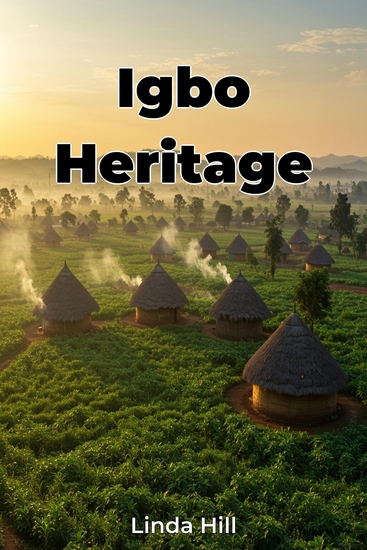
Igbo Heritage - cover

Igbo Heritage

Linda Hill

Übersetzer A AI

Verlag: Publifye

  • 0
  • 0
  • 0

Beschreibung

Igbo Heritage explores the rich and complex history of the Igbo people of Nigeria, offering a vital look into pre-colonial African societies. Challenging conventional narratives, the book reveals a sophisticated civilization characterized by decentralized governance, thriving trade networks, and profound cultural traditions. The Igbo people, through autonomous village communities and age-grade associations, fostered participatory decision-making, a model starkly different from centralized statehood. Readers will discover how Igbo trade networks spurred economic prosperity and cultural exchange, contributing significantly to Nigeria's diverse cultural landscape.

 
The book takes an interdisciplinary approach, synthesizing historical accounts, anthropological studies, archaeological findings, and oral traditions. It meticulously traces the origins and migrations of the Igbo people, delving into their unique political organization and economic practices. Igbo Heritage further examines Igbo culture, including religious beliefs, artistic expressions, and kinship systems. By focusing on the agency and resilience of the Igbo people, the book provides a nuanced understanding of their contributions to Nigerian society and their enduring legacy.

 
Beginning with the historical and geographical context of Igboland, the book progresses through examinations of Igbo political organization, economic life, and cultural practices. It culminates in an analysis of the impact of colonialism and the subsequent struggles for independence, demonstrating how pre-colonial structures shaped post-colonial experiences. This comprehensive approach makes Igbo Heritage a valuable resource for anyone interested in African history, Nigerian studies, and the cultural diversity of the world.
Verfügbar seit: 19.03.2025.
Drucklänge: 64 Seiten.
Weitere Bücher, die Sie mögen werden

  • The Fenway Effect - A Cultural History of the Boston Red Sox - cover

    The Fenway Effect - A Cultural...

    David Krell

    • 0
    • 0
    • 0
    To be a part of Red Sox Nation is to be a hopeful romantic who neither betrays loyalty nor surrenders hope in the direst of circumstances. From Bangor to Back Bay, New Englanders endure in baseball matters. And life. The team's history has intersected with the history of Boston and well beyond it, through the Curse of the Bambino, the military service of Ted Williams during World War II, and the Boston Marathon bombing. The Fenway Effect chronicles these stories and others that have built the incredible saga of the Boston Red Sox. 


    How did Cheers depict the passion of Boston's sports fans? Why is Narragansett beer so important to New England? What's the architectural impact of The Teammates—the statue of Bobby Doerr, Johnny Pesky, Ted Williams, and Dom DiMaggio outside Fenway Park? What did the Boston press really think about Red Sox owner Harry Frazee selling Babe Ruth to the Yankees? What was the origin of Fenway Park's predecessor—Huntington Avenue Grounds? 


    Even Yankees fans will tip their caps to the rich impact of the Red Sox on music, movies, branding, broadcasting, and more. Plus, there's a chapter focusing on the oral history of Red Sox fans, some of whom share here anecdotes that are funny, insightful, and heartwarming.
    Zum Buch
  • Death in Custody - How America Ignores the Truth and What We Can Do about It - cover

    Death in Custody - How America...

    PhD Jay D. Aronson, MD Roger A....

    • 0
    • 0
    • 0
    Deaths resulting from interactions with the US criminal legal system are a public health emergency, but the scope of this issue is intentionally ignored by the very systems that are supposed to be tracking these fatalities. In order to make a real difference and address this human rights problem, researchers and policy makers need reliable data. 


    In Death in Custody, Roger A. Mitchell Jr., MD, and Jay D. Aronson, PhD, share the stories of individuals who died in custody and chronicle the efforts of activists and journalists to uncover the true scope of deaths in custody. From Ida B. Wells's enumeration of extrajudicial lynchings more than a century ago to the Washington Post's current effort to count police shootings, the work of journalists and independent groups has always been more reliable than the state's official reports. 


    Mitchell and Aronson outline a practical, achievable system for accurately recording and investigating these deaths. They argue for a straightforward public health solution: adding a simple checkbox to the US Standard Death Certificate that would create an objective way of recording whether a death occurred in custody. These tangible solutions would allow us to see the full scope of the problem and give us the chance to truly address it.
    Zum Buch
  • Hannah on Hungerstrike - cover

    Hannah on Hungerstrike

    William T McCartney

    • 0
    • 0
    • 0
    This play is about Hanna Sheehy Skeffington on hunger strike in Mountjoy. She is joined by James Connolly in Mountjoy prison. In 1913 both were in Mountjoy prison and both went on hunger strike. The people are real and of great historical importance. The events are real. The dialogue is fictitious and is the author’s attempt to simulate the issues at that time. A degree of artistic nuance has been applied to the setting. The content therefore, while based on real events and people, is not a factual historical record but just the opinion of the author.
    Zum Buch
  • Hohokam Civilization - Desert Farmers and the Engineers of Ancient Arizona - cover

    Hohokam Civilization - Desert...

    Rolf Hedger

    • 0
    • 0
    • 0
    The Hohokam civilization, flourishing in the deserts of what is now southern Arizona, represents one of the most fascinating examples of ancient ingenuity in the American Southwest. Known for their advanced irrigation techniques, complex social structures, and distinctive artistic expressions, the Hohokam thrived in a harsh environment for over a thousand years. Their story provides valuable insight into human adaptability and innovation in response to challenging surroundings. 
    The origins of the Hohokam civilization are traced back to around 300 BCE, with their culture emerging as a distinct entity by approximately 600 CE. Archaeologists and researchers have found evidence of their presence in the Sonoran Desert, a region marked by intense heat and little rainfall. Despite these extreme conditions, the Hohokam were able to build thriving communities that relied heavily on farming, with maize, beans, and squash being staple crops. The Hohokam’s ability to create sustainable agricultural systems in the desert is considered one of their greatest achievements. 
    Central to the Hohokam way of life was their mastery of water management. They constructed a vast network of irrigation canals, some of which stretched for miles, to channel water from rivers into their fields. This water was crucial not only for agriculture but also for their communities' survival. The Hohokam’s innovative canal systems transformed the desert landscape, allowing them to cultivate the land and support large populations. These systems remain a testament to their engineering skills and ability to harness the natural environment for their benefit.
    Zum Buch
  • Handling Your Emotions - Emotional Intelligence as a Gift Being Your Best Self & the Power of Self Compassion - cover

    Handling Your Emotions -...

    E.J. Mattson

    • 0
    • 0
    • 0
    Handling our emotions often requires more than we can manage alone. Support and guidance are often missing. Here you will find an approach that teacher:How to recognize your emotions before they take overStrategies to maintain equilibriumSomatic awareness activitiesMindfulness exercises  
    This book is almost more than just a handbook of techniques. It explores:Mindset... and how to maximize yours!Emotional intelligence ... and its application!The science of emotionsAccessible review of the terms and concepts used when talking about emotional well-being 
    Here you have found a structured resource which provides:quick find advice on specific emotional experiencesin depth conversation on the science of emotionscoaching on how to maximize mindseta concrete guide to emotional intelligence
    Zum Buch
  • Infinite Fountain of Light An - Jonathan Edwards for the Twenty-First Century - cover

    Infinite Fountain of Light An -...

    George M. Marsden

    • 0
    • 0
    • 0
    For perspective on our own times and how we got here, it helps to listen to wise guides from other eras. In An Infinite Fountain of Light, the renowned American historian George Marsden illuminates the landscape with wisdom from one such mentor: Jonathan Edwards. Drawing on his deep expertise on Edwards and American culture, Marsden explains where Edwards stood within his historical context and sets forth key points of his complex thought. By also considering Benjamin Franklin and George Whitefield, two of Edwards's most influential contemporaries, Marsden unpacks the competing cultural and religious impulses that have shaped our times. In contrast, Edwards offered us an exhilarating view of the centrality of God's beauty and love. Christians' love for God, he taught, can be the guiding love of our lives, opening us to transformative joy and orienting all our lesser loves. There is an infinite fullness of all possible good in God, a fullness of every perfection, of all excellency and beauty, and of infinite happiness, wrote Edwards. This infinite fountain of light should, diffusing its excellent fullness, pour forth light all around. With Marsden's guidance, listeners will discover how Edwards's insights can renew our own vision of the divine, of creation, and of ourselves.
    Zum Buch