Rejoignez-nous pour un voyage dans le monde des livres!
Ajouter ce livre à l'électronique
Grey
Ecrivez un nouveau commentaire Default profile 50px
Grey
Abonnez-vous pour lire le livre complet ou lisez les premières pages gratuitement!
All characters reduced
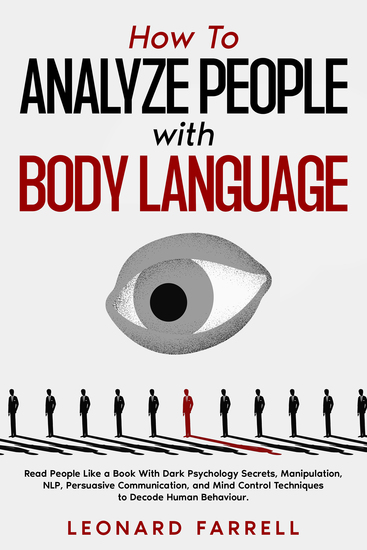
How To Analyze People with Body Language - Read People Like a Book With Dark Psychology Secrets Manipulation NLP Persuasive Communication and Mind Control Techniques to Decode Human Behaviour - cover

How To Analyze People with Body Language - Read People Like a Book With Dark Psychology Secrets Manipulation NLP Persuasive Communication and Mind Control Techniques to Decode Human Behaviour

Leonard Farrell

Maison d'édition: Publishdrive

  • 0
  • 0
  • 0

Synopsis

Become a Master of Human Psychology and Subliminal Manipulation with this Definitive Guide to Analyzing People!
 
If you want to master the art of reading people through their body language…
 
And if you want to protect yourself against manipulation and dark psychology…
 
Then look no further than “How To Analyze People with Body Language” by Leonard Farrell!
 
With practical tips that’s made for the real world, you will learn how to analyze people with ease and gain a deeper understanding of their true intentions.
 
Here’s what you’ll learn:
 
- Develop the skills to analyze people like a pro and understand their every move, thought, and feeling.
 
- Protect yourself against manipulation and dark psychology by recognizing the signs and learning how to respond appropriately.
 
- Unlock the secrets of persuasive communication and mind control techniques to influence others and get what you want.
 
- Develop a winning personality that will help you succeed in all aspects of life.
 
- Improve your public speaking skills and communicate effectively with anyone, anywhere.
 
And so much more!
 
Worried that learning how to analyze people and protecting yourself against manipulation might be unethical? Don’t fret!
 
This book provides you with the tools to read people effectively while also ensuring that you use this knowledge for good.
 
By learning how to analyze people you can understand them better and communicate more effectively, leading to stronger relationships and more positive outcomes.
 
Get your copy and start this journey in human behavior!
Disponible depuis: 26/08/2024.
Longueur d'impression: 135 pages.


D'autres livres qui pourraient vous intéresser

  • The Roman Emperor Aurelian - Restorer of the World: New Revised Edition - cover

    The Roman Emperor Aurelian -...

    John F. White

    • 0
    • 0
    • 0
    Aurelian saved the Roman Empire from foreign invasion and collapse, earning him the title Restorer of the World from a grateful Senate. This is his story as restorer of the world. 


    The ancient Sibylline prophecies had foretold that the Roman Empire would last for 1000 years. As the time for the expected dissolution approached in the middle of the third century AD, the empire was lapsing into chaos, with seemingly interminable civil wars over the imperial succession. The western empire had seceded under a rebel emperor and the eastern empire was controlled by another usurper. Barbarians took advantage of the anarchy to kill and plunder all over the provinces. Yet within the space of just five years, the general, later emperor Aurelian had expelled all the barbarians from with the Roman frontiers, reunited the entire empire and inaugurated major reforms of the currency, pagan religion, and civil administration. 


    His accomplishments have been hailed by classical scholars as those of a superman, yet Aurelian himself remains little known to a wider audience. His achievements enabled the Roman Empire to survive for another two centuries, ensuring a lasting legacy of Roman civilization for the successor European states. Without Aurelian, the Dark Ages would probably have lasted centuries longer. This is a new, revised edition.
    Voir livre
  • The Children's Train - Escape on the Kindertransport - cover

    The Children's Train - Escape on...

    Jana Zinser

    • 0
    • 0
    • 0
    This compelling Holocaust action adventure story tells of bravery, sacrifice, and the survival of the human spirit against Hitler and the horrors of war."Gripping and impossible to put down. I cried several times throughout. Perfect ending, emotional but complete." - Goodreads reviewIt begins in November 1938 on The Night of the Broken Glass, when Jewish people of Germany are terrified as Hitler's men shatter their store windows, steal and destroy their belongings, and arrest many Jewish fathers and brothers.Parents face unparalleled fear for their own lives but their focus is on protecting their beloved children.When England arranges to take the children out of Germany by train, the Kindertransport is organized and parents scramble to get places on the trains for their young family members, worried about what the future will hold.Soon, trains filled with Jewish children escaping the Nazis chug over the border into Holland, where they are ferried across the English Channel to England and to freedom. But for Peter, the shy violin player, his sister Becca, and his friends Stephen and Hans, life in England holds challenges as well. Peter's friend Eva, who did not get a seat on the Kindertransport, is left to the evil plans of Hitler.Peter, working his musician's hands raw at a farm in Coventry, wonders if they should have stayed and fought back instead of escaping. When the Coventry farm is bombed as the Nazis reach England, Peter feels he has nothing left. He decides it's time to stand and fight Hitler.Peter courageously returns to Germany to join the Jewish underground resistance, search desperately for his mother and sister he left behind in Berlin, and try to rescue his friend Eva."A beautifully written book. Sadly, the historical details are true and this makes the story all the more poignant. At times heartbreaking, at times hopeful and optimistic, this book will stay with the reader for a long time. The author is definitely one to watch" ~ Dorothy M Calderwood (Media Professional) for NetGalley". . . Jana Zinser brilliantly expresses the horror, confusion and fear that not only Peter but the other children in the novel are feeling and thinking when witnessing the atrocities by the Nazis . . When I began this book I thought that I had quite a lot of knowledge about the Holocaust but I was surprised to learn about the Kindertransport children. Although this novel is fiction, the Kindertransport was not and I will never forget about the ones that made it on those trains and also the ones who did not . . ." - Amanda - NetGalley and Goodreads reviews". . . The Children's Train by Jana Zinser absolutely blew me away! Heartbreaking, terrifying and traumatic it was also filled with hope and courage, determination and inspiration. Over six million Jews died at the hands of the Nazis and many of them were children. Though The Children's Train is fiction, the sad and tragic truth stands out and stays with you. I know this book will stay with me! The Children's Train is an absolute credit to this author and I have no hesitation in recommending it extremely highly. . . " - Brenda, Goodreads review"I'm positive that I held my breath for most of this book. I wouldn't be surprised if I'd held my breath for the entire time I'd been reading this. This book was so unlike any other I've read. It's gripping, powerful, heartbreaking and intense --- so, so, so intense . . . I honestly have no words right now; this book was amazing and thrilling, and so sad." - Leah, Goodreads review 
    Voir livre
  • Abraham Lincoln - His Life Death Morals Civil War and Assassination - cover

    Abraham Lincoln - His Life Death...

    Kelly Mass

    • 0
    • 0
    • 0
    From 1861 till his assassination in 1865, Abraham Lincoln was an American legal representative and statesman who functioned as the 16th president of the United States. Lincoln led the nation through the American Civil War, preserving the Union, eliminating slavery, enhancing the federal government, and helping the economy of the United States. 
    Lincoln grew up on the frontier, mainly in Indiana, and was born into poverty in a log cabin. He was self-taught and went on to end up being a legal representative, Whig Party leader, Illinois state lawmaker, and member of the U.S.A. Congress for Illinois. 
    In 1849, he resumed his law business, but was bothered by the Kansas-- Nebraska Act, which permitted farther terrain to be opened to slavery. In 1854, he went back to politics as a leader of the freshly formed Republican politician Party, and in 1858, he disputed Stephen Douglas in front of a nationwide audience. 
    Let’s learn more about this distinct, important, prominent figure in the United States’ history.
    Voir livre
  • The World War II History Journals:1945 - cover

    The World War II History...

    Liam Dale

    • 0
    • 0
    • 0
    Do you want to learn more about World War II, but don’t have time to read/listen to huge, long books? Then let The History Journals take you on an hourly history tour of each year of the war with The World War II History Journals series which includes one book per year from 1939 to 1945. 
     
    Throughout this series of journals released to acknowledge 80 years since the beginning of WW2, we will be looking at the seven years of that conflict on an annual basis. The conflict, the buildup to war, the major battles, the strategies and technological developments, the effect on civilians, and most importantly of all we’ll consider the role of the soldiers, sailors, and airmen who gave their lives fighting for the freedom of others. 
     
    Although the Allied nations faced the New Year of 1945 with a huge sense of hope, there was still a great deal of work to be done if world peace was to become a reality. Adolf Hitler and his Axis powers were finally facing defeat after seven years at war, but just like any wounded animal in the wild, they continued to pose a very real and dangerous threat. Follow us onward into the history of WW2 in 1945 – and the end of the war. 
     
    You will learn about: 
     
    A retreating Japan responds with Kamikaze pilots, Russian push to Warsaw 
    Hitler’s suicide 
    German army withdraws after Battle of the Bulge, American forces target Iwo Jima 
    The last rush for Berlin, VE Day, Truman authorizes nuclear bomb testing 
    Hiroshima, Nagasaki, America drops the atomic bomb, Japan surrenders, VJ Day 
     
    Be sure to read/listen to all the books in the series - one for each year through the end of the war in 1945!
    Voir livre
  • Wealth Supremacy - How the Extractive Economy and the Biased Rules of Capitalism Drive Today’s Crises - cover

    Wealth Supremacy - How the...

    Marjorie Kelly, Edgar Villanueva

    • 0
    • 0
    • 0
    This powerful analysis explains how the bias toward wealth that is woven into the very fabric of American capitalism is damaging people, the economy, and the planet and explores what the foundations of a new economy could be. 
     
    This bold manifesto exposes seven myths underlying wealth supremacy-the bias that institutionalizes infinite extraction of wealth by and for the wealthy and is the hidden force behind economic injustice, the climate crisis, and so many other problems of our day: 
     
    -	The Myth of Maximizing-No amount of wealth is ever enough. 
    -	The Myth of Fiduciary Duty-Corporate managers' most sacred duty is to expand capital. 
    -	The Myth of Corporate Governance-Corporate membership must be reserved for capital alone. 
    -	The Myth of the Income Statement-Income to capital must always be increased, while income to labor must always be decreased. 
    -	The Myth of Materiality-Profit-that is, material gain-alone is real, while social and environmental damages are not. 
    -	The Myth of Takings-The first duty of government must be the protection of private property. 
    -	The Myth of the Free Market-There should be no limits on the sphere of influence of corporations and capital. 
     
    Kelly argues instead for the democratization of ownership: public ownership of vital services, worker-owned businesses, and more. And she sketches the outlines of a nonextractive capitalism that would be subordinate to the public interest. This is an ambitious reimagining of the very foundations of our economy and society.
    Voir livre
  • Iron Brigade and Stonewall Brigade The: The History of the Civil War’s Most Famous Brigades - cover

    Iron Brigade and Stonewall...

    Editors Charles River

    • 0
    • 0
    • 0
    The Eastern Theater of the Civil War saw the bloodiest and most famous battles, as well as the biggest losses, giving the Iron Brigade a chance to demonstrate its mettle during legendary confrontations with Robert E. Lee’s Army of Northern Virginia, particularly at the battles of Second Bull Run, South Mountain, Antietam, and Gettysburg. In fact, the brigade suffered the highest percentage of casualties of any brigade in the Civil War, rendering it almost incapable of maintaining a fighting force by June 1864, during the middle of Ulysses S. Grant’s Overland Campaign. 
    General Thomas Jonathan Jackson and his brigade earned the nickname “Stonewall” at First Manassas by turning the tide of that battle, and they would become known as the legendary foot cavalry by bottling up 3 different Union armies in the Shenandoah Valley in 1862. Although Stonewall Jackson and the Stonewall Brigade may share the most famous nickname to come out of the Civil War, it’s still unclear whether Barnard Bee, the general who provided the legendary name at First Manassas, meant it as a complaint that they were not moving or as a compliment for standing resolute in the heat of battle. 
    Regardless, the Stonewall Brigade went on to fight in every major battle in the Eastern theater of the American Civil War, to the extent that of the 6,000 men who fought with the brigade over the course of four years, less than 200 remained by the time General Robert E. Lee surrendered at Appomattox Courthouse on April 9, 1865. They were organized, trained, and mentored by one of the most revered military leaders in American history, and they made a decisive impact on battles like First Manassas, the 1862 Valley Campaign, and Chancellorsville. The brigade was virtually a spent force by the end of the Battle of Spotsylvania Courthouse in May 1864, which took place nearly a year after Stonewall Jackson himself had been mortally wounded at Chancellorsville.
    Voir livre