Rejoignez-nous pour un voyage dans le monde des livres!
Ajouter ce livre à l'électronique
Grey
Ecrivez un nouveau commentaire Default profile 50px
Grey
Abonnez-vous pour lire le livre complet ou lisez les premières pages gratuitement!
All characters reduced
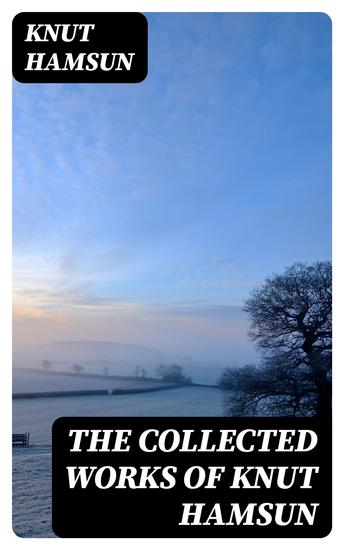
The Collected Works of Knut Hamsun - cover

The Collected Works of Knut Hamsun

Knut Hamsun

Traducteur George Egerton, William W. Worster, Paula Wiking

Maison d'édition: DigiCat

  • 0
  • 0
  • 0

Synopsis

Knut Hamsun's "The Collected Works of Knut Hamsun" is an extensive compilation showcasing the evolution of his writing style and thematic preoccupations. Characterized by psychological depth and a keen observation of human nature, Hamsun's works encompass a variety of genres, from novels and essays to poetry. This collection captures the essence of modernist literature, with its focus on individual consciousness and the existential struggles of humanity against the backdrop of a rapidly industrializing world. Hamsun's lyrical prose and stream-of-consciousness narrative ultimately serve as a poignant exploration of desire, alienation, and the complexities of existence. Born in 1859 in Norway, Knut Hamsun was a prolific writer and a key figure in the modernist movement. His early experiences in rural Norway and subsequent travels deeply influenced his literary voice, as he grappled with notions of nature, identity, and the human psyche. Hamsun received the Nobel Prize in Literature in 1920, solidifying his legacy as one of the most important writers of the 20th century. His controversial views and complex personal life also inform the themes of conflict and moral ambiguity in his writing. Readers seeking a profound examination of the human condition will find "The Collected Works of Knut Hamsun" to be an invaluable resource. This collection not only embodies Hamsun's artistic vision but also invites readers to engage with his insights into the very fabric of human existence. For those interested in modernist literature and psychological exploration, Hamsun's works remain a compelling and influential voyage into the heart of human experience.
Disponible depuis: 13/11/2022.
Longueur d'impression: 1729 pages.

D'autres livres qui pourraient vous intéresser

  • The Last September - cover

    The Last September

    Elizabeth Bowen

    • 0
    • 0
    • 0
    The Last September is set in Ireland during the Irish War of Independence in the early 1920s, a time of political turmoil and social change. The story focuses on the Fall of the Anglo-Irish aristocracy, symbolized through the life of 18-year-old Lois Farquar, who is living with her aunt and uncle at their country estate, Danielstown.
    
    Lois's coming-of-age is intertwined with the unraveling of the societal structures around her, as the tension between the Anglo-Irish gentry and the Irish nationalists intensifies. The novel explores themes of political conflict, personal disillusionment, and the complexities of love, loyalty, and identity. Lois is caught in a world of fading privileges, societal expectations, and uncertain allegiances, while also navigating her own desires, relationships, and the shifting nature of her identity.
    
    Through Bowen's rich, atmospheric prose, The Last September portrays the personal and cultural upheaval of the period, highlighting the impact of historical change on individual lives. The novel paints a vivid picture of a world in transition, as characters struggle with the forces of history, the loss of old certainties, and the inevitability of change.
    Voir livre
  • The Incredulity of Father Brown - cover

    The Incredulity of Father Brown

    G. K. Chesterton

    • 0
    • 0
    • 0
    In the third of his series of Father Brown short stories G.K Chesterton is almost reticent in putting his clerical detective at the forefront of the narrative. 
    In the majority of the tales the diminutive priest makes a somewhat unremarkable entrance as almost an afterthought; a seemingly inconsequential individual whom the colourful personalities that populate the stories might easily overlook. But the beauty of Chesterton’s creation is that Father Brown in his anonymity is precisely placed to observe and penetrate both the souls and minds of men.
    Voir livre
  • Gentle Breathing - From their pens to your ears genius in every story - cover

    Gentle Breathing - From their...

    Ivan Bunin

    • 0
    • 0
    • 0
    Ivan Alekseyevich Bunin was born on 22nd October 1870 in Voronezh province, in the South-West of the Russian Empire. 
    His early life was plagued by his Father’s gambling habits which caused his education to be erratic and the family to lose most of their wealth. 
    Bunin published his first poem in 1887 in St Petersburg and later in Oryol he worked for the local paper and became its editor, handily allowing him to publish his own poems and short stories.  There he met and married Varvara Pashchenko.  Ivan Bunin's debut book of poetry ‘Poems (1887–1891)’ was published in 1891. 
    This poetry and his translation of Longfellow garnered him his first Pushkin Prize.  Now he switched to writing prose and his novella ‘Antonov Apples’ is regarded as his first masterpiece.  Many more would follow. 
    The October Revolution of 1905 found Bunin in the Crimea.  Scenes of ‘class struggle’ he saw more as the oppressed people's craving for anarchy and destruction. 
    In November 1906 he began a passionate affair with Vera Muromtseva, within a few months they were touring through Egypt and Palestine.  ‘The Bird's Shadow’ collection was the result.   
    His second Pushkin Prize came in 1909 for Poems (1903–1906) and further translations.  He was now elected to the prestigious Russian Academy. 
    More widespread fame came in 1910 with ‘The Village’, a controversial and bleak portrayal of Russian country life.  Travel too beckoned them back to the Middle East, Ceylon (now Sri Lanka) and for winters in Capri with their friend Maxim Gorky.  
    That friendship suddenly ended in April 1917 as the revolution began to ferment in war-ravaged Russia.  After the Bolsheviks took power and the upheavals continued, he decided to leave Russia, finally achieving that in early 1920.  
    It would take some time to heal the wounds and stress he had been under and for his writing to begin again.  Settled in France, Bunin published many of his previous works and collections of novellas.  He also made regular contributions to the Russian emigre press.  
    Although reluctant to become involved in politics, Bunin was now feted as both a writer and the figurehead of non-Bolshevik Russian values and traditions.  In 1933 he became the first Russian to be awarded the Nobel Prize for Literature ‘for following through and developing with chastity and artfulness the traditions of Russian classic prose.’  
    In 1938 Bunin began working on the celebrated cycle of nostalgic, and erotically themed stories known Dark Avenues (or Dark Alleys).  
    As World War II broke out he chose to remain in Grasse spending the war at his remote Villa Jeanette, high in the mountains.  
    Ivan Bunin was a staunch anti-Nazi, and often, under difficult conditions, sheltered fugitives after Vichy was occupied by the Germans.  He wrote but did not publish during these years until on August 23rd the Nazi’s fled Grasse without a fight.  The next day the Americans came.  
    In May 1945 he returned to Paris and, apart from convalescing at times in Juan-les-Pins, he stayed for the rest of his life. 
    After 1948, with his health deteriorating, Bunin concentrated upon writing his memoirs and a book on Chekhov.  His last years were overshadowed by bitterness and despair at the situation in Russia and the treatment of its peoples.  He was suffering now from asthma, bronchitis and chronic pneumonia. 
    Ivan Alekseyevich Bunin died in a Paris attic flat on 8th November 1953.  Heart failure, cardiac asthma and pulmonary sclerosis were given as the causes of death.  He was 83.
    Voir livre
  • The Old Man and The Sea - cover

    The Old Man and The Sea

    Ernest Hemingway

    • 0
    • 0
    • 0
    The Old Man and the Sea is a 1952 novella by the American author Ernest Hemingway. Written between December 1950 and February 1951, it was the last major fictional work Hemingway published during his lifetime. It tells the story of Santiago, an aging fisherman, and his long struggle to catch a giant marlin. The novella was highly anticipated and was released to record sales; the initial critical reception was equally positive, but attitudes have varied significantly since then.
    Voir livre
  • Cousin Mary - From their pens to your ears genius in every story - cover

    Cousin Mary - From their pens to...

    Mary Russell Mitford

    • 0
    • 0
    • 0
    The bookshelves of British literature are incredible collections that have gathered together centuries of very talented authors.  From these Isles their fame spread and whilst among their number many are now forgotten or neglected their talents endure.  Among them is Mary Russell Mitford.
    Voir livre
  • Emma - Audiobook - cover

    Emma - Audiobook

    Jane Austen, Classic Audiobooks,...

    • 0
    • 0
    • 0
    In Emma, Jane Austen presents one of her most charming yet flawed heroines — Emma Woodhouse, a wealthy young woman with a passion for matchmaking and a tendency to meddle in others' lives. Believing herself to be an expert in love, Emma attempts to orchestrate romantic pairings among her friends, often with humorous and unintended consequences.As her plans unravel and her self-assuredness is challenged, Emma is forced to confront her own feelings, misjudgments, and personal growth. The novel is a delightful comedy of manners that explores themes of pride, class, and the complexities of human relationships, all with Austen's signature wit and insight.
    Voir livre