Join us on a literary world trip!
Add this book to bookshelf
Grey
Write a new comment Default profile 50px
Grey
Subscribe to read the full book or read the first pages for free!
All characters reduced
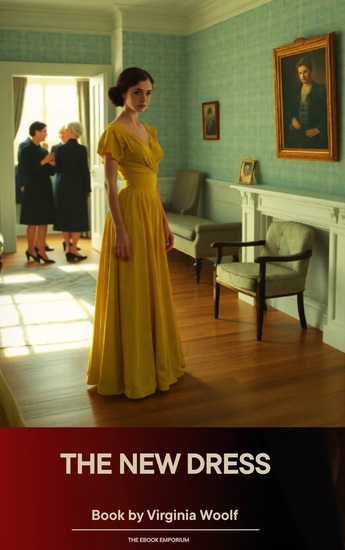
The New Dress - cover

The New Dress

Virginia Woolf

Publisher: The Ebook Emporium

  • 0
  • 0
  • 0

Summary

What happens when self-doubt overshadows a moment meant for joy?

First published in 1927, The New Dress by Virginia Woolf is a poignant modernist short story that explores the quiet anxieties of social life. Set during an evening party, the narrative follows Mabel Waring as she becomes painfully aware of her appearance, her dress, and her place among others.

Through Woolf's signature stream-of-consciousness style, the story captures the inner turmoil behind polite conversation, revealing how insecurity, comparison, and memory shape personal identity. What appears to be a simple social gathering becomes a powerful psychological portrait of self-consciousness and isolation.

This eBook presents the original text in a clear, accessible format, allowing readers to experience one of Woolf's most emotionally resonant short works.

Inside this eBook, you'll explore:

A subtle yet powerful study of insecurity and social anxiety

Woolf's modernist narrative technique

Themes of identity, class, and self-perception

A timeless reflection on inner life and social pressure

Often studied in literature courses and admired for its emotional honesty, The New Dress remains deeply relevant to anyone who has ever felt out of place.

Step into a moment where a dress reveals the human mind. Buy now and experience one of Virginia Woolf's most insightful short stories.
Available since: 01/21/2026.
Print length: 23 pages.

Other books that might interest you

  • Othello | Simple Shakespeare Series - The classic play adapted to modern language - cover

    Othello | Simple Shakespeare...

    Jeanette Vigon

    • 0
    • 0
    • 0
    In a world where Shakespeare's intricate tales are often perceived as inaccessible, Jeanette Vigon offers a refreshing gateway into the classic story of "Othello" with her rendition in the Simple Shakespeare series. This modern retelling not only breathes new life into the tragic story of love, jealousy, and betrayal but also makes it effortlessly comprehensible for today's readers. Vigon’s adaptation retains the essence and emotional depth of the original, while presenting it in a language that speaks directly to the contemporary audience. 
    Perfect for both new enthusiasts and seasoned Shakespeare lovers seeking a different perspective, this version of "Othello" unfolds the complex dynamics between the characters in a setting that resonates with the modern-day context. Through her adept storytelling, Vigon navigates the themes of trust, deception, and the tragic consequences of misinterpretations, making the tale as relevant today as it was in Shakespeare’s time. 
    This book is an essential addition to the collection of anyone looking to dive into the rich narrative of one of Shakespeare’s most compelling tragedies, without the barriers of archaic language. Whether you're a student grappling with Shakespeare for the first time or a teacher looking for accessible literature for your class, Jeanette Vigon’s "Othello" promises a compelling and thought-provoking read that bridges the gap between past and present. 
    Experience "Othello" anew in this captivating retelling, where ancient Venice's cobblestone streets meet the relatable dialogue of today. Discover the timeless story of Othello, Desdemona, and Iago, brought vividly to life through Vigon’s masterful storytelling. Immerse yourself in a tale where each sentence is a step closer to unravelling the fate of characters who’ve never felt more real.
    Show book
  • The Odd Women - cover

    The Odd Women

    George Gissing

    • 0
    • 0
    • 0
    Before he was 21 George Gissing conceived the ambition of writing a long series of novels, somewhat in the manner of Balzac, whom he admired. The first of these, Workers in the Dawn, appeared in 1880, to be followed by 21 others. Between 1886 and 1895 he published one or more novels every year. He also wrote Charles Dickens: A Critical Study (1898), a perceptive piece of literary criticism. 
     
    Gissing's work has a good deal of documentary interest for its detailed and accurate accounts of lower-middle-class London life. On the social position and psychology of women, he is particularly acute: The Odd Women is a powerful study of female frustration. He did not lack human sympathies, but his obvious contempt for so many of his characters reflects an artistic limitation. Gissing was deeply critical, in an almost wholly negative way, of contemporary society. Of his novels, New Grub Street, considered by some critics to be his only great book, is unique in its merciless analysis of the compromises required by the literary life. 
     
    Gissing's 1893 novel takes on the 19th century "Woman Question" by looking at themes of feminism, marriage, and love. The novel raises these issues through the lives of several contrasting women: Mary Barfoot, a feminist philanthropist who helps train women for careers; her close friend Rhoda Nunn, who believes marriage is a disastrous choice for women; and Monica Madden, who starts out as one of their protegees but chooses to marry a seemingly kind older man. As Monica experiences the challenges of married life, Rhoda finds herself drawn to Mary's cousin, the charming but apparently profligate Everard
    Show book
  • Evening Guest An - From their pens to your ears genius in every story - cover

    Evening Guest An - From their...

    Alexander Kuprin

    • 0
    • 0
    • 0
    Alexander Kuprin was born in Narovchat, Penza in Russia on 7th September 1870. 
    At 3 his Father died and he and mother moved to Moscow. By 10 he was enrolled at the Second Moscow Military High School and there his interest in literature began. The Alexander Military Academy followed and two years later he was a sub-lieutenant and posted to an Infantry Regiment for a further four years. 
    Despite his duties he was a now a keen writer and published his first short story at this time. His military duties also garnered him experiences for his breakthrough work ‘The Duel’.  Leaving the military he left for Kiev to work for local newspapers.  He continued to publish both stories and novels and by 1901 he was in St Petersburg becoming part of a group that included Chekhov, Ivan Bunin, Maxim Gorky and Leonid Andreyev.  
    In the years that followed further controversial works and acclaim followed.  His comments on the regime meant he was also put under secret police surveillance.   
    As World War I erupted, Kuprin opened a military hospital but was then given command of an infantry company in Finland. He was soon discharged on grounds of ill health.  
    The October Revolution saw him praise Lenin, but he warned that the Bolsheviks threatened Russian culture and might cause further widespread suffering to the peasants.  As Civil War raged he took his family to Helsinki and then on to Paris. 
    Exile saw his talents decline further and his succumbing to alcoholism. He became lonely and withdrawn. The family's poverty increased his malaise.   
    In May 1937, the Kuprin’s returned to Moscow.  He now saw his work published but wrote almost nothing new.  In 1938 his health rapidly deteriorated.  Already suffering from a kidney problems and sclerosis, he had now developed cancer of the oesophagus.  
    Alexander Kuprin died on 25th August 1938.
    Show book
  • A Cullenden of Virginia - From their pens to your ears genius in every story - cover

    A Cullenden of Virginia - From...

    Thomas Wolf

    • 0
    • 0
    • 0
    Thomas Clayton Wolfe was born at the family home, 92 Woodfin Street, in Asheville, North Carolina on October 3rd, 1900.  
    Aged 15, Wolfe began his studies at the University of North Carolina at Chapel Hill (UNC) where he enrolled in a playwriting course. Wolfe graduated in 1920 and enrolled at the Graduate School for Arts and Sciences at Harvard. Here he studied playwriting under the tutelage of George Pierce Baker. In 1922 he received his master's degree from Harvard.  
    Wolfe now began the transition from studying to commercial playwright. He went to New York in November, 1923 trying to sell his plays to Broadway.  The Theatre Guild came close to producing Welcome to Our City but in the end declined.  Wolfe now believed his style of writing was more suited to fiction.  Grasping the opportunity this afforded him he sailed to England in October 1924 to write and from there on to France, Italy and Switzerland. 
    In 1926 Wolfe began writing a novel, O Lost. This would eventually become Look Homeward, Angel. It was based on his years in Asheville. The original manuscript of O Lost was over 1100 pages. Maxwell Perkins, one of the great book editors of the age, worked at his publishers, Scribner’s and he began to focus the book, cutting and re-shaping it to center it on the character of Eugene.   
    The novel was published in 1929. It was a success.   
    Wolfe now committed the next 4 years to writing a multi-volume epic entitled The October Fair.  At Scribner’s Perkins once more decided to edit it down to a single volume; Of Time and the River.  It was even more successful than his first. It was hailed as the literary event of 1935 and cemented his reputation as one of America’s foremost novelists.  
    In 1938, after submitting his new opus, which ran to an incredible one million words, to his new editor, Edward Aswell, Wolfe left to tour the West, a part of the country he had never before visited. Whilst travelling Wolfe became ill with pneumonia and spent three weeks in a Seattle hospital. Complications arose. The prognosis was serious.  He was diagnosed with miliary tuberculosis of the brain. 
    On September 6th, he was sent to Baltimore's Johns Hopkins Hospital for treatment. The ensuing operation revealed that the disease had overrun the entire right side of his brain.  
    Thomas Clayton Wolfe never regained consciousness and died shortly before his 38th birthday on September 15th, 1938.
    Show book
  • Coriolanus - cover

    Coriolanus

    William Shakespeare

    • 0
    • 0
    • 0
    A classic performance of one of the Bard's classics. 
    Raised to the heights of power in recognition of his bravery against the Volscian army, Caius Marcius Coriolanus, finds himself betrayed by Brutus and Sicinius. Exiled from Rome and seeking vengeance, Coriolanus allies himself with the Aufidius, a general in the Volscian army. But, as Coriolanus discovers with tragic consequences, treachery begets treachery.
    Show book
  • Once - cover

    Once

    D H Lawrence

    • 0
    • 0
    • 0
    'Once' was written by D H Lawrence in 1912. The story is largely autobiographical, written when Lawrence and Frieda (Anita in the Story) had fled England together to live in Austria and Italy. Frieda had had an affair while they were in Austria and she told Lawrence about it. 'Once' explores Lawrence's reactions to being betrayed while still being in love and desiring the betrayer.
    Show book