Rejoignez-nous pour un voyage dans le monde des livres!
Ajouter ce livre à l'électronique
Grey
Ecrivez un nouveau commentaire Default profile 50px
Grey
Abonnez-vous pour lire le livre complet ou lisez les premières pages gratuitement!
All characters reduced
An Astonishment of Stars - Stories - cover

An Astonishment of Stars - Stories

Kirti Bhadresa

Maison d'édition: ECW Press

  • 0
  • 1
  • 0

Synopsis

A beautifully written short story collection that charts the lives of racialized women as they navigate their relationships, aspirations, and the burdens of memory and expectations
		 
“Sharply observed and gracefully told, this is a collection shining with all the unexpected delights and defeats that make up a life.” — Anuja Varghese, author of Chrysalis
		 
The wife who uses the name of her white husband in public. The mother who cleans the small-town hospital while her daughter moves to the city to forget their shared past. The well-behaved teen girl who anxiously watches her older sister slip further and further away from their hovering parents. Each of these characters is both familiar and singular, reminding us of women we have been, of our mothers and daughters, neighbors and adversaries.
		 
Kirti Bhadresa is a keen observer of humanity, especially of the BIPOC women whose domestic and professional work is the backbone of late-stage capitalism but whose lives receive so little attention in mainstream culture. An Astonishment of Stars is a collection that sees those who are unseen and cuts to the heart of contemporary womanhood, community collisions, and relationships both chosen and forced upon us.
Disponible depuis: 01/10/2024.
Longueur d'impression: 296 pages.
D'autres livres qui pourraient vous intéresser

  • I'm Sorry Here's a Plasma Rifle - A Collection of Short Stories Poems and Pastry Recipes - cover

    I'm Sorry Here's a Plasma Rifle...

    Aaron N. Hall

    • 0
    • 0
    • 0
    SENT BACK FROM THE YEAR 2124, I’m Sorry, Here’s a Plasma Rifle is the last known work of author Aaron N. Hall before his tragic jet ski accident with a shipping container of rubber ducks. 
    It contains seven short stories, eighteen poems, and four pastry recipes that highlight his affection for fantasy, science fiction, and the endearingly odd. 
    The current edition has been republished including the notes of Dr. Arthur B. Salazar, who sent the book from the future before being cryogenically frozen and launched into space prior to Earth’s decay. 
    Listen, enjoy, then say hello to the void.
    Voir livre
  • Gentle Breathing - From their pens to your ears genius in every story - cover

    Gentle Breathing - From their...

    Ivan Bunin

    • 0
    • 0
    • 0
    Ivan Alekseyevich Bunin was born on 22nd October 1870 in Voronezh province, in the South-West of the Russian Empire. 
    His early life was plagued by his Father’s gambling habits which caused his education to be erratic and the family to lose most of their wealth. 
    Bunin published his first poem in 1887 in St Petersburg and later in Oryol he worked for the local paper and became its editor, handily allowing him to publish his own poems and short stories.  There he met and married Varvara Pashchenko.  Ivan Bunin's debut book of poetry ‘Poems (1887–1891)’ was published in 1891. 
    This poetry and his translation of Longfellow garnered him his first Pushkin Prize.  Now he switched to writing prose and his novella ‘Antonov Apples’ is regarded as his first masterpiece.  Many more would follow. 
    The October Revolution of 1905 found Bunin in the Crimea.  Scenes of ‘class struggle’ he saw more as the oppressed people's craving for anarchy and destruction. 
    In November 1906 he began a passionate affair with Vera Muromtseva, within a few months they were touring through Egypt and Palestine.  ‘The Bird's Shadow’ collection was the result.   
    His second Pushkin Prize came in 1909 for Poems (1903–1906) and further translations.  He was now elected to the prestigious Russian Academy. 
    More widespread fame came in 1910 with ‘The Village’, a controversial and bleak portrayal of Russian country life.  Travel too beckoned them back to the Middle East, Ceylon (now Sri Lanka) and for winters in Capri with their friend Maxim Gorky.  
    That friendship suddenly ended in April 1917 as the revolution began to ferment in war-ravaged Russia.  After the Bolsheviks took power and the upheavals continued, he decided to leave Russia, finally achieving that in early 1920.  
    It would take some time to heal the wounds and stress he had been under and for his writing to begin again.  Settled in France, Bunin published many of his previous works and collections of novellas.  He also made regular contributions to the Russian emigre press.  
    Although reluctant to become involved in politics, Bunin was now feted as both a writer and the figurehead of non-Bolshevik Russian values and traditions.  In 1933 he became the first Russian to be awarded the Nobel Prize for Literature ‘for following through and developing with chastity and artfulness the traditions of Russian classic prose.’  
    In 1938 Bunin began working on the celebrated cycle of nostalgic, and erotically themed stories known Dark Avenues (or Dark Alleys).  
    As World War II broke out he chose to remain in Grasse spending the war at his remote Villa Jeanette, high in the mountains.  
    Ivan Bunin was a staunch anti-Nazi, and often, under difficult conditions, sheltered fugitives after Vichy was occupied by the Germans.  He wrote but did not publish during these years until on August 23rd the Nazi’s fled Grasse without a fight.  The next day the Americans came.  
    In May 1945 he returned to Paris and, apart from convalescing at times in Juan-les-Pins, he stayed for the rest of his life. 
    After 1948, with his health deteriorating, Bunin concentrated upon writing his memoirs and a book on Chekhov.  His last years were overshadowed by bitterness and despair at the situation in Russia and the treatment of its peoples.  He was suffering now from asthma, bronchitis and chronic pneumonia. 
    Ivan Alekseyevich Bunin died in a Paris attic flat on 8th November 1953.  Heart failure, cardiac asthma and pulmonary sclerosis were given as the causes of death.  He was 83.
    Voir livre
  • Dies Irae - From their pens to your ears genius in every story - cover

    Dies Irae - From their pens to...

    Kenneth Grahame

    • 0
    • 0
    • 0
    Kenneth Grahame was born on 8th March 1859 in Edinburgh. 
    At age 5 his mother succumbed to puerperal fever.  His father, who had a drinking problem, now sent his 4 children to live with their grandmother at her large house in Cookham, Berkshire. Here the children lived in large open grounds next to the river.  These early experiences would in later years, be retold in his writing through a myriad of characters. 
    Grahame loved being a pupil at St Edward's School, Oxford and wanted to enroll at the university there but his guardian demurred on account of the cost. 
    Instead, a banking career was chosen for him, starting in 1879 at the Bank of England, where he rose steadily to the rank of its Secretary until retiring, with a pension, in 1908 due to ill health. 
    Alongside his commercial career Grahame had written and published various stories and essays in several periodicals. Some were anthologized as ‘Pagan Papers’ in 1893, and two years later ‘The Golden Age’ and later still ‘Dream Days’ and its masterpiece ‘The Reluctant Dragon’ became part of many home libraries.  His ability to view life through the lens of a young and curious child was superb, enabling the reader to easily identify with the character.   
    Grahame married Elspeth Thomson in 1899 and they had one child; Alastair, born semi-blind and plagued by health problems.  In a heart-rending tragedy he would later take his own life whilst attending Oxford University in 1920.   
    In 1908 Grahame reworked many of the bedtime stories he had fashioned for his son into the enduring favourite; ‘The Wind in the Willows’, describing the heart-warming adventures of Mr Toad and his friends.   
    Kenneth Grahame died in Pangbourne, Berkshire, on 6th July 1932.
    Voir livre
  • Gooseberries - From their pens to your ears genius in every story - cover

    Gooseberries - From their pens...

    Anton Chekhov

    • 0
    • 0
    • 0
    Anton Pavlovich Chekhov was born on 29th January 1860 in Taganrog, on the south coast of Russia.  
    His family life was difficult; his father was strict and over-bearing but his mother was a passionate story-teller, a subject Chekhov warmed to. As he later said; ‘our talents we got from our father, but our soul from our mother’.  
    At school Chekhov was distinctly average. At 16 his father mis-managed his finances and was declared bankrupt. His family fled to Moscow. Chekhov remained and eked out a living by various means, including writing and selling short sketches to newspapers, to finish his schooling. That completed and with a scholarship to Moscow University obtained he rejoined his family. 
    He was able to help support them by selling satirical sketches and vignettes of Russian lifestyles and gradually obtained further commissions. In 1884, he qualified as a physician and, although it earned him little, he often treated the poor for free, he was fond of saying ‘Medicine is my lawful wife, and literature is my mistress.’ 
    His own health was now an issue as he began to cough up blood, a symptom of tuberculosis.  Despite this his writing success enabled him to move the family into more comfortable accommodation.  
    Chekhov wrote over 500 short stories which included many, many classics including ‘The Kiss’ and ‘The Lady with a Dog’.  His collection ‘At Dusk’ won him the coveted Pushkin Prize when was only 26.  
    He was also a major playwright beginning with the huge success of ‘Ivanov’ in 1887.   
    In 1892 Chekhov bought a country estate north of Moscow. Here his medical skills and money helped the peasants tackle outbreaks of cholera and bouts of famine. He also built three schools, a fire station and a clinic.  It left him with less time for writing but the interactions with real people gained him detailed knowledge about the peasantry and their living conditions for his stories.  
    His most famous work, ‘The Seagull’ was received disastrously at its premiere in St Petersburg. It was later restaged in Moscow to highlight its psychological aspects and was a huge success. It led to ‘Uncle Vanya’, ‘The Three Sisters’ and ‘The Cherry Orchard’.  
    Chekhov suffered a major lung hemorrhage in 1897 while visiting Moscow. A formal diagnosis confirmed tuberculosis and the doctors ordered changes to his lifestyle.  
    Despite a dread of weddings the elusive literary bachelor quietly married the actress Olga Knipper, whom he had met at rehearsals for ‘The Seagull’, on 25th May 1901. 
    By May 1904 with his tuberculosis worsening and death imminent he set off for the German town of Badenweiler writing cheerful, witty letters to his family and assuring them his health was improving.  
    On 15th July 1904 Anton Chekhov died at Badenweiler.  He was 44.
    Voir livre
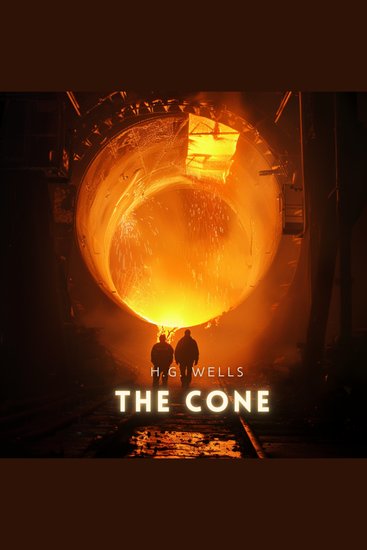
  • The Cone - cover

    The Cone

    H. G. Wells

    • 0
    • 0
    • 0
    In H.G. Wells' gripping tale "The Cone," a visceral story of revenge unfolds within the industrial setting of an ironworks. The narrative follows Horrocks, the ironworks manager, as he guides his friend Raut through the smoky, infernal landscape of his domain. Unbeknownst to Raut, Horrocks is aware of an affair between Raut and his wife. The tour takes a dark turn as Horrocks, fueled by betrayal and rage, leads Raut to the mouth of a gigantic smelting furnace—the cone. Wells masterfully builds tension, culminating in a shocking, tragic climax that explores themes of passion, jealousy, and the destructive power of human emotions.
    Voir livre
  • Dreadful Fancies - a steampunk-ish collection - cover

    Dreadful Fancies - a...

    Christine Morgan

    • 0
    • 0
    • 0
    Welcome to the world of yesteryear's world of tomorrow!  
     A world of inventions and intrigues, ingenious science and eldritch sorcery, mechanical marvels and magical mischief, daring exploration and dangerous adventure. A world powered by steam and teslic coils and etheric energies, where paranormalists ply their trade alongside constables and scholars and daffy dilettantes.  
    From the grim and gritty city to the bustling urban metrop ... from the hardscrabble life in the factories to the high society of lavish country estates ... from the airscrew-propelled platform of a flying industrial complex to the suboceanic travels of a nautilus expedition ...  
    Welcome to a darkly delightful tour of Dreadful Fancies.
    Voir livre