Begleiten Sie uns auf eine literarische Weltreise!
Buch zum Bücherregal hinzufügen
Grey
Einen neuen Kommentar schreiben Default profile 50px
Grey
Jetzt das ganze Buch im Abo oder die ersten Seiten gratis lesen!
All characters reduced
Oi You Lot - cover

Oi You Lot

Kareem Parkins-Brown

Verlag: Little Betty

  • 0
  • 0
  • 0

Beschreibung

'The sky belongs to everybody and everybody belongs to the sky.
When the genie comes out, wish for late busesand missed trains, and beers on benches,because when someone is gone, they are gone.'
Kareem Parkins-Brown's highly-anticipated pamphlet is an audacious and richly plural celebration of friends and selves, present and otherwise. In Parkins-Brown's hands, language bends like an illusionist's spoon – a dazzling, fisheye-lens distortion of daily grief, absurdity and communion – while reminding us always that the trick is to carry on living.
'Kareem Parkins-Brown's excellent pamphlet is like a funeral held in a bouncy castle: the line-breaks slip on their own tears, jumping mourners get bruised by their collisions and the laughing starts to sound a lot like crying.' Caroline Bird
'I have been waiting for this book for years. There's no voice like Kareem Parkin-Brown's. Sacred and profane, these are critical, kinetic poems for, and of, right now.' Rachel Long
'Kareem Parkins-Brown is one of the most beloved wordsmiths on the London poetry circuit. 'Oi You Lot' will show its readers why.' Raymond Antrobus
Verfügbar seit: 25.06.2024.
Drucklänge: 32 Seiten.
Weitere Bücher, die Sie mögen werden

  • Metamorphosis (NHB Modern Plays) - (stage version) - cover

    Metamorphosis (NHB Modern Plays)...

    Franz Kafka

    • 0
    • 0
    • 0
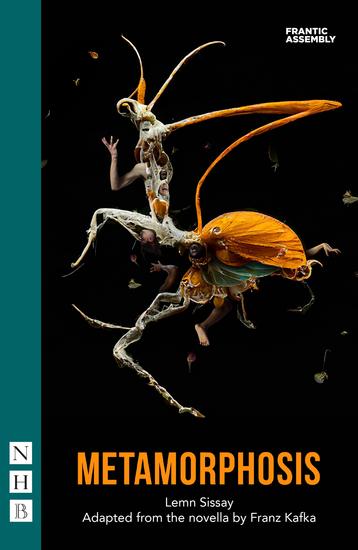
    Gregor Samsa wakes up each morning, quietly leaves the house to take the same train, and works to pay off the family debt.
    But that world explodes one morning, when Gregor awakes to find himself changed. To those around him he is dangerous, untouchable vermin. Worse than that, he is a burden.
    Metamorphosis, Franz Kafka's shocking tale of cruelty and kindness, has been a literary landmark since it was first published in 1915. Lemn Sissay's thrilling stage adaptation is a visceral and vital depiction of humans struggling within a system that crushes them under its heel. It was commissioned and first produced in 2023 by Frantic Assembly, in a co-production with Theatre Royal Plymouth, Curve, MAST Mayflower Studios, and Lyric Hammersmith Theatre, and was directed by Scott Graham.
    Zum Buch
  • The Ruins of Nostalgia - cover

    The Ruins of Nostalgia

    Donna Stonecipher

    • 0
    • 0
    • 0
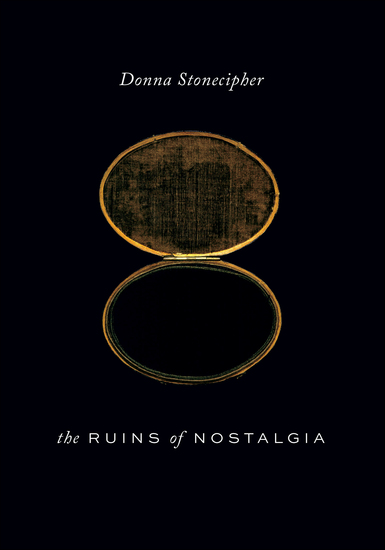
    What is it to feel nostalgia, to be skeptical of it yet cleave intently to the complex truths of feeling and thought? In a series of 64 gorgeous, ramifying, unsettling prose poems addressing late-twentieth- and twenty-first century experience and its discontents, The Ruins of Nostalgia offers a strikingly original exploration of the misunderstood phenomenon of nostalgia as both feeling-state and historical phenomenon. Each poem, also titled The Ruins of Nostalgia, is a kind of lyrical mini-essay, playful, passionate, analytic. Some poems take a location, memory, conceit, or object as their theme. Throughout the series, the poems recognize and celebrate the nostalgias they ironize, which are in turn celebrated and then ironized again. Written often in the fictional persona of the first-person plural, The Ruins of Nostalgia explores the rich territory where individual response meets a collective phenomenon.[sample poem]The Ruins of Nostalgia 13Where once there had been a low-end stationery store minded by an elderly beauty queen, there was now a store for high-end espresso machines minded by nobody. Where once there had been an illegal beer garden in a weedy lot, there was now a complex of luxury lofts with Parisian-style ivory façades. Where once there had been a bookstore and a bike shop and a bakery, there was now a wax museum for tourists. Where once there had been an empty lot there was now a building. Where once there had been an empty lot there was now a building. Where once there had been an empty lot there was now a building. Where once there had been an empty lot there was now a building. Where once there had been farms there were now subdivisions. Where once there had been subdivisions there were now sub-subdivisions. We lived in a sub-subdivision of a subdivision. We ourselves had become subdivided—where once we had merely been of two minds. * Where once there had been a river there was now a road. A vocal local group had started a movement to break up the road and "daylight" the river, which still flowed, in the dark, underneath the road. * Could we daylight the farms, the empty lots, the stationery store, the elderly beauty queen, the city we moved to? Was it still flowing somewhere, under the luxury lofts, deliquescing in the dark, inhabited by our luxury selves, not yet subdivided, because not yet whole? * Could we daylight the ruins of nostalgia?
    Zum Buch
  • Indexical Elegies - cover

    Indexical Elegies

    Jon Paul Fiorentino

    • 0
    • 0
    • 0
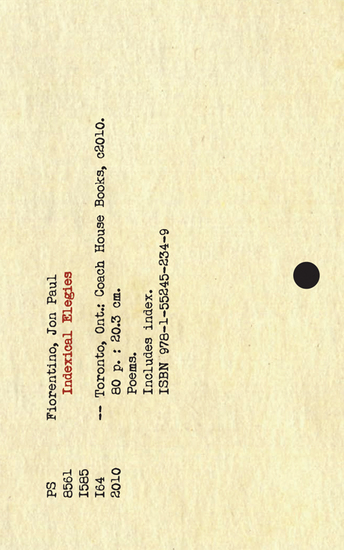
    Jon Paul Fiorentino's new collection is a whip-smart poetic investigation of anxiety in all its many manifestations. Anxiety caused by geography, anxieties of influence and looming worries about loss inform the poems as they weave narrative threads that highlight both the treachery of language and its necessity in shaping human experience.
       
    The poems here build on Derrida's ideas about the psychological implications of memory and the archival impulse and on philosopher Charles Sanders Peirce's semiotics of 'the index.' Indexical Elegies is a rich, emotionally charged work that showcases Fiorentino's talents at their feisty, engaged best. From its Post-Prairie pamphleteering and Montreal musings to its moving elegies, this is provocative poetry that never loses touch with the reader's pleasure.
      
       
    Praise for Fiorentino's The Theory of the Loser Class:
       
    'Fiorentino is smart and deft … By turns compassionate, funny and filled with self-loathing, The Theory of the Loser Class is never without the possibility of redemption.' – Globe and Mail
    Zum Buch
  • Harbinger - Poems - cover

    Harbinger - Poems

    Shelley Puhak

    • 0
    • 0
    • 0
     “The speaker in Shelley Puhak’s Harbinger is no closer to knowing herself than I am, than we are, which is why we trust her. Each similarly titled poem holds a triptych mirror up to the artist and, in so doing, up to us all, so we may better see ourselves as we are. In ever-changing form.” —Nicole Sealey  
    A stunning meditation on artistic creation and historical memory from the winner of the National Poetry Series, chosen by Nicole Sealey 
    From “Portrait of the artist, gaslit” to “Portrait of the artist’s ancestors” to “Portrait of the artist reading a newspaper,” the poems in Harbinger reflect the many facets of the artistic self as well as the myriad influences and experiences that contribute to that identity. 
    “Portrait of the artist as a young man” has long been the default position, but these poems carve out a different vantage point. Seen through the lens of motherhood, of working as a waitress, of watching election results come in, or of simply sitting in a waiting room, making art—and making an artist—is a process wherein historical events collide with lived experience, both deeply personal but also unfailingly political. When we make art, for what (and to whom) are we accountable? And what does art-making demand of us, especially as apocalypse looms? 
    With its surprising insights, Harbinger, the latest book from acclaimed poet Shelley Puhak, shows us the reality of the constantly evolving and unstable self, a portrait of the artist as fragmentary, impressionable, and always in flux. 
      
    Zum Buch
  • Naming the Trees - cover

    Naming the Trees

    Ness Owen

    • 0
    • 0
    • 0
    In this our imagined future we watch them sound the trees hoping for deadwood, knowing the living are always harder to cut.
    – Show Us What it is to Love a Forest with Song
    A deep-dive into the human relationship with trees and how trees have shaped folklore and literature. Sparked by a campaign to save the ancient forest of Penrhos, an SSSI on Ynys Môn, from being turned into a holiday camp, Ness explores Welsh folklore of trees and her own love for and engagement with the trees and other wild aspects of her home, as well as more common garden flowers, which should be treated with respect (Daffodils are Dangerous). Ness has an ongoing conversation with her native language and some poems are presented bilingually: there is a link to be made between the disregarding of native language and the disregarding of native habitat. Far more than a book of nature poems there is a simmering frustration at the casual way we despoil our environment without any concern for what is destroyed or the ongoing impact of that destruction.
    Zum Buch
  • Holy Sparks - Poems - cover

    Holy Sparks - Poems

    Diana Woodcock

    • 0
    • 0
    • 0
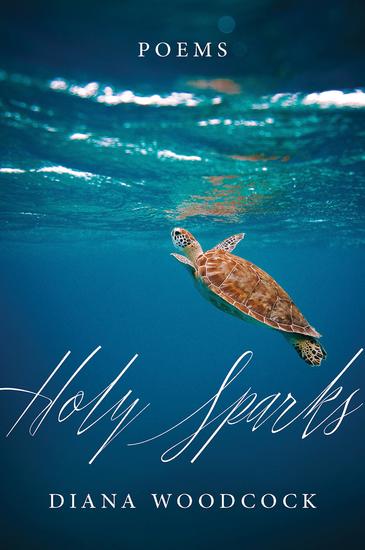
    Holy Sparks is a collection of poems grounded in a belief in the kinship between the cosmos and its Creator. Biophilic imagery is used throughout the poems to suggest that reverence for the earth is a natural consequence of reverence for God. The language of poetry is used to interconnect the human, natural and sacred, and to express humanity's moral and ethical responsibility to our nonhuman kin. These poems question what it means for humans to live in right relationship with earth's lifesystems, and they suggest that our very identity is tied to our reverence for the natural world. They offer a space of confession, reparation and praise of what remains. Holy Sparks is a call to partake of Earth's wisdom so that we might participate in the Creator's ongoing work.
    Zum Buch