Rejoignez-nous pour un voyage dans le monde des livres!
Ajouter ce livre à l'électronique
Grey
Ecrivez un nouveau commentaire Default profile 50px
Grey
Abonnez-vous pour lire le livre complet ou lisez les premières pages gratuitement!
All characters reduced
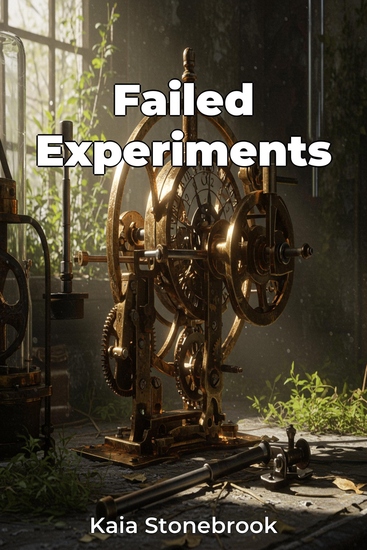
Failed Experiments - cover

Failed Experiments

Kaia Stonebrook

Traducteur A AI

Maison d'édition: Publifye

  • 0
  • 0
  • 0

Synopsis

Failed Experiments delves into the surprising history of science by examining experiments that went hilariously wrong. It reveals how flawed hypotheses and experimental errors, often driven by the zeitgeist of the time, paradoxically contributed to scientific progress. The book explores how even ludicrous attempts can reveal truths about the natural world, while also navigating the ethical considerations surrounding experiments involving humans and animals. The book argues that failure is not the opposite of success but a crucial component of it.

 
It starts by establishing the scientific method and experimental design principles, then thematically groups case studies, such as those fueled by superstition or those plagued by methodological flaws. By analyzing what went wrong, the book emphasizes the importance of embracing failures as learning opportunities. Readers will gain a deeper understanding of the scientific process and the iterative cycle of experimentation, observation, and revision.
Disponible depuis: 29/03/2025.
Longueur d'impression: 61 pages.


D'autres livres qui pourraient vous intéresser

  • Hubris - The Rise Fall and Future of Humanity - cover

    Hubris - The Rise Fall and...

    Thomas Trappe, Johannes Kruse

    • 0
    • 0
    • 0
    Humans are the most intelligent beings this planet has ever produced. But how is it that we find ourselves faced with an existential crisis that threatens to overwhelm us? 


    Leading archaeogeneticist Johannes Krause and journalist Thomas Trappe investigate what DNA can tell us about how we got where we are and what our future might be. They show how the first humans were defeated again and again and suffered fatal setbacks, and how Homo sapiens succeeded in conquering continents, overcoming natural borders, and bringing other species under its control. But the genetic blueprint that enabled us to get to the place where we are today had one flaw: it didn't factor in planetary boundaries. Now that we are approaching those boundaries for the first time after millions of years of evolution, an urgent question arises: can we learn to live within the planetary limits, or are we doomed by our DNA to continue to expand, consume, and absorb the resources around us to the point of exhaustion, consigning ourselves and other species to extinction? 


    While the looming climate crisis does not augur well for humanity's capacity to adapt to the new situation in which it finds itself, we are not at the mercy of our DNA—or at least we don't have to be. But can we harness the lessons of the past to survive the present?
    Voir livre
  • The mistery of Tesla and the pyramids - cover

    The mistery of Tesla and the...

    Patrizia Luraschi

    • 0
    • 0
    • 0
    The Egyptian pyramid is one of the most mysterious structures we have on Earth. Many times we will have wondered, seeing the pyramid of Khufu live or in the figure, how it could is been built, chi l'ha messa lì in quel luogo, e quando; ma soprattutto per quale ragione? Consisting of two million three hundred thousand stones, and weighing six millions tons, a mass of stones perfectly embedded like a laser, carried even from distant areas, and weighing eight tons each. When they were new, the pyramids could be compared to jewels, magnificent structures, which time has hardly scratched. But the most frequent question that comes to mind about them is: who built them? And were human beings able at that time to build something so huge and perfect? Or did they accept some outside help? And why was it so important to put them there? What was the purpose of putting them there? Now we will try to explain this great mystery, which shocked even Nicola Tesla, who was almost close to replicating them, creating free energy for the whol
    Voir livre
  • Vision Matters - Strategy for Managing Sudden Change - cover

    Vision Matters - Strategy for...

    Margaret Gilbert

    • 0
    • 0
    • 0
    The audio book provides a framework for managing ongoing and sudden change s it relates to vision loss and blindness.The book provides a focus on living  well, how to manage change of circumstances as well as to provide solutions around employment, accommodation, managing in the medical environment.The book outlines the necessary tools to manage independently or with family.
    Voir livre
  • Every Last Fish - A Deep Dive into Everything They Do for Us and We Do to Them - cover

    Every Last Fish - A Deep Dive...

    Rose George

    • 0
    • 0
    • 0
    Slippery, wet, and strange: Fish can be easier to think of as food than as fellow animals. But what do we know about these creatures we meet on our dinner table and how they got there? But with warming oceans, diminishing fish stocks, and questions about fish farming practices, where will the fish come from? 
     
    In Every Last Fish, Rose George dives into these questions by exploring the vast industries that support our appetite for fish sticks and salmon burgers, and the colossal illegal fishing trade whose practices and standards are unmonitored and often dangerous. Journeying to the bottom of the ocean and back, she examines the machinations of this $200 billion food system―one that's growing rapidly even as fish populations disappear. 
     
    Along the way, George introduces us to the people on the front lines of fishes and fishing: fishermen, divers, marine biologists, fish fryers, and fishwives. Her journey ends at the fish counter, with guidance for listeners looking to make better choices, both for the ocean's health and their own. 
     
    Ranging from Alaska to the United Kingdom to Senegal and beyond, Every Last Fish is an unforgettable trip through the ocean's inhabitants and workers.
    Voir livre
  • In the Herbarium - The Hidden World of Collecting and Preserving Plants - cover

    In the Herbarium - The Hidden...

    Maura C. Flannery

    • 0
    • 0
    • 0
    Collections of preserved plant specimens, known as herbaria, have existed for nearly five centuries. These pressed and labeled plants have been essential resources for scientists, allowing them to describe and differentiate species and to document and research plant changes and biodiversity over time—including changes related to climate. 


    Maura C. Flannery tells the history of herbaria, from the earliest collections belonging to such advocates of the technique as sixteenth-century botanist Luca Ghini, to the collections of poets, politicians, and painters, and to the digitization of these precious specimens today. She charts the growth of herbaria during the Age of Exploration, the development of classification systems to organize the collections, and herbaria's indispensable role in the tracking of climate change and molecular evolution. Herbaria also have historical, aesthetic, cultural, and ethnobotanical value—these preserved plants can be linked to the Indigenous peoples who used them, the collectors who sought them out, and the scientists who studied them. 


    This book testifies to the central role of herbaria in the history of plant study and to their continued value, not only to biologists but to entirely new users as well: gardeners, artists, students, and citizen-scientists.
    Voir livre
  • Anthropocene - A Very Short Introduction - cover

    Anthropocene - A Very Short...

    Erle C. Ellis

    • 0
    • 0
    • 0
    The proposal that the impact of humanity on the planet has left a distinct footprint, even on the scale of geological time, has recently gained much ground. Global climate change, shifting global cycles of the weather, widespread pollution, radioactive fallout, plastic accumulation, species invasions, the mass extinction of species—these are just some of the many indicators that we will leave a lasting record in rock, the scientific basis for recognizing new time intervals in Earth's history. The Anthropocene, as the proposed new epoch has been named, is regularly in the news. 


    Even with such robust evidence, the proposal to formally recognize our current time as the Anthropocene remains controversial both inside and outside the scholarly world. Instead, the Anthropocene has emerged as a powerful new narrative, a concept through which age-old questions about the meaning of nature and even the nature of humanity are being revisited and radically revised. 


    This Very Short Introduction explains the science behind the Anthropocene and the many proposals about when to mark its beginning: the nuclear tests of the 1950s? The beginnings of agriculture? The origins of humans as a species? The Anthropocene remains a work in progress. Is 
    this the story of an unprecedented planetary disaster? Or of newfound wisdom and redemption?
    Voir livre