Rejoignez-nous pour un voyage dans le monde des livres!
Ajouter ce livre à l'électronique
Grey
Ecrivez un nouveau commentaire Default profile 50px
Grey
Abonnez-vous pour lire le livre complet ou lisez les premières pages gratuitement!
All characters reduced
Towards Kilimanjaro: Carrying Parkinson’s in my backpack - cover

Nous sommes désolés! L'éditeur ou l'auteur a retiré ce livre de notre catalogue. Mais ne vous inquiétez pas, vous pouvez toujours choisir les livres que vous souhaitez parmi plus de 500 000 titres!

Towards Kilimanjaro: Carrying Parkinson’s in my backpack

Julio Rocha

Maison d'édition: Autografia

  • 0
  • 0
  • 0

Synopsis

In 2017, the author went on a 7-day trip to climb Mount Kilimanjaro, the highest mountain in Africa.  He had been diagnosed with Parkinson’s seven years before and wanted to tell how his life changed since then. He details the evolution of his condition, the treatments and his  limitations. He shows how his positive mindset pushed him forward to reach the present moment in good health and with an active working routine. He compares his case to his brother’s, who also had Parkinson’s but couldn’t handle the situation as good as he could. The book is illustrated with the pictures taken along the way and also presents a preface by his oldest son, who accompanied him along the trip.
Disponible depuis: 25/03/2022.


D'autres livres qui pourraient vous intéresser

  • Gravel Rides South West England - 24 gravel bike adventures in the West Country - cover

    Gravel Rides South West England...

    Katherine Moore

    • 0
    • 0
    • 0
    Gravel Rides South West England features 24 cycling routes, ranging from 16 to 180 kilometres, showcasing the extensive gravel trails of the West Country.
    Gravel enthusiast and experienced route creator Katherine Moore has taken her love of the South West and extensive local knowledge to put these routes together – each one is a delight and shows off the highlights of this diverse region of England. Ride mining trails and coastal gravel in Cornwall, remote trails on Dartmoor, a tour of Exmoor tea rooms in North Devon and Somerset, flint and chalk tracks on the Old Chalk Way in Dorset, fast-rolling gravel roads on Salisbury Plain in Wiltshire, and trails past the remains of old tramways and collieries in the Forest of Dean in Gloucestershire. The featured routes include both classic routes in well-known areas as well as some lesser-known gravel riding gems – there is something to discover for both new and experienced gravel cyclists.
    Each route includes all the information you need to help you plan your ride, interesting background information about the local area, types of terrain covered and refreshment recommendations in addition to detailed route descriptions, stunning photography and overview mapping. Downloadable GPX files of the routes are also available.
    This book is full of practical tips and advice on all aspects of gravel riding, including the bike itself, essential kit to carry when out on a ride, and bikepacking if you want to extend your adventures.
    Voir livre
  • The Greek War of Independence - Freedom from the Ottoman Yoke - cover

    The Greek War of Independence -...

    Nova Ashford

    • 0
    • 0
    • 0
    The Greek War of Independence, which began in 1821, was the culmination of centuries of subjugation under the Ottoman Empire. The Ottoman Turks had ruled over Greece since the fall of Constantinople in 1453, imposing their control over the Greek-speaking territories of the Eastern Mediterranean. While the Greeks endured under Ottoman rule for nearly four centuries, various socio-political, religious, and economic factors fostered the desire for independence. These factors would eventually fuel a revolution that would reshape Greece’s future and contribute to the broader wave of nationalistic movements across Europe in the 19th century. 
    The Ottoman Empire's control over Greece was characterized by a rigid hierarchical structure. While Greeks were allowed to practice their religion and maintain certain aspects of their culture, they were treated as second-class citizens, subject to high taxes and military conscription. This created deep resentment and a longing for autonomy. However, resistance to Ottoman rule was sporadic and often crushed by the overwhelming power of the Empire. The Greeks, scattered across various islands and mainland regions, lacked the unity needed to mount an effective challenge to Ottoman authority. 
    One of the key elements that ignited the desire for Greek independence was the rise of nationalist and revolutionary ideas in Europe during the late 18th and early 19th centuries. The French Revolution of 1789 had sparked waves of liberalism and nationalism across the continent, and these ideas reached Greece through intellectuals, students, and traders. The Enlightenment ideals of liberty, equality, and fraternity resonated with many Greeks, who saw them as a path toward the freedom they had been denied for centuries.
    Voir livre
  • South West Scotland - cover

    South West Scotland

    Tom Atkinson

    • 0
    • 0
    • 0
    The lovely land of hills, moors and beaches is bounded by the Atlantic and the Solway. Steeped in history and legend, still unspoiled, it is a land whose peace and grandeur are at least comparable to the Highlands, and yet it is hardly known. No area of Scotland better repays exploration than this.
    From the Auld Kirk of Alloway where tales of Tam O'Shanter resound, to the legends of St Ninian at one of Scotland's earliest Christian sites, Whithorn, this region is lovingly described by a local author, who will explore with you the splendour of Culzean Castle and delights of Wanlockhead, Scotland's highest village.
    Voir livre
  • Two Old Fools in Turmoil - Old Fools Book 5 - cover

    Two Old Fools in Turmoil - Old...

    Victoria Twead

    • 0
    • 0
    • 0
    When dark, sinister clouds loom, Victoria and Joe find themselves facing life-changing decisions. Happily, silver linings also abound in this, the fifth Old Fools chronicle. 
    A fresh new face joins the cast of familiar characters but the return of a bad penny may be more than some can handle. What does the future hold for the Spanish village of El Hoyo and the two old fools?
    Voir livre
  • The Cultural Revolution - China's Radical Change - cover

    The Cultural Revolution -...

    Nova Ashford

    • 0
    • 0
    • 0
    The Cultural Revolution, which took place in China from 1966 to 1976, was one of the most tumultuous and transformative periods in the country’s history. Initiated by Mao Zedong, the founding father of the People’s Republic of China, the movement sought to preserve Chinese communism by removing capitalist, traditional, and cultural elements from Chinese society. At its core, the Cultural Revolution aimed to enforce Maoist ideology, reaffirm his leadership, and transform the cultural, social, and political fabric of China. It was a radical attempt to reshape Chinese society by addressing perceived corruption and ideological impurity within the Communist Party and broader society. 
    Mao’s motivations for launching the Cultural Revolution were multifaceted. After the failure of the Great Leap Forward (1958-1962), which had resulted in widespread famine and economic chaos, Mao’s position within the Communist Party had been weakened. The Cultural Revolution provided Mao with an opportunity to reassert his control over the party and eliminate rivals, many of whom were seen as too moderate or resistant to his vision of a truly communist society. It also reflected Mao’s concern that China was veering away from the revolutionary ideals that had initially driven the Communist Party. 
    The movement was largely propelled by the Red Guards, a youth-based movement that encouraged the younger generation to challenge authority and remove perceived counter-revolutionary influences. Under the banner of Maoism, the Red Guards sought to destroy the "Four Olds"—old customs, old culture, old habits, and old ideas. This led to widespread destruction of cultural heritage, including temples, books, and artworks. Intellectuals, teachers, and perceived enemies of the revolution were subjected to violent persecution, public humiliation, and forced labor, with many being sent to the countryside for "re-education."
    Voir livre
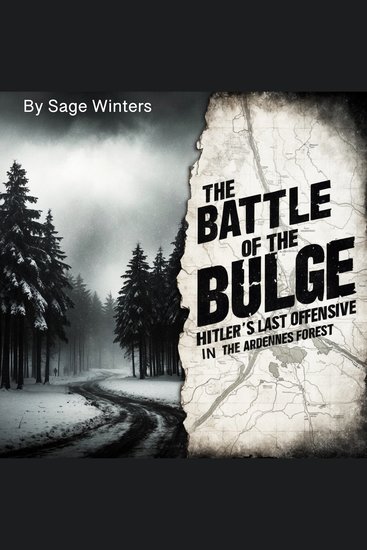
  • The Battle of the Bulge - Hitler's Last Offensive in the Ardennes Forest - cover

    The Battle of the Bulge -...

    Sage Winters

    • 0
    • 0
    • 0
    In the winter of 1944, as the Allies closed in on Nazi Germany from both the west and east, Adolf Hitler’s regime found itself increasingly cornered. Desperate to reverse the tide of the war, Hitler launched one last, audacious offensive: the Battle of the Bulge. Known as Germany’s last major push against the Allied forces, the battle took place in the dense forests of the Ardennes region in Belgium, Luxembourg, and France. This surprise attack, initiated on December 16, 1944, was meant to divide the Allied armies, capture vital port cities like Antwerp, and cripple the Allied war effort. In his final attempt to change the course of the war, Hitler gambled everything—hoping to break the deadlock and buy time for his collapsing forces. 
      
    The Battle of the Bulge was an enormous, high-stakes operation that relied on surprise, speed, and overwhelming force. The Ardennes was chosen not only for its strategic location but also because it was considered an unlikely place for a large-scale attack. The Allies, exhausted from months of fighting and underestimating the potential of a German counteroffensive, were caught off guard. The weather, heavy with snow and fog, further complicated the Allied defense and gave the Germans an initial advantage. Hitler believed that a swift, unexpected strike through the dense forests would disorient the Allies, creating confusion and panic, and ultimately forcing a favorable settlement. 
      
    However, this final gamble was doomed to fail. Despite the initial successes of the German forces, the battle’s outcome ultimately hinged on the determination of the Allied soldiers, the rapid mobilization of reinforcements, and the logistical prowess of the Allies.
    Voir livre