Begleiten Sie uns auf eine literarische Weltreise!
Buch zum Bücherregal hinzufügen
Grey
Einen neuen Kommentar schreiben Default profile 50px
Grey
Jetzt das ganze Buch im Abo oder die ersten Seiten gratis lesen!
All characters reduced
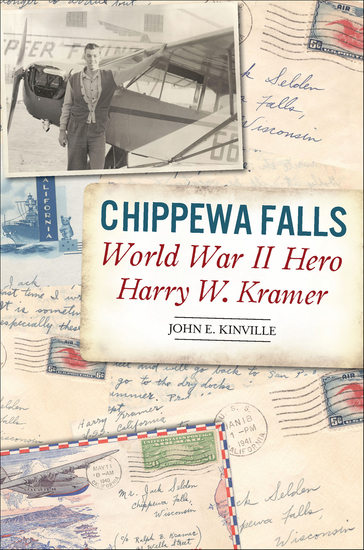
Chippewa Falls World War II Hero Harry W Kramer - cover

Chippewa Falls World War II Hero Harry W Kramer

John E. Kinville

Verlag: The History Press

  • 0
  • 0
  • 0

Beschreibung

Chippewa Falls' First World War II Casualty Young Harry Wellington Kramer was looking for adventure and a leg up in Depression-era Wisconsin. He found both aboard the Navy battleship USS California . Traveling across the western United States and the Pacific Ocean, Harry was quick to share his experiences with family and friends in Chippewa Falls. As he realized his dreams and served his country, his parents anxiously followed the developments that would lead to America's involvement in World War II. All of these events converged with the attack on Pearl Harbor, in which Harry was tragically killed fulfilling his duties. Though gone, Harry W. Kramer is not forgotten. Compiling thirty-three letters between Harry and home, local author and history teacher John E. Kinville tells the story of a life cut short but well lived.
Verfügbar seit: 10.04.2023.
Drucklänge: 210 Seiten.
Weitere Bücher, die Sie mögen werden

  • Proclaim Liberty Throughout All the Land - How Christianity Has Advanced Freedom and Equality for All Americans - cover

    Proclaim Liberty Throughout All...

    Mark David Hall

    • 0
    • 0
    • 0
    Proclaim Liberty Throughout All the Land demonstrates that Christianity is responsible for advancing liberty and equality for all Americans. 


    Scholars and popular authors regularly claim that Christianity, at least orthodox Christianity, has fostered oppression and intolerance. A common narrative is that liberty and equality have been advanced primarily when America's leaders embrace progressive manifestations of religion or reject faith altogether. 


    This book demonstrates that Christianity is responsible for advancing liberty and equality for all citizens. Throughout American history, Christians have been motivated by their faith to create fair and just institutions, fight for political freedom, oppose slavery, and secure religious liberty for all. 


    The New York Times's 1619 Project is only a recent and prominent manifestation of the tendency of journalists, academics, and popular writers to portray American Christianity as a force of oppression and intolerance. Without shying away from the ways in which the Christian faith has been used to defend and even encourage harmful practices, Proclaim Liberty Throughout All the Land shows that it has far more often been a force for good.
    Zum Buch
  • Who We Are Is Made - An Audio-Anthology - cover

    Who We Are Is Made - An...

    Nicole Combeau, Daniel Amador,...

    • 0
    • 0
    • 0
    Who We Are Is Made is an audio-anthology of South Florida writers and their roots, a collection of histories that came together through an open call for submissions, through workshops, through mentorships, and sometimes through phoning a friend. We set out to explore how much of us is actually the gift, legacy, the influence of those from other generations. How do they shape the language we use to describe the world around us? We carry histories across continents and cultivate them locally. We ferry recipes across the Americas and we share them with our neighbors, our friends. When we take a closer look at these things we carry, we start to see beyond the thing itself, to see it differently. These stories portray the complex and diverse makeup of Miami and South Florida, honoring the generations that shape who we are.
    Zum Buch
  • The Analects - cover

    The Analects

    Confucius

    • 0
    • 0
    • 0
    "The Analects," a collection of sayings and ideas attributed to Confucius, offers profound insights into ethics, leadership, and personal development. This timeless text emphasizes the importance of moral integrity, filial piety, and virtuous conduct in both individual and societal life. Through anecdotes and dialogues, it guides readers on a path toward wisdom, emphasizing the cultivation of character and the role of exemplary leadership in creating a harmonious society. "The Analects" serves as a foundational text of Confucian philosophy, providing enduring wisdom for ethical living and responsible governance. Read in English, unabridged.
    Zum Buch
  • Start of the Vietnam War The: The History and Legacy of the Events that Began America’s Most Controversial War - cover

    Start of the Vietnam War The:...

    Editors Charles River

    • 0
    • 0
    • 0
    The Vietnam War could have been called a comedy of errors if the consequences weren’t so deadly and tragic. In 1951, while war was raging in Korea, the United States began signing defense pacts with nations in the Pacific, intending to create alliances that would contain the spread of Communism. As the Korean War was winding down, America joined the Southeast Asia Treaty Organization, pledging to defend several nations in the region from Communist aggression. One of those nations was South Vietnam.  
    	Before the Vietnam War, most Americans would have been hard pressed to locate Vietnam on a map. South Vietnamese President Diệm’s regime was extremely unpopular, and war broke out between Communist North Vietnam and South Vietnam around the end of the 1950s. Kennedy’s administration tried to prop up the South Vietnamese with training and assistance, but the South Vietnamese military was feeble. A month before his death, Kennedy signed a presidential directive withdrawing 1,000 American personnel, and shortly after Kennedy’s assassination, new President Lyndon B. Johnson reversed course, instead opting to expand American assistance to South Vietnam. 
    	The post-analysis of war is a complicated and process that benefits from hindsight, and the involvement of the United States in Vietnam over about a decade was no exception. Never formally declared as a “war,” the Vietnam War was not fought in clean lines or with clear missions. Viewers of the evening news listening to the “box score” of killed and wounded each night had at best a hazy notion of what was happening a world away in Southeast Asia. If anything, their leaders were both attentive to reelection and on a certain level were themselves unsure of what was truly taking place. A military draft that sent over 50,000 American soldiers to their deaths was triggered by a resolution sought by President Lyndon B. Johnson in a decision to contain communism in a distant Asian land. 
    Zum Buch
  • Power Up - Leadership Character and Conflict Beyond the Superhero Multiverse - cover

    Power Up - Leadership Character...

    Steven Leonard, Jonathan Klug,...

    • 0
    • 0
    • 0
    "...offers an eclectic menu of treats that serve up a new and fresh look at a genre we rarely connect directly to the demands of the real world, much less plumb for key lessons about leadership." — ARMY Magazine
    
    In the past decade, heroes and villains spawned from the pages of comic books have upended popular culture and revolutionized the entertainment industry. The narratives weave together a multitude of complementary and sometimes competing storylines, spun across decades, generations, and mediums, forming a complex tapestry that simultaneously captures the imagination and captivates the mind. These stories reveal our own vulnerabilities while casting an ideal to which we aspire. They pull at our deepest emotions and push us to the cusp of reality, and bring us back to Earth with a renewed hope of a better tomorrow. They are an endless source of powerful metaphors to help us learn and develop, then be the best versions of ourselves possible.
    
    Through the lens of the superhero genre, each chapter explores contemporary challenges in leadership, team building, and conflict, while emphasizing the role of humanity and human nature in our own world.
    
    Contributors: Ian Boley, Jo Brick, Mitch Brian, Max Brooks, Mike Burke, Kelsey Cipolla, Amelia Cohen-Levy, Mick Cook, Jeff Drake, Clara Engle, Candice Frost, Ronald Granieri, PhD, Heather S, Gregg, PhD, James Groves, Geoff Harkness, PhD, Theresa Hitchens, Kayla Hodges, Cory Hollon, PhD, Joshua Huminski, Erica Iverson, Alyssa Jones, Mathew Klickstein, Jonathan Klug, Matt Lancaster, Steve Leonard, Karolyn McEwen, Eric Muirhead, Jon Niccum, Kera Rolsen, Mick Ryan, Julie Still, Patrick Sullivan, Aaron Rahsaan Thomas, Dan Ward, Janeen Webb, PhD.
    Zum Buch
  • If Thought Cannot Achieve Why Should It Suffer? - Brockwood Park and Gstaad 1975 - Dialogue 7 - cover

    If Thought Cannot Achieve Why...

    Jiddu Krishnamurti

    • 0
    • 0
    • 0
    If thought cannot achieve, why should it suffer? - 18 July 1975  
    • How does science investigate the mysterious? 
    • If thought cannot achieve, why should it suffer? 
    • Can consciousness, which is filled with the things of thought, empty itself? 
    • Thought cannot possibly apprehend, comprehend or be aware of the whole. • Time. 
    • Krishnamurti’s early years.
    Zum Buch