Begleiten Sie uns auf eine literarische Weltreise!
Buch zum Bücherregal hinzufügen
Grey
Einen neuen Kommentar schreiben Default profile 50px
Grey
Jetzt das ganze Buch im Abo oder die ersten Seiten gratis lesen!
All characters reduced
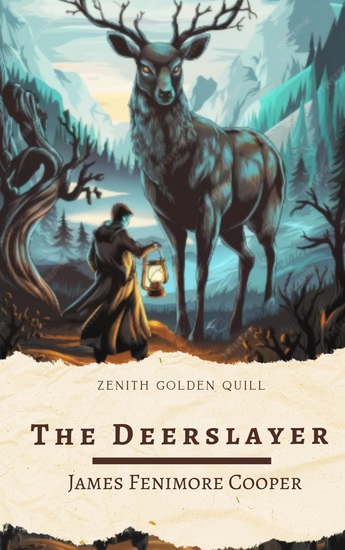
The Deerslayer - A Gripping Tale of Honor Wilderness and Native America - cover

The Deerslayer - A Gripping Tale of Honor Wilderness and Native America

James Fenimore Cooper, Zenith Golden Quill

Verlag: Zenith Golden Quill

  • 0
  • 0
  • 0

Beschreibung

Before Hawkeye, before the war—there was Deerslayer.

The Deerslayer is the stirring prequel to James Fenimore Cooper's The Last of the Mohicans, introducing Natty Bumppo, a young frontiersman destined to become one of literature's most iconic heroes. Set in the forests of pre-Revolutionary America, this classic follows Deerslayer's first journey into the wild, his confrontation with Native tribes, and his moral awakening in a land torn by conflict.

Filled with rich landscapes, philosophical depth, and thrilling action, this novel explores timeless themes of identity, cultural tension, and the cost of progress. Cooper's vision of early America is both a love letter to the wilderness and a critical look at frontier justice.

This illustrated edition includes historical notes and a foreword that contextualizes the novel for today's reader.

"A foundational American epic of wilderness and conscience." — Library Journal
"Cooper's most introspective and morally complex Leatherstocking tale." — The Boston Globe

Click Buy Now and begin the legendary journey of Natty Bumppo.
Verfügbar seit: 13.05.2025.
Drucklänge: 306 Seiten.

Weitere Bücher, die Sie mögen werden

  • Gentle Breathing - From their pens to your ears genius in every story - cover

    Gentle Breathing - From their...

    Ivan Bunin

    • 0
    • 0
    • 0
    Ivan Alekseyevich Bunin was born on 22nd October 1870 in Voronezh province, in the South-West of the Russian Empire. 
    His early life was plagued by his Father’s gambling habits which caused his education to be erratic and the family to lose most of their wealth. 
    Bunin published his first poem in 1887 in St Petersburg and later in Oryol he worked for the local paper and became its editor, handily allowing him to publish his own poems and short stories.  There he met and married Varvara Pashchenko.  Ivan Bunin's debut book of poetry ‘Poems (1887–1891)’ was published in 1891. 
    This poetry and his translation of Longfellow garnered him his first Pushkin Prize.  Now he switched to writing prose and his novella ‘Antonov Apples’ is regarded as his first masterpiece.  Many more would follow. 
    The October Revolution of 1905 found Bunin in the Crimea.  Scenes of ‘class struggle’ he saw more as the oppressed people's craving for anarchy and destruction. 
    In November 1906 he began a passionate affair with Vera Muromtseva, within a few months they were touring through Egypt and Palestine.  ‘The Bird's Shadow’ collection was the result.   
    His second Pushkin Prize came in 1909 for Poems (1903–1906) and further translations.  He was now elected to the prestigious Russian Academy. 
    More widespread fame came in 1910 with ‘The Village’, a controversial and bleak portrayal of Russian country life.  Travel too beckoned them back to the Middle East, Ceylon (now Sri Lanka) and for winters in Capri with their friend Maxim Gorky.  
    That friendship suddenly ended in April 1917 as the revolution began to ferment in war-ravaged Russia.  After the Bolsheviks took power and the upheavals continued, he decided to leave Russia, finally achieving that in early 1920.  
    It would take some time to heal the wounds and stress he had been under and for his writing to begin again.  Settled in France, Bunin published many of his previous works and collections of novellas.  He also made regular contributions to the Russian emigre press.  
    Although reluctant to become involved in politics, Bunin was now feted as both a writer and the figurehead of non-Bolshevik Russian values and traditions.  In 1933 he became the first Russian to be awarded the Nobel Prize for Literature ‘for following through and developing with chastity and artfulness the traditions of Russian classic prose.’  
    In 1938 Bunin began working on the celebrated cycle of nostalgic, and erotically themed stories known Dark Avenues (or Dark Alleys).  
    As World War II broke out he chose to remain in Grasse spending the war at his remote Villa Jeanette, high in the mountains.  
    Ivan Bunin was a staunch anti-Nazi, and often, under difficult conditions, sheltered fugitives after Vichy was occupied by the Germans.  He wrote but did not publish during these years until on August 23rd the Nazi’s fled Grasse without a fight.  The next day the Americans came.  
    In May 1945 he returned to Paris and, apart from convalescing at times in Juan-les-Pins, he stayed for the rest of his life. 
    After 1948, with his health deteriorating, Bunin concentrated upon writing his memoirs and a book on Chekhov.  His last years were overshadowed by bitterness and despair at the situation in Russia and the treatment of its peoples.  He was suffering now from asthma, bronchitis and chronic pneumonia. 
    Ivan Alekseyevich Bunin died in a Paris attic flat on 8th November 1953.  Heart failure, cardiac asthma and pulmonary sclerosis were given as the causes of death.  He was 83.
    Zum Buch
  • Lazarus - cover

    Lazarus

    Leonid Andreyev

    • 0
    • 0
    • 0
    "When Lazarus rose from the grave, after three days and nights in the mysterious thraldom of death, and returned alive to his home, it was a long time before anyone noticed the evil peculiarities in him that were later to make his very name terrible."    One of Andreyev's best-known short stories, "Lazarus" follows the Eastern Orthodox tradition that Lazarus never smiled again, and it explores what happened to the biblical figure after his resurrection from the dead. The unsettling coldness that exudes from the man who cheated death cannot be denied by anyone who meets him. As his notoriety increases, few can resist the chance of an audience with the man who has seen beyond the realms of life, but be they urchin or Emperor, none can stand to be in the presence of Lazarus for long.     "Lazarus", first published in Russian in 1906, deals with themes of faith, mortality and the human condition. This recording is based on a translation by Thomas Seltzer.
    Zum Buch
  • The Unpleasantness at the Bellona Club - cover

    The Unpleasantness at the...

    Dorothy L. Sayers

    • 0
    • 0
    • 0
    General Fentiman is found dead on the afternoon of November 11 in his armchair at the Bellona Club—just hours after the passing of his wealthy estranged sister. At ninety years old, his physician certifies death by natural causes. The important question, then, is not how he died, but when, as the answer determines the fate of an inheritance worth half a million pounds. If he died after his sister, her fortune stands to go to his grandsons, who are sorely in need of the funds. However, if his sister outlived him—even if only briefly—the money instead goes to his sister's companion, Ann Dorland. Fellow Bellona Club member and amateur sleuth Lord Peter Wimsey has to untangle a series of events to determine the general's precise time of death—and figure out if it was, in fact, a result of natural causes.
    Zum Buch
  • Mumu - cover

    Mumu

    Ivan Turgenev

    • 0
    • 0
    • 0
    "Mumu" is the psychological story of Ivan Turgenev about the deaf-mute janitor Gerasim, who, due to the whim of his lady, was forced to part with his beloved and drown his only friend - a dog. The author sympathizes with the simple and kind Gerasim, and his mistress portrays tough, cynical and capricious.
    Other famous works, such as "Asya", "Fathers and Sons", "Noble's Nest", "Biryuk", "Fire at Sea", "Inn", "Clock, belong to the author", "Three portraits", "Strange story", " Date", etc.
    Ivan Turgenev is an outstanding writer of the 19th century, a corresponding member of the Imperial Academy of Sciences in the category of the Russian language and literature, and the author of philosophical and psychological poems, short stories, short novels and novels.
    Zum Buch
  • The Hound of the Baskervilles - cover

    The Hound of the Baskervilles

    Arthur Conan Doyle

    • 0
    • 0
    • 0
    Step into the moody, mist-shrouded moors of Devonshire in The Hound of the Baskervilles, one of the most gripping and atmospheric tales of Sherlock Holmes and Dr. John Watson. When the Baskerville family is plagued by the legend of a spectral hound, Sherlock Holmes is called upon to uncover the truth behind the mysterious death of Sir Charles Baskerville.
     
    As Watson investigates the eerie moor and the people surrounding the Baskerville estate, he encounters shadowy figures, chilling clues, and the ominous howls of a beast that seems to haunt the night. Holmes, with his unmatched intellect and razor-sharp deductive skills, must unravel the threads of superstition and deceit to reveal the shocking truth.
     
    Packed with suspense, intrigue, and one of literature’s most iconic mysteries, The Hound of the Baskervilles is a masterclass in storytelling. Perfect for fans of detective fiction, gothic thrillers, and classic literature, this audiobook will keep you captivated from the first clue to the final revelation. Prepare to be enthralled by Holmes' genius as he faces one of his most menacing cases.
    Zum Buch
  • Les Misérables: Volume 4: The Idyll in the Rue Plumet and the Epic in the Rue St Denis - Book 13: Marius Enters the Shadow (Unabridged) - cover

    Les Misérables: Volume 4: The...

    Victor Hugo

    • 0
    • 0
    • 0
    Victor-Marie Hugo (26 February 1802 - 22 May 1885) was a French poet, novelist, essayist, playwright, and dramatist of the Romantic movement. During a literary career that spanned more than sixty years, he wrote abundantly in an exceptional variety of genres: lyrics, satires, epics, philosophical poems, epigrams, novels, history, critical essays, political speeches, funeral orations, diaries, and letters public and private, as well as dramas in verse and prose.
    BOOK 13: MARIUS ENTERS THE SHADOW: he voice which had summoned Marius through the twilight to the barricade of the Rue de la Chanvrerie, had produced on him the effect of the voice of destiny. He wished to die; the opportunity presented itself; he knocked at the door of the tomb, a hand in the darkness offered him the key.
    Zum Buch