Join us on a literary world trip!
Add this book to bookshelf
Grey
Write a new comment Default profile 50px
Grey
Subscribe to read the full book or read the first pages for free!
All characters reduced
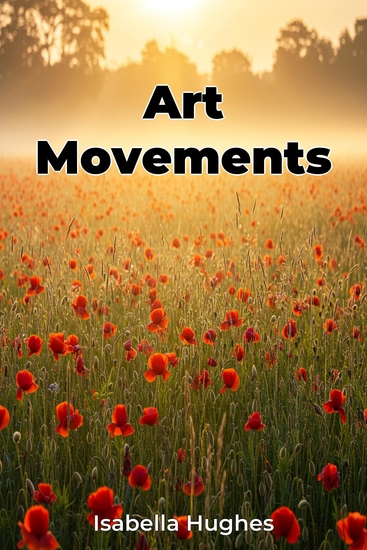
Art Movements - cover

Art Movements

Isabella Hughes

Translator A Ai

Publisher: Publifye

  • 0
  • 0
  • 0

Summary

Art Movements explores the transformative shifts in artistic expression from the mid-19th century to today, revealing how movements like Impressionism and Surrealism challenged established norms and reshaped our perception of art. The book argues that each movement mirrors its time, responding to technological advancements, political upheavals, and evolving social values. It offers a comprehensive historical, social, and theoretical context, tracing the origins and key figures of each movement. Understanding these movements is presented as essential for appreciating art history and contemporary artistic practices.

 
The book takes a chronological approach, dedicating individual chapters to key movements and examining their historical background, defining characteristics, and lasting impacts. For example, a simple sunrise inspired Impressionism, sparking a revolution and forever changing how we perceive art. It highlights the interconnectedness of art history by focusing on the dialogue between movements, revealing how each built upon or reacted against its predecessors. Art Movements progresses through time, ultimately discussing contemporary art and its relationship to the past.
Available since: 03/05/2025.
Print length: 65 pages.

Other books that might interest you

  • The Fallacies of Racism - Understanding How Common Perceptions Uphold White Supremacy 1st Edition - cover

    The Fallacies of Racism -...

    Jennifer Patrice Sims

    • 0
    • 0
    • 0
    Everyone has an opinion on racism. The vast majority of people would vehemently deny that they or those close to them are "racist," yet many of the most common understandings of racism are highly problematic. "If you mean no harm, then it can't be racist." Yes, it can. "There are anti-discrimination laws now, so racism no longer occurs." Incorrect. "Some of my best friends are Black, so I can't be racist." Not true. 


    In this sharp, open-minded, and witty book, sociologist Jennifer Patrice Sims succinctly addresses these problematic perceptions of racism as fallacies. Building on existing academic theories and drawing on her own cross-national research, two decades of teaching, and analyses of contemporary issues, she delves into the most common and insidious fallacies about racism. In revealing them to be rooted in what scholars call an "epistemology of ignorance," she shows how these perceptions justify and uphold white supremacy (inadvertently or otherwise). 


    Accessibly written and full of concrete examples, this book will be of great value to anyone who wants to understand the common misunderstandings about racism that frustrate contemporary politics, classrooms, workplaces, and dinner tables.
    Show book
  • American Revolution for Kids The: A Captivating Guide to the United States War of Independence - cover

    American Revolution for Kids...

    Captivating History

    • 0
    • 0
    • 0
    Did you know the American Revolution changed how Britain treated the rest of its colonies? 
    The American Revolution was fought between the Thirteen Colonies and the British Empire. Although most thought the British would win, the colonists overthrew British rule and established their own country. Other people realized the ideals of the American Revolution could be applied to their societies. They also wanted liberty and justice for all. 
    For years, scholars have studied individuals or specific events of the American Revolution. They focused on revolutionaries like Alexander Hamilton or events like the Battle of Lexington and Concord. But the American Revolution was more than just a few people and battles. It was filled with world-changing ideas. 
    It's time to step back into history and learn about the American Revolution. In this new and captivating book, you’ll discover what made the American Revolution so special and how it still influences us today. 
    Here are some of the questions you will uncover within the pages of this book:Was the Boston Tea Party really a party?How was Abigail Adams a revolutionary?Why did the first English colony vanish?Who started the Boston massacre?Why didn’t King George III want to let the American colonies go?Where was the Battle of Bunker Hill fought?How did the Sons of Liberty help the revolution?Was the revolution fought because of slavery?Why were the colonists so angry about taxes?When did the French join the revolution?Why did the colonists create the phrase “no taxation without representation?” 
    Scroll up and click the “add to cart” button to learn more about the history of the American Revolution!
    Show book
  • Analytic Idealism in a Nutshell - A straightforward summary of the 21st century's only plausible metaphysics - cover

    Analytic Idealism in a Nutshell...

    Bernardo Kastrup

    • 0
    • 0
    • 0
    As the failures of physicalism begin to shake the confidence of even the most biased of its supporters, a new view on the nature of reality is establishing itself as the only tenable alternative: Analytic Idealism. According to it, there is a world out there independent of our individual minds, but such world is—just like ourselves—also mental or experiential. While being a realist, naturalist, rationalist, and even reductionist view, Analytic Idealism flips our culture-bound intuitions on their head, revealing that only through understanding our own inner nature can we understand the nature of the world. This book embodies its author's years-long experience on how best to explain Analytic Idealism to someone who has never studied it before and has no background in the technical fields involved. It meets the listeners where they are, holding their hand as they are shown—through a series of evocative metaphors—how to see through their own unexamined assumptions, so to realize how the impossible dilemmas of physicalism disappear when nature is regarded from a slightly different slant. The conclusions have tremendous implications for our values and way of life, as well as our understanding of purpose, self, identity, and death.
    Show book
  • In My Humble Opinion: My So-Called Life - cover

    In My Humble Opinion: My...

    Soraya Roberts

    • 0
    • 0
    • 0
    A smart, engaging investigation of the show that brought real teens to TV My So-Called Life lasted only 19 episodes from 1994 to 1995, but in that time it earned many devoted viewers, including the showrunners who would usher in the teen TV boom of the late ’90s and the new millennium. With its focus on 15-year-old Angela Chase’s search for her identity, MSCL’s realistic representation of adolescence on TV was groundbreaking; without her there would be no Buffy or Felicity, Rory Gilmore or Veronica Mars. The series’ broadcast coincided with the arrival of third-wave feminism, the first feminist movement to make teen voices a priority, and Angela became their small-screen spokesperson. From her perspective, MSCL explored gender, identity, sexuality, race, class, body image, and other issues vital to the third wave (and the world). To this day, passionate fans dissect everything from what Rickie Vasquez did for gay representation to what Jordan Catalano did for leaning, and Soraya Roberts makes an invaluable contribution to that conversation with In My Humble Opinion.
    Show book
  • Zen at the End of Religion - An Introduction for the Curious the Skeptical and the Spiritual but Not Religious - cover

    Zen at the End of Religion - An...

    James Ishmael Ford

    • 0
    • 0
    • 0
    Zen as the ideal path for those who have left institutional religion behind 
     
    Do you feel there is something more to be found in life? Is there something more for your life? Traditionally people turn to religions to find that "more." 
     
    Today, when cultures are in upheaval and traditional religions are collapsing, a prominent Zen teacher explores the possibility of a spirituality at the heart of all religions. 
     
    Zen at the End of Religion is a brief introduction to Zen as a practical expression of perennial wisdom, a "naturalistic perennialism." 
     
    The book offers a simple introduction to the core of Zen's why and how. While Zen is a rich and varied tradition, this introduction focuses on the essentials, the foundations of the Zen way. This book explores the Four Noble Truths, the Two Truths, the Ten Ox Herding Pictures, Zen meditation, samadhi, koans, enlightenment, and more.
    Show book
  • Violence and the Sacred - cover

    Violence and the Sacred

    René Girard

    • 0
    • 0
    • 0
    Violence and the Sacred is René Girard's landmark study of human evil. Here Girard explores violence as it is represented and occurs throughout history, literature, and myth. Girard's forceful and thought-provoking analyses of Biblical narrative, Greek tragedy, and the lynchings and pogroms propagated by contemporary states illustrate his central argument that violence belongs to everyone and is at the heart of the sacred.
    Show book