
Rejoignez-nous pour un voyage dans le monde des livres!
Ajouter ce livre à l'électronique
Grey
Ecrivez un nouveau commentaire Default profile 50px
Grey
Abonnez-vous pour lire le livre complet ou lisez les premières pages gratuitement!
All characters reduced
Magic Systems - cover

Magic Systems

Hugo Raines

Traducteur A AI

Maison d'édition: Publifye

  • 0
  • 0
  • 0

Synopsis

Magic Systems explores the art of crafting compelling magic systems in fantasy fiction, arguing that a well-defined system is crucial for effective storytelling. 

 
The book emphasizes the importance of internal consistency, limitations, and logical implementation to create immersive worlds and compelling narratives. It examines how magic systems influence plot, character development, and world-building, highlighting that the most successful systems seamlessly integrate into the narrative. 

 
For instance, the book shows how carefully considered magic mechanics can drive character motivations and reflect the values of the fictional world. The book progresses step-by-step, introducing core principles like hard and soft magic while exploring how to define limits, costs, and consistent mechanics. 

 
It uses examples from fantasy literature, game design, linguistics, and cognitive science to provide a nuanced perspective on magic system design. One interesting fact is that consistent magic systems contribute to a reader's suspension of disbelief. 

 
The book offers practical strategies and exercises for writers and game designers to create their own systems enhancing the believability and narrative power of their stories.
Disponible depuis: 05/05/2025.
Longueur d'impression: 83 pages.

D'autres livres qui pourraient vous intéresser

  • Instructions to His Generals - The Military Philosophy of Frederick the Great - cover

    Instructions to His Generals -...

    Frederick the Great, Tim Zengerink

    • 0
    • 0
    • 0
    What if you could master the art of leadership, inspire loyalty, and achieve victory through strategy and discipline? 
    Instructions to His Generals: The Military Philosophy of Frederick the Great presents the timeless wisdom of one of history’s greatest military leaders, thoughtfully adapted for today’s listeners. 
    Frederick the Great, King of Prussia, distilled his strategies and leadership principles into concise instructions for his generals. His insights provide a practical roadmap for military success, effective leadership, and strategic thinking. Beyond the battlefield, these principles offer profound lessons for modern leaders, strategists, and anyone seeking success through preparation and discipline. 
    This isn’t just a military text—it’s a guide to mastering leadership, building confidence, and achieving success in the face of challenges. 
    What You’ll Discover: 
    - Strategic Leadership: Inspire loyalty, build disciplined teams, and lead decisively with preparation and adaptability. 
    - The Art of Strategy: Gain insights into planning, executing campaigns, and succeeding through calculated decisions. 
    - Discipline and Adaptability: Embrace preparation, resilience, and flexibility to overcome obstacles. 
    - Clear, Accessible Language: Frederick’s timeless instructions are presented in a modernized format for today’s leaders. 
    Frederick the Great’s Instructions offers a masterclass in leadership, strategy, and discipline. His principles continue to inspire leaders and professionals striving to succeed in a competitive world. 
    Imagine having the tools to lead decisively, adapt to challenges, and inspire confidence in those you lead. 
    Download your copy today and transform your approach to leadership with Frederick the Great’s timeless wisdom.
    Voir livre
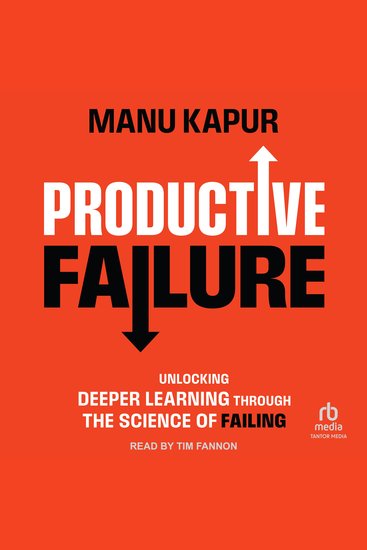
  • Productive Failure - Unlocking Deeper Learning Through the Science of Failing - cover

    Productive Failure - Unlocking...

    Manu Kapur

    • 0
    • 0
    • 0
    Productive Failure shows you how to design the experience of failing. Research shows that repeated experiences of intriguing, constructive failure can help students develop creativity and learn more deeply. When carefully curated, failure can become a signal for learning, not the noise detracting from it. Learners gain a lifelong readiness to push themselves outside of their comfort zones, using setbacks as launchpads. 


    The principles in this book are powerful for anyone taking charge of and designing their own lifelong learning. This book unpacks the science of Productive Failure and describes design principles that let you harness Productive Failure for your own benefit. 


    ● Learn and understand the science of failure 


    ● Apply the research-based Productive Failure framework in classrooms, teams, groups, and organizational settings 


    ● Learn techniques to deepen learning experiences 


    ● Reach new levels of critical thinking, innovation, and success by making failure the norm and learning how to cope with it 


    This fascinating and actionable book is a must for educators, parents, managers, leaders, and anyone who needs to help others (or themselves) learn how to learn.
    Voir livre
  • We Were Perfect Parents Until We Had Children - 60 000 Village Families Share Their Wisdom - cover

    We Were Perfect Parents Until We...

    Karin Schimke, Vanessa Raphaely

    • 0
    • 0
    • 0
    'I straighten her little tiara every morning – I lift her chin and remind her that she is meant for greater things than playground bullies.'
    
    'Everything shines in its own time. There is no timetable for life. Timetables are for classrooms, not for people.'
    These are just some of the wisdoms shared on The Village, South Africa's beloved Facebook group for parents raising tweens, teens and young adults.
    Having kids is a baffling endeavour beset with sulk, meltdowns, anxiety and disappointment – and that's just the parents! When you get that call to the principal's office? When the school acceptances don't come? When the bedroom door slams and you hear your child sobbing behind it? All awful but it's also a precious time.
    The trick? To find a way to enjoy our families, love our children and believe in them and ourselves despite the daily challenges. And laugh . . .
    In this book, Vanessa Raphaely and Karin Schimke have gathered together life lessons and insights from The Village members. It contains the gems and remedies from the real parenting experts – the parents – to help you raise your family in your own perfectly imperfect way.
    Voir livre
  • How to Make Money - An Ancient Guide to Wealth Management (series: Ancient Wisdom for Modern Readers) - cover

    How to Make Money - An Ancient...

    PLINY

    • 0
    • 0
    • 0
    Ancient Romans liked money. But how did they make a living and sometimes even become rich? The Roman economy was dominated by agriculture, but it was surprisingly modern in many ways: the Romans had companies with CEOs, shareholders, and detailed contracts regulated by meticulous laws; systems of banking and taxation; and a wide range of occupations, from merchant and doctor to architect and teacher. The Romans also enjoyed a relatively open society, where some could start from the bottom, work, invest, and grow rich. How to Make Money gathers a wide variety of ancient writings that show how Romans thought about, made, invested, spent, lost, and gave away money. 


    The Roman elite idealized farming and service to the state but treated many other occupations with suspicion or contempt, from money lending to wage labor. But whatever their attitudes, pecunia made the Roman world go round. In the Satyricon, Trimalchio brags about his wealth. Seneca accumulated a fortune—but taught that money can't buy happiness. Eumachia inherited a brick factory from her father, married well, and turned to philanthropy after she was widowed. How to Make Money also takes up some of the most troubling aspects of the Roman economy, slavery and prostitution, which the elite deemed unrespectable but often profited from.
    Voir livre
  • Red List - MI5 and British Intellectuals in the Twentieth Century - cover

    Red List - MI5 and British...

    David Caute

    • 0
    • 0
    • 0
    A gripping history of the Security Service and its covert surveillance on British writers and intellectuals in the twentieth century 
    In the popular imagination, MI5—or the Security Service—is know chiefly as the branch of the British state responsible for chasing down those who pose a threat to the country’s national security, from Nazi fifth columnists during the Second World War to Soviet spies during the Cold War and today’s domestic extremists. Yet, aided by the release of official documents to the National Archives, David Caute argues in this radical and revelatory history of the Security Service that suspicion often fell on those who posed no threat to national security. Instead, this “other history” of MI5, ignored in official accounts, was often fueled by the political prejudices of MI5’s personnel and involved a huge program of surveillance against anyone who dared question the status quo. 
    Caute, a prominent historian and expert on the history of the Cold War, tells the story of the massive state operation to track the activities of a range of journalists, academics, scientists, filmmakers, writers, and others who, during the twentieth century, the Security Service perceived as a threat to the national interest. Those who were tracked include such prominent figures as Kingsley Amis, George Orwell, Doris Lessing, John Berger, Benjamin Britten, Eric Hobsbawm, Michael Foot, Harriet Harman, and others.
    Voir livre
  • Death Glitch - How Techno-Solutionism Fails Us in This Life and Beyond - cover

    Death Glitch - How...

    Tamara Kneese

    • 0
    • 0
    • 0
    An accessible yet erudite deep dive into how platforms are remaking experiences of death 


    Since the internet's earliest days, people have died and mourned online. In quiet corners of past iterations of the web, the dead linger. But attempts at preserving the data of the dead are often ill-fated, for websites and devices decay and die, just as people do. Death disrupts technologists' plans for platforms. It reveals how digital production is always collaborative, undermining the entrepreneurial platform economy and highlighting the flaws of techno-solutionism. 


    Big Tech has authority not only over people's lives but over their experiences of death as well. Ordinary users and workers, though, advocate for changes to tech companies' policies around death. Drawing on internet histories along with interviews with founders of digital afterlife startups, caretakers of illness blogs, and transhumanist tinkerers, the technology scholar Tamara Kneese takes listeners on a vibrant tour of the ways that platforms and people work together to care for digital remains. What happens when commercial platforms encounter the messiness of mortality?
    Voir livre