Begleiten Sie uns auf eine literarische Weltreise!
Buch zum Bücherregal hinzufügen
Grey
Einen neuen Kommentar schreiben Default profile 50px
Grey
Jetzt das ganze Buch im Abo oder die ersten Seiten gratis lesen!
All characters reduced
Excursions (Annotated) - cover

Excursions (Annotated)

Henry David Thoreau

Verlag: ePembaBooks

  • 0
  • 0
  • 0

Beschreibung

This edition includes the following editor's analysis: Henry David Thoreau, the indomitable environmentalist


Originally published in 1863, "Excursions" is an anthology of several essays by American transcendentalist and environmentalist Henry David Thoreau. These essays represent Thoreau in many stages of his writing career, ranging from 1842 to 1862.
The anthology was published posthumously and contains an introduction entitled "Biographical Sketch" in which fellow transcendentalist Ralph Waldo Emerson provides a description of Thoreau.

The collection, other than R. W. Emerson's biography of Thoreau, contains nine of Thoreau’s most engaging and popular essays: Natural History of Massachusetts, A Walk to Wachusett, The Landlord, A Winter Walk, The Succession of Forest Trees, Walking, Autumnal Tints, Wild Apples, and Night and Moonlight.
Verfügbar seit: 25.06.2022.

Weitere Bücher, die Sie mögen werden

  • The Flag Cross and the Station Wagon - A Graying American Looks Back at His Suburban Boyhood and Wonders What the Hell Happened - cover

    The Flag Cross and the Station...

    Bill McKibben

    • 0
    • 0
    • 0
    "Narrator Eric Jason Martin adds gusto to this mini-memoir, which spans much of author Bill McKibben's lifetime."-AudioFile on The Flag, the Cross, and the Station Wagon Bill McKibben—award-winning author, activist, educator—is fiercely curious. “I’m curious about what went so suddenly sour with American patriotism, American faith, and American prosperity.”Like so many of us, McKibben grew up believing—knowing—that the United States was the greatest country on earth. As a teenager, he cheerfully led American Revolution tours in Lexington, Massachusetts. He sang “Kumbaya” at church. And with the remarkable rise of suburbia, he assumed that all Americans would share in the wealth.But fifty years later, he finds himself in an increasingly doubtful nation strained by bleak racial and economic inequality, on a planet whose future is in peril.And he is curious: What the hell happened?In this revelatory cri de coeur, McKibben digs deep into our history (and his own well-meaning but not all-seeing past) and into the latest scholarship on race and inequality in America, on the rise of the religious right, and on our environmental crisis to explain how we got to this point. He finds that he is not without hope. And he wonders if any of that trinity of his youth—The Flag, the Cross, and the Station Wagon—could, or should, be reclaimed in the fight for a fairer future.A Macmillan Audio production from Henry Holt and Co.
    Zum Buch
  • Malayan Campaign - A History from Beginning to End - cover

    Malayan Campaign - A History...

    Hourly History

    • 0
    • 0
    • 0
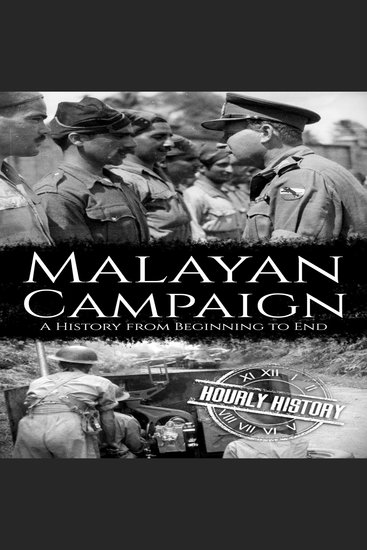
    Discover the remarkable history of the Malayan Campaign...Prior to December 1941, Great Britain commanded an empire that stretched across the globe. However, after the Malayan Campaign, which began on December 8, 1941 and ended on January 31, 1942, the world order was up for grabs as the Empire of Japan contested British rule and American military might in the Pacific in the early years of World War II. Influenced by racial stereotypes, the West initially failed to perceive the full expanse of Japan’s growing power in Asia. That ignorance enabled the Japanese to begin the war in the Pacific against the Western Allied Powers, invading the British colony of Malaya after Japan’s surprise attack on Pearl Harbor. From the beginning, the Japanese commanded both air and sea, while the British, Malayan, Indian, and Australian forces struggled to defend Malaya. By the end of January 1941, the Allies were retreating to Singapore, and Malaya was under Japanese control after nearly 50,000 troops belonging to the Commonwealth had been killed or captured.
     
    Discover a plethora of topics such as
    
    The ABCD Line
    The Empire on Which the Sun Never Sets
    December 8, 1941: A Day of Infamy
    The Battle of Jitra
    Retreating to Singapore
    Zum Buch
  • Home Is the Road - Wandering the Land Shaping the Spirit - cover

    Home Is the Road - Wandering the...

    Diane Glancy

    • 0
    • 0
    • 0
    From the award-winning Native American literary writer Diane Glancy comes a book about travel, belonging, and home. Travel is not merely a means to bring us from one location to another. "My sense of place is in the moving," Glancy writes. For her the road is home—its own satisfying destination. But the road also makes demands on us: asking us to be willing to explore the incomprehensible parts of the landscapes we inhabit and pass through—as well as to, ultimately, let them blur as they go by. This, Glancy says, is home. 


    Glancy teases out the lessons of the road that are never easy to define, grappling with her own: childhood's puzzle pieces of her Cherokee heritage and a fraught but still compelling vision of Christianity. As she clocks an inordinate amount of driving, as she experiments with literary forms, she looks to what the land has held for centuries, before the roads were ever there. 


    This, ultimately, is a book about land, tradition, religion, questions, and the puzzle pieces none of us can put together quite right. It's a book about peripheral vision, conflicting narratives, and a longing for travel.
    Zum Buch
  • Secrets of Mesoamerica - What Did the Aztec Maya and Olmec Really Know? - cover

    Secrets of Mesoamerica - What...

    Alda Dagny

    • 0
    • 0
    • 0
    How much do you know about the ancient civilizations that molded our world today? 
    Modern society has come a long way. The digital era is well and truly upon us, and technology continues to advance and dominate our everyday lives. 
    While there are many benefits to this, it has also led to many people wanting to learn more about those who came before us, with one big question they want to answer. 
    How did ancient civilizations survive with so many fewer resources than we have available today? 
    You’ve come to the right place to find the answer! 
    Introducing Secrets of Mesoamerica, a must-read for anyone who wants to know everything there is to learn about the rich history of this significant era of our history. 
    With all of the commodities and knowledge available today, it is almost impossible to fathom how civilizations survived before us. 
    But not only did the Mesoamericans survive, they also thrived. 
    This book will show you how and teach you everything you could want to know about this fascinating time. 
    Inside Secrets of Mesoamerica, discoverthe Olmec, Mayan, and Aztec civilizations.the inventions and progress made during these civilizations.how Mesoamerican society and politics operated.the medical advancements made in this era.the most famous mysteries from this era. 
    Immerse yourself in this incredible cultural period, which helped shape our modern society. 
    Grab a copy of Secrets of Mesoamerica today!
    Zum Buch
  • The Strenuous Life - cover

    The Strenuous Life

    Theodore Roosevelt

    • 0
    • 0
    • 0
    The speech "The Strenuous Life" by Theodore Roosevelt, is one of his most famous and enduring speeches. Delivered in Chicago on April 10, 1899, to the Hamilton Club, it served as a call to action for Americans to embrace hard work, duty, and perseverance as the foundation of a prosperous and strong nation. Roosevelt argued against a life of ease and inactivity, believing that such a life led to individual and national decay. Instead, he championed the virtues of hard work, physical strength, and moral integrity as essential to both personal fulfillment and the success of the country.Roosevelt's speech is imbued with the spirit of American exceptionalism and manifest destiny, urging Americans to take up the "strenuous life" of active engagement in domestic and foreign affairs. He saw the challenges of his time—such as the frontier's closing, industrialization, and the United States' emergence as a world power—as opportunities for Americans to demonstrate their resilience and pioneering spirit.The speech also reflects Roosevelt's beliefs in imperialism and American expansionism, which were influential in his advocacy for the United States' role in the Spanish-American War and its aftermath, including the annexation of territories like Puerto Rico, Guam, and the Philippines. Roosevelt argued that the strenuous life was not only about personal achievement but also about national duty and the moral obligation to bring American values and civilization to what he considered less developed parts of the world."The Strenuous Life" speech is emblematic of Roosevelt's larger body of work and philosophy, combining his advocacy for personal virtue with a vision of American global leadership. It remains a touchstone for discussions on American identity, values, and foreign policy.
    Zum Buch
  • Stories on Lord Shiva series -25 - From various sources of Shiva Purana - cover

    Stories on Lord Shiva series -25...

    Anusha HS

    • 0
    • 0
    • 0
    Lord shiva is adi and he is only the anthya. He is the sole reason for the happenings in both the movable and immovable worlds. Therefore, it is said that not even a spring of grass will move without his permission. He is the one who has given life to all the creatures. He is also the one who takes away the lives of all the creatures. Sadhus sages and aghoraas practice severe penance without minding day and night on Lord Shiva. He blesses his devotees with boons. He is called Bole Shankar. All recite his five syllabled mantra or panchakshari mantra " om Namah Shivaya" which is the most popular one among all the other mantras. Lord Shiva who is also called Parameswara is the one who has got no birth and death. He is only the beginning and he is the end. Nandi which happens to be the vehicle of Lord Shiva is a bull. The abode of Lord Shiva is Mount Kailash. In Hindu religion Lord Shiva is called Devaadi Deva Mahadeva which means God for all the Gods. He is the supreme God. Lord Shiva has three eyes. The third eye is situated in between his brows. The third eye is used by him only whenever he wants to destroy the things. He is the one who dwells at cemetery
    Zum Buch