Begleiten Sie uns auf eine literarische Weltreise!
Buch zum Bücherregal hinzufügen
Grey
Einen neuen Kommentar schreiben Default profile 50px
Grey
Jetzt das ganze Buch im Abo oder die ersten Seiten gratis lesen!
All characters reduced
The Chronicle of the Discovery and Conquest of Guinea (Vol 1&2) - Complete Edition - cover

The Chronicle of the Discovery and Conquest of Guinea (Vol 1&2) - Complete Edition

Gomes Eannes de Zurara

Übersetzer C. Raymond Beazley, Edgar Prestage

Verlag: Good Press

  • 0
  • 0
  • 0

Beschreibung

In "The Chronicle of the Discovery and Conquest of Guinea (Vol. 1&2)," Gomes Eannes de Zurara meticulously documents the early Portuguese explorations and conquests along the West African coast during the 15th century. Written in a prose style characteristic of medieval chronicles, the text weaves historical fact with narrative flair, presenting a vivid account of the encounters between Europeans and indigenous peoples. This work not only charts the ambitious endeavors of Portuguese explorers but also reflects the era'Äôs complex interplay of commerce, conquest, and cultural exchange, situating it firmly within the canon of exploratory literature of the Age of Discovery. Gomes Eannes de Zurara, a contemporary of the events he chronicles, served as a royal secretary and chronicler in the court of Prince Henry the Navigator. His close association with influential figures in the maritime expansion of Portugal provided him unique access to firsthand accounts and documents. Zurara's personal investment in this period of exploration, coupled with his commitment to literary craft, allowed him to shape a narrative that elucidates both the triumphs and moral ambiguities of colonial ventures. This monumental work is recommended for scholars and general readers alike, as it serves as an essential primary source for understanding the motivations and consequences of early European imperialism. "The Chronicle of the Discovery and Conquest of Guinea" offers a gripping lens through which to examine the profound historical transformations initiated by exploration, making it a vital addition to any library focused on world history.
Verfügbar seit: 12.12.2023.
Drucklänge: 507 Seiten.


Weitere Bücher, die Sie mögen werden

  • The History of France Under German Occupation During World War II - cover

    The History of France Under...

    Editors Charles River

    • 0
    • 0
    • 0
    Emerging from France's catastrophic 1940 defeat like a bedraggled and rather sinister phoenix, the French State – better known to history as “Vichy France” or the “Vichy Regime” after its spa-town capital – stands in history as a unique and bizarre creation of German Fuhrer Adolf Hitler's European conquests. A patchwork of paradoxes and contradictions, the Vichy Regime maintained a quasi-independent French nation for some time after the Third Reich invasion until the Germans decided to include it in their occupation zone. Headed by a French war hero of World War I, Marshal Philippe Petain, and his later Prime Minister Pierre Laval, Vichy France displayed strong right-wing, conservative, and authoritarian tendencies, though it never lapsed fully into fascism until the Germans arrived to reduce its role to little more than a mask over their own dominion. Petain carried out several major initiatives in an effort to counteract the alleged “decadence” of modern life and to restore the strength and “virtues” of the French “race.” Accordingly, he received willing support from more conservative elements of society, even some factions within the Catholic Church.  
    Of course, not all French people proved willing to surrender to the Nazi invaders, however. While large numbers “collaborated” – working for German or Vichy companies to provide for themselves or their families – and some wholeheartedly backed the new regime out of opportunism, fascist conviction, or other motivations, many courageous French resisted the Nazis and the quisling Vichy state. At the same time, despite the legends, the French Resistance never grew into a single unified organization. Rather, it remained divided in several major and numerous minor factions, each with their own philosophy and agenda. While these factions all shared the same goal – opposition to the Germans their Vichy pawns – they viewed each other with some suspicion and sometimes cooperated only grudgingly.
    Zum Buch
  • The Last Jewish Gangster: The Middle Years - cover

    The Last Jewish Gangster: The...

    David Larson

    • 0
    • 0
    • 0
    The second installment of this saga of gangland lore follows gregarious gangster, Michael Hardy, further down his twisted criminal path. The Last Jewish Gangster, The Middle Years, starts in 1968 with Hardy sentenced to twelve years in the world’s most dangerous prison in Mexico after taking the rap for his mother’s counterfeiting scheme, hoping to have finally earned her love and respect. Once he’s released from prison, Hardy returns to Brooklyn and tries to go straight, but drifts back into a world of crime. He gets Sammy “the Bull” Gravano to join his crew to pull major heists like kidnapping drug lords for million-dollar ransoms, and robbing cop bag men. To evade the law, he goes to Europe and ends up in Israel where he works on a Kibbutz, touching the hem of his Jewish heritage. Hardy devolves further into a gangster’s life when he returns to Brooklyn, running a finger of the Mob’s Five-Fingers International Car Theft Ring, participating in a stolen airline ticket scam, and doing fourteen hits for the Mob, still hoping his mother will take notice. When she gets busted for the car theft ring, she turns him in to reduce her time. Crushed by his mother’s callous self-interest, Hardy ends up cutting a deal with Rudy Giuliani to nab a dirty cop to reduce his time and negotiate his place in the witness protection program. Relocating to LA under an alias, it doesn’t take long for Hardy to land a gig as muscle for a Hollywood studio and meet his future wife, a sex worker who stole from his mother. The lines between love and revenge begin to blur.
    Zum Buch
  • Clean air - cover

    Clean air

    Gianfranco Rosolia

    • 0
    • 0
    • 0
    Imagine living without clean air. For the people who lived on the doorstep of Monkton Coke Works, their daily reality was a horrendous nightmare of hazardous and acrid sulfur dioxide emissions, all-pervading soot, and clamorous tannoys. Over decades, the facility grew unflaggingly, converting ever-increasing quantities of coal into coke without concern for the residents' well-being. In forming the Hebburn Residents' Action Group, Jennie Shearan united and empowered the underrepresented residents of Monkton Lane Estate, and gave them a voice, igniting a national dialogue about the health risks from the pollution that her neighborhood had to endure. CLEAN AIR is an exhilarating memento of the lengths that Jennie Shearan went to in order to secure environmental equity for her community. It is a David and Goliath account of a fearless working class woman who put it all on the line and left no stone unturned in her uncompromising fight for the right to clean air.
    Zum Buch
  • The American Open Road - Narrative and Popular Imagination - cover

    The American Open Road -...

    Jeffrey Alan Melton

    • 0
    • 0
    • 0
    WINNER OF THE ELIZABETH AGEE PRIZE IN AMERICAN LITERATURE  
     
    The American Open Road offers a rich exploration of how the mythos of the open road has shaped, and been shaped by, American culture. Beginning with the post–World War II boom that solidified car culture as central to American life, Melton reflects on how roads, automobiles, and landscapes have been represented in literature, film, and other cultural texts, highlighting the interplay between mobility and narrative. 
     
    Melton examines how the open road functions as a symbol of autonomy, reinvention, and resistance. He highlights how road narratives have also exposed deeper tensions in American life―especially around race, gender, and power―and how historically marginalized voices have used the road to reclaim space and tell new stories. 
     
    From the romanticism of Route 66 to the political edge of modern road films, The American Open Road offers an engaging analysis of the narratives that continue to define American identity and longing. For listeners interested in cultural history, travel literature, or the enduring pull of the highway, this book offers a compelling view from the passenger seat of America's most iconic journeys.
    Zum Buch
  • Spain - What Everyone Needs to Know(r)
2nd Edition - cover

    Spain - What Everyone Needs to...

    William Chislett

    • 0
    • 0
    • 0
    In Spain: What Everyone Needs to Know®, a timely addition to Oxford's What Everyone Needs to Know® series, veteran journalist William Chislett provides political and historical context for Spain's current economic and political predicament. Chislett recounts the country's fascinating and often turbulent history, beginning with the Muslim conquest in 711 and ending with the nation's deep economic crisis, sparked by the spectacular collapse of its real estate and construction sectors in 2010. He explains the country's transition from dictatorship to democracy and covers such issues as the creation of a welfare state, the influx of immigrants, internal strife from the separatist Catalan region, the effects of stringent austerity measures, the strengths and weaknesses of the economy, and how the country can create a more sustainable economic model for the future. In a concise, question-and-answer format that allows listeners to quickly access areas of particular interest, the book addresses a wide range of questions, including: What was the legacy of the Muslim presence between 711 and 1492? How did the Spanish Empire Arise? What were the causes of the 1936-39 Civil War? Why did the Socialists win a landslide victory in the 1982 election? What was the impact of European Economic Community membership? What is the violent Basque separatist group ETA? And more.
    Zum Buch
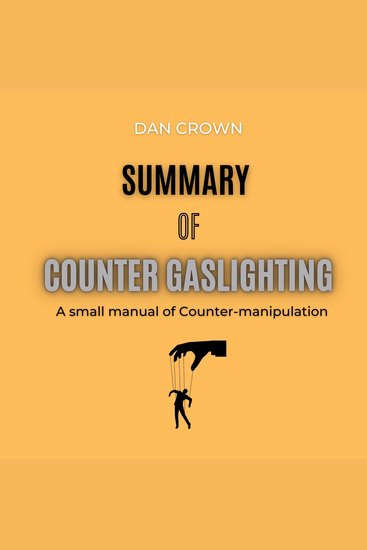
  • Summary of Counter Gaslighting - A small manual of Counter-manipulation - cover

    Summary of Counter Gaslighting -...

    Dan Crown

    • 0
    • 0
    • 0
    In a world where psychological well-being is paramount, understanding the nuances of manipulative behaviors is crucial. One of the most insidious forms of manipulation is gaslighting. This chapter delves deep into the definition of gaslighting, aiming to equip you with the knowledge to identify and protect yourself from this covert form of emotional abuse. 
    What is Gaslighting? 
    Gaslighting is a form of psychological manipulation in which a person or a group covertly sows seeds of doubt in a targeted individual or group, making them question their own memory, perception, or judgment. It often leads to significant emotional distress, confusion, and a diminished sense of self-worth in the victim. 
    The Core Elements of Gaslighting 
    -Doubt: The manipulator's primary tool is doubt. By questioning the validity of the victim's memories or perceptions, the manipulator creates uncertainty. 
    -Denial: Despite evidence to the contrary, the gaslighter will deny behaviors or events, further confusing the victim. 
    -Discredit: The gaslighter may also discredit the victim to others, isolating the victim and undermining their support system. 
    -Dependency: Over time, the victim may become dependent on the gaslighter for their version of reality, eroding the victim's ability to trust their own judgment.
    Zum Buch