Rejoignez-nous pour un voyage dans le monde des livres!
Ajouter ce livre à l'électronique
Grey
Ecrivez un nouveau commentaire Default profile 50px
Grey
Abonnez-vous pour lire le livre complet ou lisez les premières pages gratuitement!
All characters reduced
Tender Buttons - cover

Tender Buttons

Gertrude Stein

Maison d'édition: Open Road Media

  • 0
  • 1
  • 0

Synopsis

A classic work of experimental poetry by a titan of modernist literatureTender Buttons, Stein’s first published work of poetry, debuted in 1914 as a volume of powerful avant-garde expression. This meditation on ordinary living is presented in three compelling sections—“Objects,” “Food,” and “Rooms”—through which Stein delights in experiments with language. Emphasizing rhythm and sonority over traditional grammar, Stein’s wordplay has garnered praise from readers and critics alike. In “A Piece of Coffee,” for example, Stein plays with conventional language and cubist imagery to produce a stunningly original literary effect:A single image is not splendor. Dirty is yellow. A sign of more is not mentioned. A piece of coffee is not a detainer. The resemblance to yellow is dirtier and distincter. The clean mixture is whiter and not coal color, never more coal color than altogether.   This ebook has been professionally proofread to ensure accuracy and readability on all devices.
Disponible depuis: 28/10/2014.
Longueur d'impression: 134 pages.

D'autres livres qui pourraient vous intéresser

  • The Sentimental Bloke - cover

    The Sentimental Bloke

    C. J. Dennis

    • 0
    • 0
    • 0
    The Sentimental Bloke tells the story of Bill, a member of a larrikin push (or gang) in Melbourne's Little Lonsdale red-light district, who encounters Doreen, a young woman "of some social aspiration", in a local market. Narrated by Bill, the poems chronicle their courtship and marriage, detailing his transformation from a violence-prone gang member to a contented husband and father. Read by John Derum, these "songs" show us the great romance of the Bloke and his girl Doreen, full of Australian slang about such hi-fallutin' things.
    Voir livre
  • Quiet Night Think - Poems & Essays - cover

    Quiet Night Think - Poems & Essays

    Gillian Sze

    • 0
    • 16
    • 0
    “One function of the poet at any time is to discover by his own thought and feeling what seems to him to be poetry at that time,” writes Wallace Stevens. In Quiet Night Think, award-winning poet Gillian Sze expresses her own definition.
    		 
    During the remarkable period of early parenthood, Sze’s new maternal role urges her to contemplate her own origins, both familial and artistic. Comprised of six personal essays, poems, and a concluding long poem, Quiet Night Think takes its title from a direct translation of an eighth-century Chinese poem by Li Bai, the subject of the opening essay. Sze’s memory of reading Li Bai’s poem as a child marks the beginning of an unshakable encounter with poetry. What follows is an intimate anatomization of her particular entanglement with languages and cultures.
    		 
    In her most generically diverse book yet, Sze moves between poetry and prose, mother and writer, the lyrical and the autobiographical, all the while inviting readers to meditate with her on questions of emergence and transformation: What are you trying to be? Where does a word break off? What calls to us throughout the night?
    Voir livre
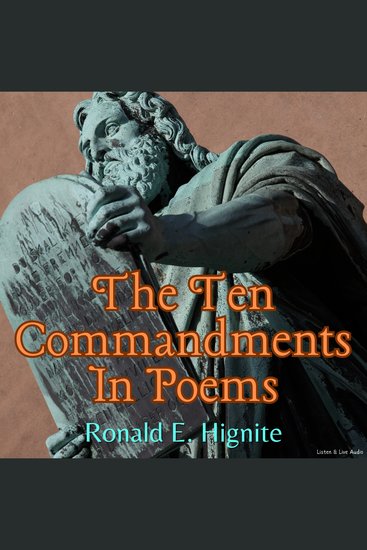
  • The Ten Commandments In Poems - cover

    The Ten Commandments In Poems

    Ron E. Hignite

    • 0
    • 0
    • 0
    Ronald E. Hignite - author of The Beatitudes in Poems - demonstrates in The Ten Commandments in Poems his poetic skills and provides greater understanding and meaning for God's laws for mankind. 
    Listeners will be inspired by the manner and design by which the events at Mt. Sinai are described in poetry and rhyme. This audio-book contains 12 poems, with one on each of the Ten Commandments, along with an introductory and closing poem. 
    Ronald E. Hignite was born in North Carolina and grew up in Connersville, Indiana. He returned to North Carolina with his family after high school and attended East Carolina University in Greenville, NC. There he earned both his undergraduate and graduate degrees. Following college, he taught English at Fork Union Military Academy in Fork Union, VA. After two years in Fork Union, he moved back to northeastern North Carolina where he spent most of his educational career in the towns of Washington, Camden, Murfreesboro, and Ahoskie. His interest in writing poetry was sparked while in college with his readings of the English poets, Byron, Shelley, and Keats. 
    ©2013 Ronald E. Hignite (P)2013 Ronald E. Hignite
    Voir livre
  • A Rhyme A Dozen ― The Night - 12 Poets 12 Poems 1 Topic - cover

    A Rhyme A Dozen ― The Night - 12...

    John Keats, Charlotte][AUTHOR...

    • 0
    • 0
    • 0
    ‘A dime a dozen’ as known in America, is perhaps equal to the English ‘cheap as chips’ but whatever the lingua franca of your choice in this series we hereby submit ‘A Rhyme a Dozen’ as 12 poems on many given subjects that are a well-rounded gathering, maybe even an essential guide, from the knowing pens of classic poets and their beautifully spoken verse to the comfort of your ears. 
    1 - A Rhyme A Dozen - 12 Poems, 12 Poets, 1 Topic - The Night - An Introduction 
    2 - To Night by Lope de Vega 
    3 - Mother Night by James Weldon Johnson 
    4 - Night by John Ruskin 
    5 - A Night in June by James Edwin Campbell 
    6 - Summer Night by Alfred Lord Tennyson 
    7 - In Drear Nighted December by John Keats 
    8 - A Winter Night by Sara Teasdale 
    9 - Night Piece by James Joyce 
    10 - Moorland Night by Charlotte Mew 
    11 - The Children of the Night by Edwin Arlington Robinson 
    12 - Ships That Pass in the Night by Paul Laurence Dunbar 
    13 - Wild Nights, Wild Nights by Emily Dickinson
    Voir livre
  • The Poetry of John Milton - Sparkling poems from the famed man behind Paradise Lost - cover

    The Poetry of John Milton -...

    John Milton

    • 0
    • 0
    • 0
    John Milton was born in Bread Street, London, on December 9th, 1608.  His early years were privately tutored before gaining a place at St Paul’s School and in 1625 he matriculated at Christ's College, Cambridge, earning a BA in 1629 and an MA in 1632. At Cambridge he had developed a reputation for poetic skill but also experienced alienation from his peers and university life as a whole.  
    The next 6 years were spent in private study. He read both ancient and modern works of theology, philosophy, history, politics, literature and science, in preparation for a poetical career.  Milton mastered Latin, Greek, Hebrew, French, Spanish, and Italian. To these he would add Old English (whilst researching his History of Britain) and also acquired more than a passing acquaintance in Dutch.  
    Although he was studying, some of his poetry from this time is remarkable; L’Allegro and Il Penseroso in 1631 and Lycidias in 1638. 
    In May 1638, Milton embarked upon a 15 month tour of France and Italy. These travels added a new and direct experience of artistic and religious traditions, especially Roman Catholicism.  He cut the journey short to return home during the summer of 1639 because of what he claimed were "sad tidings of civil war in England."  
    Once home, Milton wrote prose tracts against episcopacy, in the service of the Puritan and Parliamentary cause.  
    He married 16-year-old Mary Powell in June 1643 but she left him after only a few months during which he wrote and published several writings on divorce. Mary did return after 3 years and their life thereafter seemed harmonious.  Milton received a hostile response to the divorce tracts and drove him to write Areopagitica, his celebrated attack on pre-printing censorship.  
    With the parliamentary victory in the Civil War, Milton wrote The Tenure of Kings and Magistrates (1649) which defended popular government and implicitly sanctioned the regicide which led to his appointment as Secretary for Foreign Tongues by the Council of State.  
    On 24 February 1652 Milton published his Latin defense of the English People, Defensio Pro Populo Anglicano, also known as the First Defense. Milton's Latin prose and intellectual sweep, quickly gained him a European reputation.  
    Tragically his first wife, Mary, died on May 5th, 1652 following the birth of their fourth child.   The following year Milton had become totally blind, probably due to glaucoma.  He then had to dictate his verse and prose to helpers, one of whom was the poet Andrew Marvell. 
    He married again to Katherine Woodcock but she died in February 1658, less than four months after giving birth to a daughter, who also tragically died.  
    Though Cromwell’s death in 1658 caused the English Republic to collapse Milton stubbornly clung to his beliefs and in 1659 he published A Treatise of Civil Power, attacking the concept of a state-dominated church. Upon the Restoration in May 1660, Milton went into hiding for his life. An arrest warrant was issued and his writings burnt. He re-emerged after a general pardon was issued, but was nevertheless arrested and briefly imprisoned before influential friends, such as Marvell, now an MP, intervened 
    His third marriage was to Elizabeth Mynshull. Despite a 31-year age gap, the marriage seemed happy and Milton spent the remaining decade of his life living quietly in London, apart from a short spell in Chalfont St. Giles, during the Great Plague of London.  
    Milton was to now publish his greatest works, which had been gestating for many years.
    Voir livre

  • Expressway - cover

    Expressway

    Sina Queyras

    • 0
    • 0
    • 0
    Shortlisted for the Governor General's Award for Poetry
       
    This poem resembles urban sprawl. This poem resembles the freedom to charge a fee. The fee occurs in the gaps. It is an event. It is not without precedent. It is a moment in which you pay money. It is a tribute to freedom of choice.
       
    Reality is a parking lot in Qatar. Reality is an airstrip in Malawi.
       
    Meanwhile the expressway encloses, the expressway round and around the perimeters like wagon trains circling the bonfire, all of them, guns pointed, Busby Berkeley in the night sky.
       
    Echoing the pastoral and elegiac modes of the Romantic poets, whose reverence for nature never prevented them from addressing it with all the ideas and sensibilities their times allowed, Sina Queyras's stunning collection explores the infrastructures and means of modern mobility. Addressing the human project not so much as something imposed on nature but as an increasingly disturbing activity within it, Expressway exposes the paradox of modern mobility: the more roads and connections we build, the more separate we feel. 'Cleanse the doors of perception,' Blake urged, and with that in mind, Queyras has written a bravely lyrical critique of our ethical and ecological imprint, a legacy easily blamed on corporations and commerce, but one we've allowed, through our tacit acquiescence, to overwhelm us. Every brush stroke, every bolt and nut, every form and curve in our networks of oil and rubber, every thought and its material outcome – each decision can make or unmake us.
       
    'The works in Expressway are all so tightly wound, hyper-distilled and stressed ... This is poetry for the apocalypse.'
       
    —Broken Pencil
       
    'As a poet, Queyras is secretly romantic, writing with lyricism and a voice that's unafraid of sentiment or emotion ... Queyras' words spark like pickaxes on old asphalt.'
       
    — Eye Weekly
       
    'Queyras show[s] what poetry can do when it simultaneously maps roadways of transportation and lines of human thought.'
       
    —Spacing
       
    'Eclectic engagements characterize Queyras’s work, but any suggestion of characterization of her work immediately brings a morphing to something new, intelligent, and provocative ... Sina Queyras is a poet to read and reckon with.'
       
    —Lambda Literary Review
    Voir livre