Begleiten Sie uns auf eine literarische Weltreise!
Buch zum Bücherregal hinzufügen
Grey
Einen neuen Kommentar schreiben Default profile 50px
Grey
Jetzt das ganze Buch im Abo oder die ersten Seiten gratis lesen!
All characters reduced
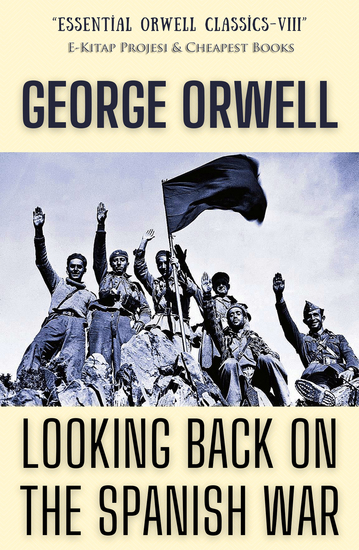
Looking Back on the Spanish War - cover

Looking Back on the Spanish War

George Orwell

Verlag: E-Kitap Projesi & Cheapest Books

  • 0
  • 0
  • 0

Beschreibung

First of all the physical memories,The sounds, the smells and the surfaces of things. It is curious that more vividly than anything that came afterwards in the Spanish war I remember the week of so-called training that we received before being sent to the front - the huge cavalry barracks in Barcelona with its draughty stables and cobbled yards, the icy cold of the pump where one washed, the filthy meals made tolerable by pannikins of wine, the Trousered militia-women chopping firewood, and the roll-call in the early mornings where my prosaic English name made a sort of comic interlude among the resounding Spanish ones, Manuel Gonzalez, Pedro Aguilar, Ramon Fenellosa, Roque Ballaster, Jaime Domenech, Sebastian Viltron, Ramon Nuvo Bosch. I name those particular men because I remember the faces of all of them. Except for two who were mere riff-raff and have doubtless become good Falangists by this time, it is probable that all of them are dead. Two of them I know to be dead. The eldest would have been about twenty-five, the youngest sixteen. One of the essential experiences of war is never being able to escape from disgusting smells of human origin. Latrines are an overworked subject in war literature, and I would not mention them if it were not that the latrine in our barracks did its necessary bit towards puncturing my own illusions about the Spanish civil war. The Latin type of latrine, at which you have to squat, is bad enough at its best, but these were made of some kind of polished stone so slippery that it was all you could do to keep on your feet. In addition they were always blocked. Now I have plenty of other disgusting things in my memory, but I believe it was these latrines that first brought home to me the thought, so often to recur: 'Here we are, soldiers of a revolutionary army, defending Democracy against Fascism, fighting a war which is about something, and the detail of our lives is just as sordid and degrading as it could be in prison, let alone in a bourgeois army.' Many other things reinforced this impression later; for instance, the boredom and animal hunger of trench life, the squalid intrigues over scraps of food, the mean, nagging quarrels which people exhausted by lack of sleep indulge in.
Verfügbar seit: 27.11.2023.
Drucklänge: 75 Seiten.

Weitere Bücher, die Sie mögen werden

  • The Gods of Mars - cover

    The Gods of Mars

    Edgar Rice Burroughs

    • 0
    • 0
    • 0
    John Carter is back!  
    In this second book in Edgar Rice Burroughs Barsoom saga, John Carter returns to Mars after he was flung back to Earth at the end of the previous title.  
    Ten long years have passed, and when he returns, John Carter finds himself once more flung into danger and high adventure! 
    Can he survive the cruel deception of the Valley Dor, which promises peace and happiness for all martians, but delivers neither? Can he escape the tunnels of the Therns? Cruel white Martians that practice cannabalism and deception? See him fight the cruel Black Pirates of Barsoom! And when imprisoned by them, who is the identity of this strange boy in the cell next to him? Watch him defy the edicts of Issus, the so called goddess of life and death upon Barsoom!  
    Will he ever reunite with his lost love? The beautiful Red Martian Princess, Dejah Thoris?  
    Another tale of pulp adventure upon the surface of mars by Edgar Rice Burroughs, narrated by Michael Ward.
    Zum Buch
  • A Child of the Jago - cover

    A Child of the Jago

    Arthur Morrison

    • 0
    • 0
    • 0
    Published in 1896, A Child of the Jago is a gritty and realistic portrayal of life in the slums of London’s East End during the late 19th century. The novel is set in an area known as the Old Jago (based on a real-life slum called the Old Nichol) and vividly describes the poverty, crime and squalor that characterised the impoverished neighbourhood.
    The story revolves around Dicky Perrott, a young boy growing up in the Jago, and his struggle for survival in a world of gangs, violence and despair.
    A Child of the Jago is considered a significant work of social realism, depicting the harshness of urban poverty and offering a stark critique of the societal structures that perpetuate it.
    Zum Buch
  • Strange Case of Dr Jekyll and Mr Hyde - An Audiobook Empire Production - cover

    Strange Case of Dr Jekyll and Mr...

    Robert Louis Stevenson

    • 0
    • 0
    • 0
    “I sat in the sun on a bench; the animal within me licking the chops of memory; the spiritual side a little drowsed, promising subsequent penitence, but not yet moved to begin.” 
    Narrator RJ Bayley and Audiobook Empire have once again teamed up to bring you another Gothic classic from Bayley's Bookshelf.  
    Robert Louis Stevenson's 1886 novella Strange Case of Dr Jekyll and Mr Hyde explores the bifurcated nature of one man's psyche and the turmoil it can bring upon society, in a time when such things were not fully understood.
    Zum Buch
  • Great Gatsby The: Original 1925 Edition (An F Scott Fitzgerald Classic Novel - cover

    Great Gatsby The: Original 1925...

    Francis Scott Fitzgerald

    • 0
    • 0
    • 0
    The Great Jazz Age Novel_______The 1925 Original Version, with Classroom History_______The Great Gatsby is considered F. Scott Fitzgerald's magnum opus, exploring themes of decadence, idealism, social stigmas, patriarchal norms, and the deleterious effects of unencumbered wealth in capitalistic society, set against the backdrop of the Jazz Age and the Roaring Twenties. At its heart, it's a cautionary tale, a revealing look into the darker side to the American Dream."When I came back from the East last autumn I felt that I wanted the world to be in uniform and at a sort of moral attention forever; I wanted no more riotous excursions with privileged glimpses into the human heart. Only Gatsby, the man who gives his name to this book, was exempt from my reaction—Gatsby who represented everything for which I have an unaffected scorn. If personality is an unbroken series of successful gestures, then there was something gorgeous about him, some heightened sensitivity to the promises of life, as if he were related to one of those intricate machines that register earthquakes ten thousand miles away. This responsiveness had nothing to do with that flabby impressionability which is dignified under the name of the "creative temperament"—it was an extraordinary gift for hope, a romantic readiness such as I have never found in any other person and which it is not likely I shall ever find again. No—Gatsby turned out all right at the end; it is what preyed on Gatsby, what foul dust floated in the wake of his dreams that temporarily closed out my interest in the abortive sorrows and short-winded elations of men..."
    Zum Buch
  • A Model Crime - From their pens to your ears genius in every story - cover

    A Model Crime - From their pens...

    William Pett Ridge

    • 0
    • 0
    • 0
    William Pett Ridge was born at Chartham, near Canterbury, Kent, on 22nd April 1859.  
    His family’s resources were certainly limited. His father was a railway porter, and the young Pett Ridge, after schooling in Marden, Kent became a clerk in a railway clearing-house. The hours were long and arduous, but self-improvement was Pett Ridge’s goal.  After working from nine until seven o’clock he would attend evening classes at Birkbeck Literary and Scientific Institute and then to follow his passion; the ambition to write.  He was heavily influenced by Dickens and several critics thought he had the capability to be his successor.  
    From 1891 many of his humourous sketches were published in the St James's Gazette, the Idler, Windsor Magazine and other literary periodicals of the day. 
    Pett Ridge published his first novel in 1895, A Clever Wife. By the advent of his fifth novel, Mord Em'ly, a mere three years later in 1898, his success was obvious.  His writing was written from the perspective of those born with no privilege and relied on his great talent to find humour and sympathy in his portrayal of working class life. 
    Today Pett Ridge and other East End novelists including Arthur Nevinson, Arthur Morrison and Edwin Pugh are being grouped together as the Cockney Novelists.   
    In 1924, Pugh set out his recollections of Pett Ridge from the 1890s: “I see him most clearly, as he was in those days, through a blue haze of tobacco smoke. We used sometimes to travel together from Waterloo to Worcester Park on our way to spend a Saturday afternoon and evening with H. G. Wells. Pett Ridge does not know it, but it was through watching him fill his pipe, as he sat opposite me in a stuffy little railway compartment, that I completed my own education as a smoker... Pett Ridge had a small, dark, rather spiky moustache in those days, and thick, dark, sleek hair which is perhaps not quite so thick or dark, though hardly less sleek nowadays than it was then”. 
    With his success, on the back of his prolific output and commercial success, Pett Ridge gave generously of both time and money to charity. In 1907 he founded the Babies Home at Hoxton.  This was one of several organisations that he supported that had the welfare of children as their mission.  
    His circle considered Pett Ridge to be one of life's natural bachelors. In 1909 they were rather surprised therefore when he married Olga Hentschel.  
    As the 1920’s arrived Pett Ridge added to his popularity with the movies. Four of his books were adapted into films.  
    Pett Ridge now found the peak of his fame had passed. Although he still managed to produce a book a year he was falling out of fashion and favour with the reading public and his popularity declined rapidly.  His canon runs to over sixty novels and short-story collections as well as many pieces for magazines and periodicals. 
    William Pett Ridge died, on 29th September 1930, at his home, Ampthill, Willow Grove, Chislehurst, at the age of 71. 
    He was cremated at West Norwood on 2nd October 1930.
    Zum Buch
  • Diplomacy - From their pens to your ears genius in every story - cover

    Diplomacy - From their pens to...

    Lafcadio Hearn

    • 0
    • 0
    • 0
    Lafcadio Hearn was born on the 27th June 1850 on the Ionian isle of Levkás in Greece to a British Army officer and a Greek Mother. 
    His father, fearing for his career prospects at being married to a Greek Orthodox wife, sent them to Dublin whilst he continued to advance his career with further postings.  Life there was difficult for mother and son.  His father returned, wounded and traumatised, when Lafcadio was three.  He annulled the marriage and she remarried but had to give up care of Lafcadio to her sister-in law.   
    After brief periods for Catholic education in England and France he emigrated to Ohio in the United States when he was 19, taking on a series of casual jobs before embarking on a career as a journalist, publishing poems and essays in Cincinnati.  It was whilst here that he began a side-line in translating, starting with Gautier and Flaubert.  He married in 1874 to a 20 year old African-American woman in violation of Ohio's anti-miscegenation law.  The marriage soon failed. 
    In 1877 he relocated to New Orleans to write on a variety of themes before picking up a two year assignment from Harper’s to write in the West Indies, where he also wrote his first novel. 
    In 1890 Harper’s sent him to Japan.  Here he left journalism and took the remarkable decision to become a schoolteacher in the north of Japan.   Enraptured by the culture he was driven to explain it in various Western publications to those who had little, if any, knowledge of its culture.  Within the year he had fallen in love with, and married, a high-born Japanese lady, together they would have four children.   
    In 1895 he became a Japanese national and took the name Koizumi Yakumo, Koizumi being his wife’s family name. 
    The following few years, whilst a professor of Literature at the Imperial University of Japan, were his most creative and admired period.   
    Lafcadio Hearn died of heart failure on the 26th of September 1904, in Tokyo, Japan shortly before leaving to deliver a series of lectures at Cornell University in New York State.  He was 54.
    Zum Buch