Begleiten Sie uns auf eine literarische Weltreise!
Buch zum Bücherregal hinzufügen
Grey
Einen neuen Kommentar schreiben Default profile 50px
Grey
Jetzt das ganze Buch im Abo oder die ersten Seiten gratis lesen!
All characters reduced
1984 - cover

1984

George Orwell

Verlag: Seven Books

  • 0
  • 1
  • 0

Beschreibung

It was a bright cold day in April, and the clocks were striking thirteen. Winston Smith, his chin nuzzled into his breast in an effort to escape the vile wind, slipped quickly through the glass doors of Victory Mansions, though not quickly enough to prevent a swirl of gritty dust from entering along with him.

The hallway smelt of boiled cabbage and old rag mats. At one end of it a coloured poster, too large for indoor display, had been tacked to the wall. It depicted simply an enormous face, more than a metre wide: the face of a man of about forty-five, with a heavy black moustache and ruggedly handsome features.

Winston made for the stairs. It was no use trying the lift. Even at the best of times it was seldom working, and at present the electric current was cut off during daylight hours. It was part of the economy drive in preparation for Hate Week. The flat was seven flights up, and Winston, who was thirty-nine and had a varicose ulcer above his right ankle, went slowly, resting several times on the way. On each landing, opposite the lift-shaft, the poster with the enormous face gazed from the wall. It was one of those pictures which are so contrived that the eyes follow you about when you move.

BIG BROTHER IS WATCHING YOU, the caption beneath it ran.
Verfügbar seit: 11.09.2024.
Drucklänge: 400 Seiten.
Weitere Bücher, die Sie mögen werden

  • The Virgin - Story from one of the most famous or infamous British figures of the 20th Century - cover

    The Virgin - Story from one of...

    Aleister Crowley

    • 0
    • 0
    • 0
    Edward Alexander Crowley was born on 12th October 1875 to wealthy parents in Royal Leamington Spa in Warwickshire. 
    He was educated at Malvern College, Tonbridge School, Eastbourne College and finally Trinity College, Cambridge where he focused on his passions of mountaineering and poetry and published several volumes. 
    Life for Crowley was to abandon his parents’ Christian faith and instead to inject himself into Western esotericism.  In 1898, he joined the esoteric Hermetic Order of the Golden Dawn and was trained in ceremonial magic before studying both Hindu and Buddhist practices in India. 
    On his Egyptian honeymoon in 1904 he claimed contact with an entity―Aiwass―who gave him the sacred Book of the Law which served as the basis for the Thelema religion where he identified as its prophet.  During the Great War, which he spent in the United States, he claimed to be working for British Intelligence but by the 1920s he had decamped to pursue a libertine lifestyle in Sicily, and in the ensuing scandals was evicted by the Italian Government. 
    He divided the following two decades between France, Germany, and England, and the continuing promotion of Thelema. 
    During his life he gained widespread notoriety for his drug use, his bisexuality, and his alarming views on society.  In short, polite society frowned on his ways, his thoughts and his influence but to many others his stance had much of value.  Even after death he was a darling for the 60’s counterculture but his influence has since waned.   
    His literary works were both prolific and covered many topics.  In the early part of his career he published many poetry books, even plays, before his darker and more forceful works came to dominate his output. 
    Aleister Crowley died on 1st December 1947 at Hastings in England. He was 72.
    Zum Buch
  • The Emperor's New Clothes - cover

    The Emperor's New Clothes

    Hans Christian Andersen

    • 0
    • 0
    • 0
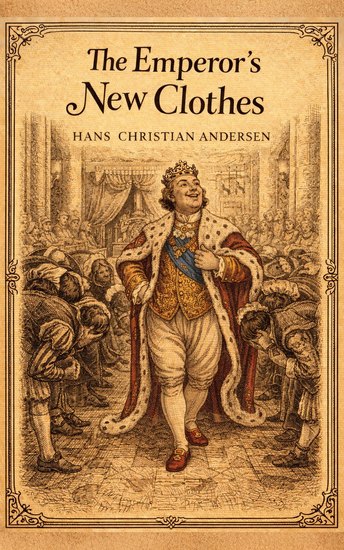
    Step into a world of vanity, deception, and surprising courage in Hans Christian Andersen's timeless classic, The Emperor's New Clothes. This beloved fairy tale tells the story of a proud and fashion-obsessed emperor who cares for little beyond his extravagant wardrobe and public image. When two cunning swindlers arrive at his court claiming they can weave the most magnificent fabric ever seen—one invisible to anyone unfit for their position or hopelessly foolish—the emperor eagerly commissions a royal suit.
    
    As the "magical" cloth is crafted, ministers and officials are sent to inspect the progress. Afraid of appearing incompetent or foolish, each one pretends to see the nonexistent fabric, praising its beauty and sophistication. The emperor himself, unwilling to admit he sees nothing, joins in the charade. Soon, the entire kingdom buzzes with admiration for a suit that does not exist.
    
    On the day of the grand procession, the emperor proudly parades through the streets wearing his "new clothes," while his subjects, equally fearful of exposing themselves as unworthy, applaud in false admiration. It is only when a small child, innocent and unafraid of judgment, speaks the simple truth—"But he isn't wearing anything at all!"—that the illusion is shattered.
    
    With humor, wit, and sharp social commentary, Andersen's tale explores themes of pride, conformity, honesty, and the power of truth. Beneath its playful storytelling lies a profound message about the dangers of vanity and the human tendency to follow the crowd rather than trust one's own judgment.
    
    The Emperor's New Clothes remains a powerful and relevant story for readers of all ages, reminding us that courage often comes from the most unexpected voices—and that sometimes, the simplest truth is the hardest to admit.
    Zum Buch
  • The Flying Inn - A Novel - cover

    The Flying Inn - A Novel

    G.K. Chesterton

    • 0
    • 0
    • 0
    'Drink because you are happy, but never because you are miserable.'
    
    First published in 1914 and packed with humour and political critique, The Flying Inn is a glowing celebration of freedom, and remains one of G.K. Chesterton's most spirited works in his corpus.
    
    A satirical adventure novel, The Flying Inn is set in a quirky, dystopian England in which a new puritanical government has outlawed alcohol and other traditional English customs. Enter Humphrey Pump and his spirited friend Captain Patrick Dalroy, who take it upon themselves to supply what the government refuses. Taking to the countryside with a cart and barrel of rum, Pump and Dalroy create a 'flying inn' which travels with them. As they dodge the authorities, take advantage of legal loopholes and rally the common people, the story becomes a rocking rebellion against bureaucracy, celebrating merriment, individual liberty and the enduring soul of England. Witty and packed with political critique, The Flying Inn is Chesterton at his finest.
    Gilbert Keith Chesterton (1874 – 1936) was an English novelist, philosopher, journalist and critic. A Christian apologist, he is famed for creating the fictional priest-detective Father Brown. His writing was also renowned for his sense of humour: known as 'the prince of paradox', Chesterton often turned common sayings upside down. Admired by several of his literary contemporaries, Chesterton's work is still widely read today.
    Zum Buch
  • The Brothers Karamazov - cover

    The Brothers Karamazov

    Fyodor Dostoyevsky

    • 0
    • 0
    • 0
    The Brothers Karamazov, also translated as The Karamazov Brothers, is the last novel by Russian author Fyodor Dostoevsky. Dostoevsky spent nearly two years writing The Brothers Karamazov, which was published as a serial in The Russian Messenger from January 1879 to November 1880. Dostoevsky died less than four months after its publication. It has been acclaimed as one of the supreme achievements in world literature.
    
    Set in 19th-century Russia, The Brothers Karamazov is a passionate philosophical novel that discusses questions of God, free will, and morality. It has also been described as a theological drama dealing with problems of faith, doubt, and reason in the context of a modernizing Russia, with a plot that revolves around the subject of patricide. Dostoevsky composed much of the novel in Staraya Russa, which inspired the main setting.
    Zum Buch
  • Her First Ball - cover

    Her First Ball

    Katherine Mansfield

    • 0
    • 0
    • 0
    "Her First Ball" is a 1921 short story by Katherine Mansfield. It was first published in The Sphere on 28 November 1921, and later reprinted in The Garden Party and Other Stories.
    A young girl called Leila has come to the city to stay with her cousins. They are going to a ball. Leila is very excited: this is her first ball. Once there, she is both excited and terrified. After dancing with several young boys her own age, she dances with a wrinkly balding man who has been coming to balls for a while. This spoils her mood until she dances with a good looking young gentleman where her worries disappear.
    Zum Buch
  • Measure for Measure - cover

    Measure for Measure

    William Shakespeare

    • 0
    • 0
    • 0
    Measure for Measure is one of darkest of Shakespeare’s comedies. Written in about 1603 and first performed in 1604, it immediately preceded the composition of the major tragedies Othello, King Lear, and Macbeth. 
    Duke Vincentino, the ruler of Vienna, fears that under his mild sovereignty, the people may have become lazy and lax. He decides to “go over cover” in the disguise of a monk and appoint his deputy, Angelo, who is a reputed paragon of virtue, as temporary ruler. 
    On assuming power, Angelo inaugurates draconian provisions regarding sexual propriety. One of the first victims of this new regime is young Claudio, who has impregnated his lover Juliet, and is accordingly sentenced to death. 
    Claudio’s sister, Isabella, who is preparing to enter religious life, is encouraged to approach Angelo and plead for her brother’s life. Angelo is immediately smitten with the beautiful Isabella and makes her an offer: her brother will be spared if she yields to Angelo’s sexual advances. Isabella indignantly rejects this proposal, but finds herself unable to reveal Angelo’s hypocrisy publicly, as she fears her accusations will lack credence. 
    Fortunately, the Duke, who has not left Vienna, befriends Isabella in his assumed role of friar, and hatches a plan to both save Claudio and to unmask Angelo. 
    Featuring the voices of Denis Daly, Gary D. MacFadden, David Shears, Graham Scott, Josh Innerst, Kendra Murray, Blaise Doran, Simon Paxton, Roberta Jackson, Alexandra Lee Smith, and Alan Weyman. 
    Audio edited by Denis Daly 
    Tunes for songs provided by Alan Weyman. 
    The text used for this performance was kindly provided by playshakespeare.com.
    Zum Buch