Rejoignez-nous pour un voyage dans le monde des livres!
Ajouter ce livre à l'électronique
Grey
Ecrivez un nouveau commentaire Default profile 50px
Grey
Abonnez-vous pour lire le livre complet ou lisez les premières pages gratuitement!
All characters reduced
The Man from Brodney's - cover

The Man from Brodney's

George Barr McCutcheon

Maison d'édition: DigiCat

  • 0
  • 0
  • 0

Synopsis

In "The Man from Brodney's," George Barr McCutcheon weaves a captivating narrative that explores themes of identity, societal expectations, and the tumult of human emotions within the backdrop of early 20th-century America. Blending elements of romance and adventure, McCutcheon's literary style is marked by a robust prose and character-driven storytelling that resonates with the influence of authors such as Booth Tarkington and O. Henry. The novel intricately details the life of its protagonist, a man who finds himself at the crossroads of personal aspiration and social obligation, thereby reflecting the complexities of American societal norms of the time. George Barr McCutcheon, an influential figure in early American literature, was a prolific writer whose works often mirrored the societal changes of his era. Born in 1866, he had a profound understanding of the American psyche, shaped by his own experiences in a rapidly evolving society. His background as a successful playwright and novelist provided him with a unique lens through which to examine the intricacies of human behavior and relationships, culminating in a work that challenges readers to reconsider their views on duty and self-fulfillment. McCutcheon's "The Man from Brodney's" is an essential read for those interested in early 20th-century literature, providing a thoughtful exploration of the individual's struggle for identity amidst societal pressures. A compelling tale filled with rich characters and moral dilemmas, this novel invites readers to reflect on their own journeys and the impact of societal expectations on personal choices.
Disponible depuis: 16/09/2022.
Longueur d'impression: 256 pages.

D'autres livres qui pourraient vous intéresser

  • Madame Bovary - cover

    Madame Bovary

    Gustave Flaubert

    • 0
    • 0
    • 0
    A woman longing for passion. A life that feels too small. A dream that leads her where she never meant to go.
    Emma Bovary marries a kind but ordinary doctor, hoping for romance, beauty, and excitement. Instead, she finds herself trapped in routine and aching for more. As she pursues love, luxury, and escape, her desires turn into dangerous illusions—drawing her deeper into secrets, debt, and heartbreak she cannot control.
    
    Praised as "one of the greatest novels ever written," Flaubert's masterpiece is renowned for its exquisite prose, psychological depth, and fearless portrayal of desire and disillusionment. Emma's struggle to reconcile fantasy with reality remains as gripping today as when the book first shocked the world.
    
    If you love emotionally intense storytelling, rich character exploration, and classics that linger long after the last page, this novel is essential reading.
    
    Open the book—and step into the life of a woman whose dreams burn brighter than the world around her.
    Voir livre
  • In Our Time - cover

    In Our Time

    Ernest Hemingway

    • 0
    • 0
    • 0
    "He was alone, and he was comfortable. He felt he had left everything behind, the need for thinking, the need to understand."
    
    In Our Time is a collection of vignettes and short stories that marked the arrival of Ernest Hemmingway as a bold new voice in American literature. The works contained herein explore the themes of war, loss, love, alienation and disillusionment that are prominent in much of the author's work while encapsulating the struggles faced by individuals in the rapidly changing, post-war world. From the trenches of World War I to quiet moments of reflection in nature, Hemingways use of spare, precise prose delivers a sense of moral value and a powerful punch of emotional truth.
    
    The titles included in this collection, in order of appearance, are:
    
    - On the Quai at Smyrna
    - Indian Camp
    - The Doctor and the Doctor's Wife
    - The End of Something
    - The Three-Day Blow
    - The Battler
    - A Very Short Story
    - Soldier's Home
    - The Revolutionist
    - Mr. and Mrs. Elliot
    - Cat in the Rain
    - Out of Season
    - Cross-Country Snow
    - My Old Man
    - Big Two-Hearted River: Part 1
    - Big Two-Hearted River: Part 2
    - L' Envoi
    Ernest Hemingway (1899–1961) was an American novelist, short story writer, and journalist renowned for his econimical, understated prose, adventurous lifestyle and outspoken public image. He began his career as a reporter and published a number of short stories before gaining fame with novels such as The Sun Also Rises (1926) and A Farewell to Arms (1929), and his experiences during the Spanish Civil War informed the best-selling For Whom the Bell Tolls (1940). He was awarded the Nobel Prize in Literature in 1954, and some of his seven novels, six short-story collections and two non-fiction works have become classics of American literature.
    This audiobook is fully indexed. Once downloaded, each book and chapter will be listed so you can easily navigate to the individual sections.
    Voir livre
  • Emma - A soothing reading for relaxation and sleep - cover

    Emma - A soothing reading for...

    Jane Austen

    • 0
    • 0
    • 0
    Step into the elegant world of "Emma" by Jane Austen, gracefully narrated by Elizabeth Grace and produced by Slumber Studios. 
    If sleepless nights or a busy mind are keeping you awake, you've come to the right place. This audiobook is designed to gently guide you into a deep, restful sleep. 
    Close your eyes, relax, and let Elizabeth Grace’s calming voice lead you through the charming and witty tale of Emma Woodhouse. Experience the intrigue, romance, and humor as Emma navigates the complexities of friendship, love, and self-discovery in the quaint village of Highbury. 
    At Slumber Studios, we specialize in creating soothing content to help you unwind and drift off to sleep. This audiobook offers a slow, gentle narration paired with calming background music, ensuring a peaceful journey into dreamland. 
    If you’re looking for the perfect way to relax after a long day, this is your answer. Simply press play, get comfortable, and let Elizabeth’s tranquil narration carry you into the delightful world of "Emma." Wake up refreshed, ready to embrace the day with a sense of elegance and charm.
    Voir livre
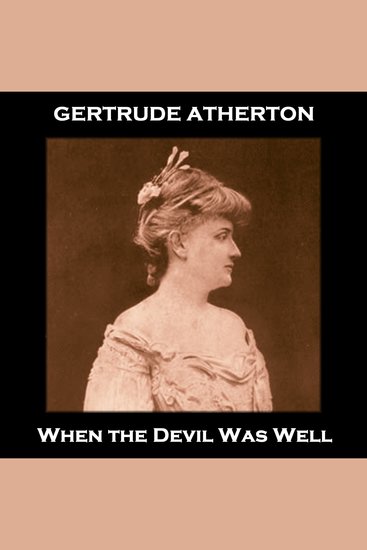
  • When the Devil Was Well - From their pens to your ears genius in every story - cover

    When the Devil Was Well - From...

    Gertrude Atherton

    • 0
    • 0
    • 0
    Gertrude Franklin Horn was born on October 30th, 1857, in San Francisco, California. Her parents separated in 1860 when she was two years old, and she was raised by her maternal grandfather, Stephen Franklin, a devout Presbyterian. He insisted she be well read, and was a great influence on her.  
    She attended St. Mary's Hall high school in Benicia, California, and, briefly, the Sayre School in Lexington, Kentucky. 
    In Kentucky, the rebellious Gertrude met George H.B. Atherton, who was courting her mother. His attentions wandered to Gertrude and, after she accepted his sixth proposal, they eloped on February 15th, 1876.  
    She went to live with him and his domineering Chilean mother. Gertrude found life stultifying. As a result of her disappointment she began to develop an independent life. But two tragedies changed her life dramatically: her son George died of diphtheria, and her husband died at sea. She was left with their daughter Muriel but and needed to support herself. Her mother-in-law agreed to raise Muriel. 
    Her first publication was ‘The Randolphs of Redwood: A Romance’, and serialised in The Argonaut in 1882. When she told her family, she was ostracized.  
    Gertrude’s first novel, ‘What Dreams May Come’, was published in 1888 under the pseudonym Frank Lin. 
    With the death of her grandfather and her mother-in-law she returned to California to resume care of Muriel. In 1891, while writing a weekly column for The San Francisco Examiner, she met Ambrose Bierce, with whom she carried on a love-hate relationship. 
    She wrote ‘Doomswoman’ in 1892, it was published in Lippincott's Monthly Magazine and as a book in 1893. The story focuses on Chonita Moncada y Iturbi and her love of Diego Estenega, as he dreams of modernizing California.  
    In 1892, Atherton left for New York to write for the New York World. She wrote letters to Bierce, confiding her loneliness, her dismay at freelance writing and her dislike of eastern literary circles. Whilst there though she published another California novel, ‘Before the Gringo Came’ (1894). 
    Following this was ‘Patience Sparhawk and Her Times’ (1897), but it proved to be controversial. Its rejection encouraged her to leave for London.  
    In 1898, she completed ‘The Californians’, her first novel set in the post-Spanish era. Critics received this much more positively: The Spectator said "The novel fairly establishes her claim to be considered as one of the most vivid and entertaining interpreters of the complex characters of emancipated American womanhood."  
    Further works followed, many from her California series dealing with the social history of California.  
    Gertrude wrote several stories of supernatural horror, including ‘Death and the Woman’, and ‘Crowned with One Crest’, as well as ‘The Foghorn’, and the much anthologised ‘The Striding Place’.  
    She was an early feminist well acquainted with the plight of women although she spoke against its militancy. Add to this her strong-will, independent-mind, and sometimes her oversteps into controversy, especially over anti-communism and its easy to identify why her novels had such sharp and strong characters. 
    Gertrude Atherton died on June 14th, 1948. She is buried in Cypress Lawn cemetery in Colma, California.
    Voir livre
  • The Count of Monte Cristo - cover

    The Count of Monte Cristo

    Alexandre Dumas

    • 0
    • 0
    • 0
    The Count of Monte Cristo (French: Le Comte de Monte-Cristo) is an adventure novel written by French author Alexandre Dumas (père) completed in 1844. It is one of the author's most popular works, along with The Three Musketeers. Like many of his novels, it was expanded from plot outlines suggested by his collaborating ghostwriter Auguste Maquet. 
    The story takes place in France, Italy, and islands in the Mediterranean during the historical events of 1815–1839: the era of the Bourbon Restoration through the reign of Louis-Philippe of France. It begins on the day that Napoleon left his first island of exile, Elba, beginning the Hundred Days period when Napoleon returned to power. The historical setting is a fundamental element of the book, an adventure story centrally concerned with themes of hope, justice, vengeance, mercy, and forgiveness. 
    Before he can marry his fiancée Mercédès, Edmond Dantès, a French nineteen-year-old first mate of the Pharaon, is falsely accused of treason, arrested, and imprisoned without trial in the Château d'If, a grim island fortress off Marseille. A fellow prisoner, Abbé Faria, correctly deduces that romantic rival Fernand Mondego, envious crewmate Danglars, and double-dealing magistrate De Villefort are responsible. Over the course of their long imprisonment, Faria educates Dantès and tells him of a cache of treasure he found. After Faria dies, Dantès escapes and finds the treasure. As the powerful and mysterious Count of Monte Cristo, he enters the fashionable Parisian world of the 1830s to avenge himself.
    Voir livre
  • Case of Charles Dexter Ward The (Part 2 of 3) - cover

    Case of Charles Dexter Ward The...

    H.P. Lovecraft

    • 0
    • 0
    • 0
    Title: The Case of Charles Dexter Ward (Part 2 of 3) 
    Series Name: Timeless Terrors 
    Series Entry: 150 
    Author: H. P. Lovecraft 
    Narrator: Jonathan Dunne 
    Original Publication: 1941 
    Public Domain: Yes 
    Description: 
    As Charles Dexter Ward’s obsession deepens, the boundaries between scholarly pursuit and dangerous obsession begin to collapse entirely. His studies of Joseph Curwen move beyond historical curiosity into obsessive reconstruction — as though he is not merely learning about the past, but attempting to rebuild it. 
    In his secluded laboratory, Ward performs increasingly strange and secretive experiments. Witnesses report unsettling disturbances: odd smells drifting from sealed rooms, lights burning late into the night, and a growing sense that Ward is no longer acting alone. His handwriting begins to shift in subtle but alarming ways, and his behavior grows more erratic, alternating between periods of intense focus and unsettling detachment. 
    At the same time, Dr. Marinus Bicknell Willett, a family physician and friend of the Ward household, begins to suspect that something profoundly unnatural is unfolding. His quiet investigation leads him through hidden records, forgotten correspondence, and disturbing clues tied to Curwen’s long-discredited reputation. What he uncovers suggests not only that Curwen was far more than a mere occult enthusiast, but that his influence may not have ended with his death. 
    As Ward’s experiments escalate, the line between past and present begins to blur. There are hints of impossible survivals, forbidden knowledge passed down through hidden means, and a growing implication that Curwen’s presence is not merely historical — but active. The city of Providence itself becomes a backdrop of mounting unease, as ordinary life continues unaware of the uncanny forces gathering just beneath its surface.
    Voir livre