Join us on a literary world trip!
Add this book to bookshelf
Grey
Write a new comment Default profile 50px
Grey
Subscribe to read the full book or read the first pages for free!
All characters reduced
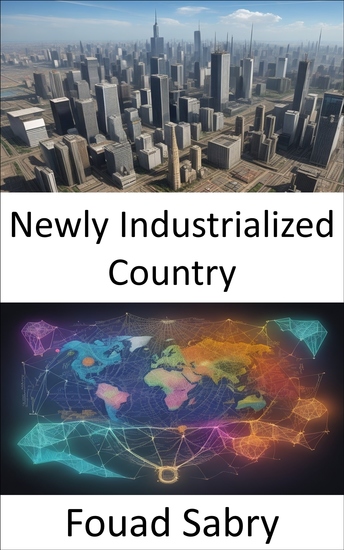
Newly Industrialized Country - Unlocking the Secrets of Emerging Economies a Journey through Newly Industrialized Countries - cover

Newly Industrialized Country - Unlocking the Secrets of Emerging Economies a Journey through Newly Industrialized Countries

Fouad Sabry

Publisher: One Billion Knowledgeable

  • 0
  • 0
  • 0

Summary

What is Newly Industrialized Country
 
A socioeconomic classification that is used to a number of countries all over the world by political scientists and economists is known as the category of newly industrialized country (NIC), newly industrialized economy (NIE), or medium income country. These countries are a subgroup of emerging nations that are experiencing a significantly higher rate of economic growth compared to other developing nations. Additionally, these nations are seeing a reorganization of society as a result of the social repercussions of industrialization, such as urbanization.
 
How you will benefit
 
(I) Insights, and validations about the following topics:
 
Chapter 1: Newly industrialized country
 
Chapter 2: Economy of Burkina Faso
 
Chapter 3: Economy of the Central African Republic
 
Chapter 4: Gross domestic product
 
Chapter 5: Economy of Nicaragua
 
Chapter 6: Developed country
 
Chapter 7: Developing country
 
Chapter 8: Economic development
 
Chapter 9: World economy
 
Chapter 10: Palace economy
 
Chapter 11: Aegean civilization
 
Chapter 12: Linear B
 
Chapter 13: Economy of Africa
 
Chapter 14: Economy of North America
 
Chapter 15: Emerging market
 
Chapter 16: BRIC
 
Chapter 17: Latin American debt crisis
 
Chapter 18: Economy of the Middle East
 
Chapter 19: VISTA (economics)
 
Chapter 20: Global recession
 
Chapter 21: CIVETS
 
(II) Answering the public top questions about newly industrialized country.
 
(III) Real world examples for the usage of newly industrialized country in many fields.
 
Who this book is for
 
Professionals, undergraduate and graduate students, enthusiasts, hobbyists, and those who want to go beyond basic knowledge or information for any kind of newly industrialized country.
Available since: 01/12/2024.
Print length: 273 pages.

Other books that might interest you

  • Decision Intelligence - Transform Your Team and Organization with AI-Driven Decision-Making - cover

    Decision Intelligence -...

    Thorsten Heilig, Ilhan Scheer

    • 0
    • 0
    • 0
    In Decision Intelligence: Transform Your Team and Organization with AI-Driven Decision-Making, a team of pioneering decision and AI strategists delivers a digestible and hands-on resource for professionals at every part of the decision-making journey. The book discusses the latest technology and approaches that bridge the gap between behavioral science, data science, and technological innovation. 


    Discover how leaders from various industries and environments are using data and AI to make better future decisions, taking both human as well as business factors into account. This book covers: 


    ● A demystifying behind-the-scenes peek inside how AI models, forecasts, and optimization for business challenges really work, and why they open up entirely new possibilities 


    ● A business-ready introduction to decision intelligence, exploring why traditional decision-making strategies are outdated and how to transition to decision-intelligence 


    ● The evolution of Decision Intelligence 


    ● An examination of decision intelligence at the organizational level 


    ● An overview of why (and where exactly) AI still needs human expertise and how to incorporate this topic in daily planning and decision making
    Show book
  • The Theory of Corporate Mind - Uncover 12 Hidden Psychological Biases at Your Workplace Control Perspectives and Achieve Career Success - cover

    The Theory of Corporate Mind -...

    PRATEEK TANDON

    • 0
    • 0
    • 0
    **12 Hidden Psychological Biases Working Against Your Career Goals in Your Office** 
    This is not a book about Racial or Gender bias. This is about something more.. 12 Hidden Psychological Biases, right at your workplace, right in front of you.. day-in & day-out! 
    Corporates spend millions of dollars every year to train their managers against biases prevalent in their workplaces. But as a new entrant or a mid-senior level employee you cannot simply hope for these trainings to instill a better sense in your colleagues and managers. For the sake of your own careers be aware of all the hidden psychological aspects that may be working against your career goals in office. 
    A Corporate office is full of psychological biases, many not even as prominent or evident as racial or gender bias. Often, we don't even realize that we are a victim of these psychological biases from our managers, until it’s too late. By then, we have either lost out on an interview or have received not-so-great annual performance rating. Awareness is the best cure to navigate through these psychologically complex situations and achieve career success. 
    The 'Theory of Corporate Mind' originates from a well-known psychological concept called 'Theory of Mind'. Theory of Mind defines the basic ability of human brain to understand and mirror others' perspective. Although this ability originates at a very young age, the adult workforce entering the corporate world doesn't seem to be utilizing this cognitive ability to its advantage. 
    Do not underestimate the power of these 12 hidden biases. They may have already costed you a lot in your career. Be Aware!
    Show book
  • Baby Bust 10th Anniversary Edition - New Choices for Men and Women in Work and Family - cover

    Baby Bust 10th Anniversary...

    Stewart D. Friedman

    • 0
    • 0
    • 0
    Stew Friedman, founding director of The Wharton School's Work/Life Integration Project, studied two generations of Wharton college students as they graduated: Gen Xers in 1992 and Millennials in 2012. The cross-generational study produced a stark discovery—the rate of graduates who planned to have children had dropped by nearly half over those twenty years. While some might wonder what this privileged group can tell us about broader trends in the United States, Friedman argues that they were "the canaries in the coal mine. . . . if they could not see a way to make their careers and families work, how could those with fewer opportunities and resources square this circle?" 


    In a new preface to this tenth anniversary edition of Baby Bust, Friedman observes that the birth rate in the United States has continued to decline in the years since. He offers new insights into why fewer people are choosing to have children, how the pandemic affected these trends, and what can be done about it. 


    In this book, Friedman addresses how views about work and family have changed; why men and women have different reasons for opting out of parenthood; how family has been redefined; what choices we face in our social and educational policy; and how organizations and individuals—especially men—can spur cultural change.
    Show book
  • Five Generations at Work - How We Win Together For Good - cover

    Five Generations at Work - How...

    Patrick Dunne, Rebecca Robins

    • 0
    • 0
    • 0
    The definitive playbook for empowering intergenerational collaboration, innovation, and productivity at work. 
     
     
    For the first time in history, we have up to five generations at work. In the context of a world in flux and polycrisis, our diversity is a powerful force multiplier for good, if we debunk the stereotypes and know how to unlock it. 


    Get inspired by exclusive case studies and conversations written through the voices of five generations and four continents across global corporates, family businesses, education, and foundations, including Ahlström, The EY Foundation, The Financial Times, Hoffmann-La Roche, Imaginable Futures, LVMH, Liberty Global, MARS, Mission 44, The Oxford Character Project, St Gallen Symposium, The UNDP and Samsung, and more! 


    ● Borrow and build on inspiring work from intergenerational alliances and intrapreneurs, to next generations and future generations 


    ● Learn from case studies and solutions across diverse business contexts 


    ● Apply the mindset, skillset, and toolkits from work delivering shared value and sustainable impact 


    Five Generations at Work is a transformative listen for all business leaders, people leaders, and CEOs.
    Show book
  • From Ideas to Impact - A Playbook for Influencing and Implementing Change in a Divided World - cover

    From Ideas to Impact - A...

    Michael Sheldrick, Idris Elba,...

    • 0
    • 0
    • 0
    In From Ideas to Impact, Michael Sheldrick delivers an inspiring and insightful discussion on how to implement social impact by driving policy change. 


    This book reveals key characteristics of successful policy entrepreneurs—visionaries bridging the gap between promises and real-world outcomes. They are practical implementers who put impact first, resisting the urge to pursue the instant dopamine boost that comes from winning arguments at all costs. They are connectors and networkers who build diverse coalitions and broker win-win solutions to address our current implementation crisis. 


    From Ideas to Impact features: 


    ● An overview of pressing challenges to avoid, including an obsession with winning arguments at the expense of results and a counterproductive aversion to negotiation 


    ● An eight-step playbook offering tools to master policy entrepreneurship, foster cooperation, build bridges, and drive policy implementation beyond stagnation, conflict, and polarization 


    ● Diverse examples spanning historical movements like the Transatlantic Slave Trade and FDR's New Deal to contemporary battles for climate justice, coal community transitions, and grassroots gender equality efforts
    Show book
  • How to Make a Positive Cultural Impact - cover

    How to Make a Positive Cultural...

    Adam G Fleming

    • 0
    • 0
    • 0
    Adam G. Fleming, artist, entrepreneur and cross-cultural worker, talks about how to build culture.
    Show book