Join us on a literary world trip!
Add this book to bookshelf
Grey
Write a new comment Default profile 50px
Grey
Subscribe to read the full book or read the first pages for free!
All characters reduced
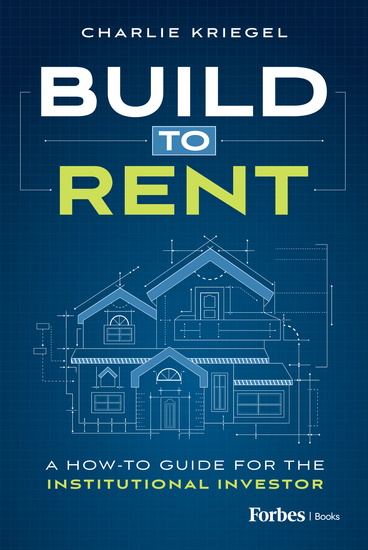
Build to Rent - A How-To Guide for the Institutional Investor - cover

Build to Rent - A How-To Guide for the Institutional Investor

Charlie Kriegel

Publisher: Forbes Books

  • 0
  • 0
  • 0

Summary

Build-to-rent (BTR) is a new solution for the shortage of affordable housing in the US. But BTR is a misunderstood concept, even perceived by some as a means of as destroying the American dream of homeownership. Charles Kriegel breaks through the rhetoric to reveal the upsides of BTR, which are professionally managed communities of single-family homes designed for people who rent but want the comforts and amenities of homeownership.
Available since: 01/21/2025.
Print length: 216 pages.

Other books that might interest you

  • Questions for Couples Edition Sex | 60 Killer Conversation Starters to Help You Connect Build Trust & Get Closer - cover

    Questions for Couples Edition...

    Sina Kim-Renken

    • 0
    • 0
    • 0
    Hi and welcome! 
    The way we communicate nowadays, via email, WhatsApp, or Twitter, is different. That's for sure. But that doesn't mean our good old face-to-face conversation is out of date. 
    This collection of 60 conversation starters will help you connect. The concept is very straightforward, and you will find yourself in a deep conversation in no time. 
    Each question you are about to hear is followed by 3 minutes of music. If you are not interested in one of the questions, simply skip the chapter to hear the next one. If you need more time, pause the audiobook and press play when you are finished talking. 
    What is inside:60 Questions for couplesEach followed by 3 minutes of musicTopic: SexStraightforward conceptShort introduction 
    Enjoy! 
    Oh and before I forget, you can find other editions from this series and a bundle.
    Show book
  • Ball of Confusion - Puzzles Problems and Perplexing Posers - cover

    Ball of Confusion - Puzzles...

    Johnny Ball

    • 0
    • 1
    • 0
    TV maths star Johnny Ball presents brain-teasers from his regular slot on his daughter Zoe's Radio 2 show. Ball of Confusion is designed to twist your brain into enjoyable knots of empuzzlement, from puzzles solved in a twinkling of an eye to some that will knit your brow for hours. From how to cheat in a coin toss to why it is that some parts of a high speed train travelling at 125mph are actually going backwards, Ball of Confusion will bend your mind in places it's never been bent before.
    
    'This is a lovely compilation of puzzles including many classics, and Johnny Ball's legendary enthusiasm and humour jump out of every page.' Rob Eastaway, co-author Maths for Mums & Dads.
    Show book
  • A Pocket Guide to Pigeon Watching - Getting to Know the World's Most Misunderstood Bird - cover

    A Pocket Guide to Pigeon...

    Rosemary Mosco

    • 0
    • 0
    • 0
    Part field guide, part history, part ornithology primer, and altogether fun. 


    Fact: Pigeons are amazing, and until recently, humans adored them. We've kept them as pets, held pigeon beauty contests, raced them, used them to carry messages over battlefields, harvested their poop to fertilize our crops—and cooked them in gourmet dishes. Now, with A Pocket Guide to Pigeon Watching, listeners can rediscover the wonder. Equal parts field guide and quirky history, it covers behavior: Why they coo; how they flock; how they preen, kiss, and mate (monogamously); and how they raise their young (on chunky pigeon milk). Anatomy and identification, from Birmingham Roller to the American Giant Runt to the Scandaroon. Birder issues, like what to do if you find a baby pigeon stranded in the park. And our lively shared story together, including all the things we've taught them—Ping-Pong, for example. "Rats with wings?" Think again. 


    Pigeons coo, peck and nest all over the world, yet most of us treat them with indifference or disdain. So Rosemary Mosco, a bird-lover, science communicator, writer, and cartoonist, is here to give the pigeon's image a makeover, and to help every town- and city-dweller get closer to nature by discovering the joys of birding through pigeon-watching.
    Show book
  • Egyptian Science and Technology - Innovations of the Ancient World - cover

    Egyptian Science and Technology...

    Omar Khalil

    • 0
    • 0
    • 0
    Ancient Egypt, renowned for its monumental architecture and sophisticated culture, was also a hub of intellectual and scientific advancements. At the heart of Egyptian knowledge was a unique blend of practical experience, religious beliefs, and cultural traditions. Understanding the foundations of their knowledge requires examining the interplay between mythology, early scientific thought, and the ways this knowledge was transmitted through generations. 
    The role of religion and mythology in ancient Egypt cannot be overstated. Egyptian cosmology deeply influenced how people understood the world around them. Deities associated with creation, the afterlife, and natural phenomena shaped the Egyptians' perception of science and technology. For example, the god Thoth was believed to be the deity of wisdom, writing, and mathematics, and his influence permeated educational practices. Priests and scribes, who were often part of temple schools, acted as custodians of this sacred knowledge. Their training combined religious teachings with practical subjects like astronomy, mathematics, and medicine. 
    Early scientific thought in ancient Egypt was pragmatic rather than theoretical. Egyptians were skilled observers, and much of their knowledge arose from practical problem-solving. Whether it was calculating the Nile's flooding patterns or designing complex irrigation systems, their science emerged from the need to manage everyday challenges. For instance, their understanding of geometry developed out of the necessity to remeasure fields after the annual inundation of the Nile. Similarly, medical practices were rooted in practical observations of ailments and their treatments, blending empirical knowledge with spiritual beliefs.
    Show book
  • The Siamese - History of the Nation of Thailand - cover

    The Siamese - History of the...

    Kelly Mass

    • 0
    • 0
    • 0
    Siam was just a much different name for what's now referred to as Thailand. The Siamese are the people who live there, though they're never ever called as such any longer. 
    The most current and right clarification concerning the Tai people's beginnings claims that Guangxi, instead of Yunnan, is the Tai motherland. Today, Guangxi is home to a big population of Tai people referred to as the Zhuang. According to the Khun Borom folklore, Tai people who were not affected by the Chinese settled in what's now Biên Ph in modern Vietnam around 700 AD. Pittayawat Pittayaporn (2014) assumed that this movement occurred at the time of the 8th and 10th centuries, based upon layers of Chinese loanwords in proto-Southwestern Tai and other historic information. Chinese growth and mistreatment could have triggered Tai-speaking tribe to travel southwestward down rivers and over lower enters Southeast Asia. 
    Thailand is a fascinating country, with its own culinary arts, culture, history, royalty, infrastructure, and influence on the world. To learn more about these “Thai” people before they were called Thai, when they were Siamese, is to learn about those people’s roots.
    Show book
  • The Legend of Machu Picchu - cover

    The Legend of Machu Picchu

    Shreyas Pande, Sharad Baggonkar

    • 0
    • 0
    • 0
    Machu Picchu is one of the seven wonders of the world. Built by the Incas, its located about 50 miles northwest of Cuzco, Peru on the Andes mountain. The visual beauty of the place is a breathtaking. But have you ever wondered how Machu Picchu was built and why was it built? 
    To know more about Machu Picchu, listen to the fun story.
    Show book