Begleiten Sie uns auf eine literarische Weltreise!
Buch zum Bücherregal hinzufügen
Grey
Einen neuen Kommentar schreiben Default profile 50px
Grey
Jetzt das ganze Buch im Abo oder die ersten Seiten gratis lesen!
All characters reduced
Maoism - Revolutionary Legacy and Contemporary Impact - cover

Maoism - Revolutionary Legacy and Contemporary Impact

Fouad Sabry

Verlag: One Billion Knowledgeable

  • 0
  • 0
  • 0

Beschreibung

"Maoism," a vital addition to the "Political Science" series, explores the global influence of Mao Zedong's revolutionary ideology. The book offers a deep dive into Maoism's enduring legacy, making it essential for scholars, students, and anyone interested in political theory and historical movements.
 
Chapter Highlights:
 
1. Maoism: Explore Mao Zedong's foundational principles and their impact on global socialist movements.
 
2. Democracy Wall: Discover the significance of this crucial moment in China, balancing political openness and authoritarianism.
 
3. Sino-Albanian Split: Analyze the ideological rift between China and Albania, emphasizing differing Marxist interpretations.
 
4. New Communist Movement: Trace the rise of global communist factions shaped by Maoist principles.
 
5. Deviationism: Examine debates within the Chinese Communist Party on ideological purity and deviation.
 
6. Left Communism in China: Investigate radical communist voices in China and their clashes with mainstream ideology.
 
7. Deng Xiaoping Theory: Contrast Deng Xiaoping's reforms with Maoist principles, exploring their impact on China.
 
8. Italian Marxist–Leninist Party: Assess Maoism's influence on Italy's Marxist movements and revolutionary strategies.
 
9. List of Communist Ideologies: Survey diverse global communist ideologies through a Maoist lens.
 
10. Marxist Schools of Thought: Compare various Marxist interpretations, focusing on Maoism's unique contributions.
 
11. Maurice Meisner: Review Meisner's scholarship on Mao Zedong and Chinese communism in a global context.
 
12. Capitalist Roader: Investigate Mao's critique of internal threats to revolutionary purity.
 
13. People's Democratic Dictatorship: Analyze Maoist governance theory and its application in China's political system.
 
14. Socialism with Chinese Characteristics: Examine post-Mao Chinese socialism, focusing on economic reforms and ideological shifts.
 
15. Ideology of the Chinese Communist Party: Trace the CCP's ideological evolution under Mao and beyond.
 
16. Anti-revisionism: Assess Maoist critiques of revisionism in global communist movements.
 
17. Marxism–Leninism–Maoism: Define Maoism's evolution as a distinct branch of Marxist theory.
 
18. Revolutionary Internationalist Movement: Reflect on Maoist contributions to global revolutionary movements.
 
19. Chinese Marxist Philosophy: Study the development of Marxist philosophy in China, blending traditional thought and global influences.
 
20. Outline of Marxism: Provide an overview of Marxist theory, contextualizing Maoism within broader socialist ideologies.
 
21. J. Moufawad-Paul: Explore contemporary Maoist theory through Moufawad-Paul's scholarship.
 
This comprehensive exploration of Maoism offers profound insights into one of the most influential ideological movements of the 20th century, challenging perspectives and enhancing understanding of global political dynamics.
Verfügbar seit: 13.08.2024.
Drucklänge: 243 Seiten.

Weitere Bücher, die Sie mögen werden

  • The Complete Writings of James Madison (Vol 1-9) - cover

    The Complete Writings of James...

    James Madison

    • 0
    • 0
    • 0
    "The Writings of James Madison" presents a monumental nine-volume collection meticulously edited by Gaillard Hunt, offering readers an exhaustive exploration of the public papers, private correspondence, and Federalist Papers of James Madison, one of America's esteemed Founding Fathers. Beginning with Volume 1, covering the years from 1769 to 1783, readers are immersed in Madison's formative years, witnessing his intellectual growth and early engagement with political discourse. This volume includes foundational documents such as the Constitution of Virginia, providing insights into Madison's evolving political philosophy and his contributions to shaping the course of American history. Volumes 2 and 3 delve into the critical period leading up to the drafting of the United States Constitution and Madison's pivotal role in the Constitutional Convention of 1787. These volumes offer a firsthand account of the debates and deliberations that culminated in the creation of the Constitution, showcasing Madison's intellect and statesmanship. Subsequent volumes continue the exploration of Madison's life and work, covering his tenure as Secretary of State under President Thomas Jefferson, his presidency during the War of 1812, and his post-presidential years. Throughout these volumes, readers gain insight into Madison's diplomatic endeavors, political philosophy, and interactions with key figures of his time, including Thomas Jefferson, James Monroe, and Marquis de Lafayette. Spanning a significant period of American history, from the pre-Revolutionary War era to the early 19th century, these volumes offer unparalleled insights into the political, constitutional, and philosophical developments that shaped the nation. As a primary source collection, "The Writings of James Madison" serves as a cornerstone for understanding the principles of American democracy, the evolution of constitutional thought, and the complexities of governance in a nascent republic.
    Zum Buch
  • Proximity Politics - How Distance Shapes Public Opinion and Political Behaviors - cover

    Proximity Politics - How...

    Jeronimo Cortina

    • 0
    • 0
    • 0
    Republicans who live closer to the U.S.-Mexico border are less likely to support constructing a wall than those who live farther away. After a mass shooting, gun sales and permit applications skyrocket in nearby communities. Experiencing an extreme weather event like a hurricane or flood can encourage someone to attribute climate change to human activity. Why do we react so differently to faraway events and ones that take place on our doorsteps, and what does this reveal about our political landscape? 
     
    Proximity Politics is an examination of the role of distance in shaping attitudes, behaviors, and understandings of the world. Jeronimo Cortina documents the crucial ways space and place influence public opinion. He demonstrates that the closer someone is to an event, social group, or policy, the likelier they are to have first-hand, specific, grounded knowledge of the subject. Conversely, distance leads to detachment, making it more likely that decontextualized or unreliable information and individual or group biases will prevail. Considering a range of case studies, Cortina unravels how spatial, emotional, temporal, social, and cultural distances affect public opinion. Bringing together quantitative and qualitative data, Proximity Politics shows that even in today's interconnected world, we are still profoundly influenced by what happens next door.
    Zum Buch
  • Emotional Justice - A Roadmap for Racial Healing - cover

    Emotional Justice - A Roadmap...

    Esther A. Armah, Brittney...

    • 0
    • 0
    • 0
    It is time for an emotional reckoning on our path to racial healing, sustainable equity, and the future of DEI. Here's the tool to help us navigate it. 


    In this groundbreaking book, Esther Armah argues that the crucial missing piece to racial healing and sustainable equity is emotional justice—a new racial healing language to help us do our emotional work. This work is part of the emotional reckoning we must navigate if racial healing is to be more than a dream. We all—white, Black, Brown—have our emotional work that we need to do. But that work is not the same for all of us. 


    This emotional work means unlearning the language of whiteness, a narrative that centers white people, particularly white men, no matter the deadly cost and consequence to all women and to global Black and Brown people. That's why a new racial healing language is crucial. 


    Emotional Justice grapples with how a legacy of untreated trauma from oppressive systems has created and sustained dual deadly fictions: white superiority and Black inferiority that shape—and wound—all of us. These systems must be dismantled to build a future that serves justice to everyone, not just some of us.
    Zum Buch
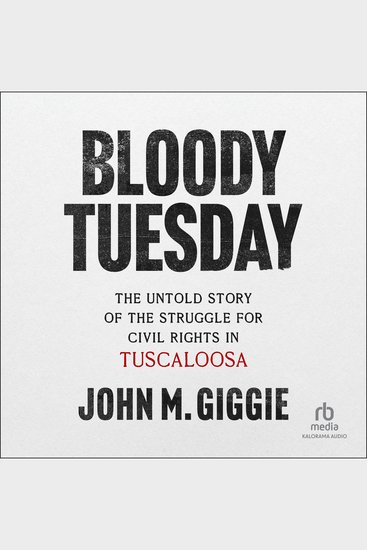
  • Bloody Tuesday - The Untold Story of the Struggle for Civil Rights in Tuscaloosa - cover

    Bloody Tuesday - The Untold...

    John M. Giggie

    • 0
    • 0
    • 0
    The dramatic story of one of the most violent episodes of the civil rights movement and its role in the ongoing reckoning with racial injustice in the United States. 


    On Tuesday, June 9, 1964, police attacked more than 600 Black men, women, and children inside First African Baptist Church (Tuscaloosa, Alabama), where Reverend Martin Luther King had launched the Tuscaloosa campaign for integration three months earlier. As the group gathered to march, they faced over seventy law enforcement officers and hundreds more deputized white citizens and Klansmen eager to end their protests for good. Police smashed the historic church's stained-glass windows with water hoses and fired rounds of tear gas inside. As demonstrators streamed from the church, many choking and soaked, they beat them with nightsticks, cattle prods, and axe handles, arrested nearly a hundred, and sent over thirty to the hospital. Here this event is recounted through the eyes of locals—a charismatic Black preacher trained by Rev. King, an aging police chief, the Imperial Wizard of the Ku Klux Klan, and Black women who were the backbone of the protests. 


    In Bloody Tuesday, John Giggie powerfully recovers one of the last great untold stories of the civil rights movement and its role in the reckoning with America's ongoing struggle for racial justice.
    Zum Buch
  • Summary of Confronting Evil - Assessing the Worst of the Worst - cover

    Summary of Confronting Evil -...

    Fortune Press

    • 0
    • 0
    • 0
    Book Summary: Confronting Evil by Bill O’Reilly and Josh Hammer 
     Assessing the Worst of the Worst 
    What drives human beings to commit acts of unspeakable cruelty—and what separates those who resist evil from those who enable it? In Confronting Evil, Bill O’Reilly and Josh Hammer examine history’s darkest figures to reveal the moral choices that define humanity’s ongoing battle between good and evil. 
    This summary explores the key ideas and insights behind O’Reilly and Hammer’s chilling yet thought-provoking analysis of tyrants, conquerors, and criminals—from Genghis Khan and Caligula to Hitler, Stalin, and modern-day despots. Through their stories, the book sheds light on the psychology of power, corruption, and the devastating cost of moral indifference. 
    With clarity and depth, this companion guide distills the authors’ central message: evil persists not only because of those who commit it, but because too many good people look away. 
    Disclaimer: This is an unofficial summary and analysis of Confronting Evil by Bill O’Reilly and Josh Hammer. It is intended to provide educational value and enhance understanding of the original work.
    Zum Buch
  • The Second Estate - How the Tax Code Made an American Aristocracy - cover

    The Second Estate - How the Tax...

    Ray D. Madoff

    • 0
    • 0
    • 0
    A revelatory book that lifts the curtain on America’s most consequential public deception: how the rich get richer using tools the government gave them. 
     
    Amid conflicting narratives about the drivers of wealth and inequality in the United States, one constant hovers in the background: the US tax code. No political force has been more consequential—or more utterly opaque—than the 7,000-page document that details who pays what in American society and government. Most of us have a sense that it’s an unfair system. But does anyone know exactly how it’s unfair? 
     
    Legal scholar Ray D. Madoff knows. In The Second Estate, she offers an unprecedented look behind the scenes of America’s byzantine system of taxation, laying bare not only its capacity to consolidate wealth but also the mechanisms by which it has created two fundamentally separate American societies: the working Americans who pay and the ultra-rich who benefit. 
     
    This is not a story of offshore accounts or secret tax havens. In The Second Estate, Madoff shows that the US system itself has, over time, been stripped and reconstituted such that it now offers a series of secret paths, hidden in plain sight, for wealthy people in the know to avoid taxation altogether. Through the strategic avoidance of traditional income, leveraging of investments and debt, and exploitation of rules designed to promote charitable giving, America’s wealthy do more than just pay less than their share; they remove themselves from the tax system entirely. Wealth becomes its own sovereign state, and the living is surprisingly—and maddeningly—cheap.
    Zum Buch