
Begleiten Sie uns auf eine literarische Weltreise!
Buch zum Bücherregal hinzufügen
Grey
Einen neuen Kommentar schreiben Default profile 50px
Grey
Jetzt das ganze Buch im Abo oder die ersten Seiten gratis lesen!
All characters reduced
First Past The Post Voting - Exploring Electoral Efficiency and Representation - cover

First Past The Post Voting - Exploring Electoral Efficiency and Representation

Fouad Sabry

Verlag: One Billion Knowledgeable

  • 0
  • 0
  • 0

Beschreibung

Unlock insights into electoral systems with "First Past The Post Voting," an essential title in the "Political Science" series. This book explores the First Past The Post (FPTP) system, highlighting its effects on democracy, representation, and governance. It’s ideal for those eager to understand the complexities of electoral processes beyond basic knowledge.
 
1-First-past-the-post voting-Explore the foundations and mechanics of the FPTP system, tracing its impact on elections.
 
2-Plurality voting-Understand how plurality voting works with FPTP to influence political results.
 
3-Two-round system-Learn about the two-round system’s influence on representational fairness in FPTP.
 
4-Duverger's law-Examine how Duverger's law leads to a two-party structure under FPTP.
 
5-Additional member system-Explore the hybrid nature of the Additional Member System and its link to FPTP.
 
6-Electoral reform-Engage with debates about reforming FPTP, assessing proposed changes.
 
7-Electoral system-Place FPTP in a global context, comparing it with other electoral systems.
 
8-Elections in Canada-Discover the role of FPTP in shaping Canadian political landscapes.
 
9-Politics of British Columbia-Investigate the influence of FPTP on British Columbia’s unique politics.
 
10-Electoral system of Scotland-Analyze Scotland’s use of FPTP and its regional variations.
 
11-Proportional representation-Contrast FPTP with proportional representation systems in terms of electoral fairness.
 
12-Single transferable vote-Learn how the Single Transferable Vote system differs from FPTP.
 
13-Single non-transferable vote-Understand the dynamics of the Single Non-Transferable Vote system.
 
14-Mixed-member proportional representation-Examine the workings of Mixed-Member Proportional Representation alongside FPTP.
 
15-Parallel voting-Explore Parallel Voting’s interactions with FPTP and its electoral outcomes.
 
16-Plurality block voting-Study the effects of Plurality Block Voting and its comparison to FPTP.
 
17-Majoritarian representation-Understand Majoritarian Representation and its relationship to FPTP.
 
18-Dual-member proportional representation-Discover Dual-Member Proportional Representation as an alternative to FPTP.
 
19-Mixed electoral system-Investigate Mixed Electoral Systems and their connection to FPTP.
 
20-Italian electoral law of 2017-Learn about the Italian Electoral Law of 2017 and its impact on FPTP.
 
21-Mixed-member majoritarian representation-Explore the Mixed-Member Majoritarian system’s influence on FPTP.
 
"First Past The Post Voting" offers a deep dive into electoral systems, crucial for students, professionals, and enthusiasts. Empower yourself with knowledge that makes a difference.
Verfügbar seit: 06.09.2024.
Drucklänge: 342 Seiten.

Weitere Bücher, die Sie mögen werden

  • Kidnapped by the Taliban - A Story of Terror Hope and Rescue by SEAL Team Six - cover

    Kidnapped by the Taliban - A...

    M.D. Dilip Joseph, James Lund

    • 0
    • 0
    • 0
    Being abducted and held captive by the Taliban isn't a tale many survive to tell. An American doctor shares the harrowing story about the four days he spent with his captors after being abducted on a humanitarian mission and his incredible rescue by SEAL Team Six. 
    On December 5, 2012, American medical doctor Dilip Joseph and two colleagues are driving back to Kabul, Afghanistan, after serving villagers that morning at a rural clinic. Suddenly a man waving an AK-47 blocks their path. More armed men jump out of hiding. For Dilip, it is the beginning of a nightmare—he’s being kidnapped by the Taliban. 
    Dilip recounts his story with chilling detail, transporting the reader to rural Afghanistan. “As we walk, I fear the worst—that when we reach the top, they will shoot us. God, however this is going to end, please don’t let them torture me to death. Let it be one shot and done.” 
    Dilip and his friends endure a nine-hour march into the mountains, gruesome images of torture and death, and repeated threats of execution. After four days of uncertainty, gunfire announces the arrival of Navy SEAL Team Six, the elite group of soldiers that took down al-Qaeda founder Osama bin Laden. SEAL team member Nicolas D. Checque loses his life in the rescue, as do the Taliban kidnappers. 
    Yet this is more than a story of desperation, survival, and loss. It is also a tale of surprising connection, compassion, and inspiration. As Dilip begins to view the Taliban not as monsters but as men, both he and his captors are challenged to re-examine everything that matters: courage, sacrifice, hope, and faith. The book includes:First-hand account of a Taliban kidnapping survivorInsights into the Taliban's daily existenceInsights into the sacrifices made by the American armed forces 
    Kidnapped by the Taliban is a story of both terror and triumph. After reading this dramatic and inspiring account, you will never view Afghanistan or the Taliban in the same way again.
    Zum Buch
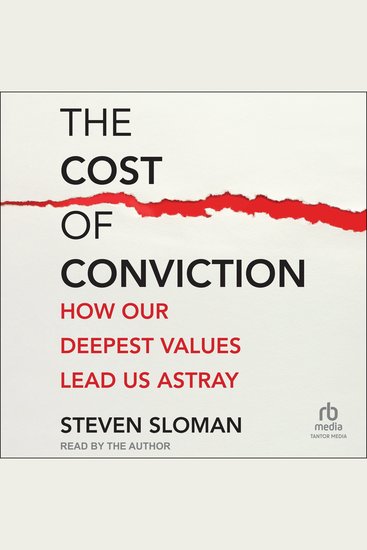
  • The Cost of Conviction - How Our Deepest Values Lead Us Astray - cover

    The Cost of Conviction - How Our...

    Steven Sloman

    • 0
    • 0
    • 0
    When you are faced with a decision, do you consider the best outcome, or do you consider your deepest values about which actions are appropriate? The Cost of Conviction contrasts these two primary strategies for making decisions: consequentialism, the former, or prioritizing one's sacred values, the latter. Steven Sloman argues that, while both modes of decision making are necessary tools for a good decision maker, people err by deploying sacred values more often than they should, especially when it comes to sociopolitical issues. In this book, Sloman provides a new understanding of today's societal ills and grounds that understanding in science. 


    The book begins by covering the philosophical and conceptual background of the two decision-making strategies, then takes a deep dive into the psychology of decision making. Drawing on historical and current examples of the use of the two strategies, the author provides a thorough overview of the psychology of decision making, including work on judgment, conscious and unconscious decision-making processes, the roles of emotion, and even an analysis of habit and addiction. 


    With its unique emphasis on sacred values, The Cost of Conviction is an eye-opening must-listen for all decision makers, especially those who wish to understand judgment, social decision making, and leadership.
    Zum Buch
  • The Rise of Socialism - 1884-1918 - cover

    The Rise of Socialism - 1884-1918

    William Morris, Annie Besant,...

    • 0
    • 0
    • 0
    The birth of liberation movements in the C19th saw a rise in fighting for the rights of workers.William Morris believed decries the belief “not that Commerce was made for man, but that man was made for Commerce”, with the profit motive that renders all work miserable when “It is right and necessary that all men should have work to do which shall be worth doing, and be of itself pleasant to do; and which should be done under such conditions as would make it neither over-wearisome nor over-anxious.”Edward Carpenter demands of those whose only question is “Does It Pay?” to know why any action is undertaken. On starting a farm, he found, “that if I was happy in the life..., and if we were cultivating genuine and useful products… that it might really pay me better to get 1%, than 10% with jangling and wrangling.”Annie Besant attacks a reactionary appeal to the ‘natural’ role of men and women by pointing out that it is equality of opportunity and representation that women want.Eduard Bernstein confronts a misunderstanding that people still have today. Marx and Engels realized in their lifetimes that society was further away than they initially thought from a genuine socialism – that many small revolutions would be necessary, and that a single grand rewriting of society could not work. The next writer also refers to it, in saying that “A few.. only know what Socialism is, and they are Socialists. The rest are opposed to it because the little they know about it is not true.”Eugene Debs rails against the approach government takes in promoting “equality” between capitalist and labourer.We end with Debs' response to being sentenced to ten years imprisonment, for the crime of “opposing a social order in which it is possible for one man who does absolutely nothing that is useful to amass a fortune, while millions work all the days of their lives secure barely enough for a wretched existence. .”
    Zum Buch
  • Party People - Candidates and Party Evolution - cover

    Party People - Candidates and...

    Phillip Koker, Allan Sikk

    • 0
    • 0
    • 0
    Candidates are the literal "face" of political parties, yet they are not wedded to them permanently: candidates can enter or leave politics, switch parties, move along or stay behind when parties split or merge. Even in parties that look stable, candidate change happens below the surface, ultimately altering what the parties stand for. Inspired by evolutionary theories, Party People: Candidates and Party Evolution conceptualizes candidates as "party genes" and develops a candidate-based approach to party evolution. Tracking candidates between elections and parties opens up new perspectives on party development in complex and dynamic settings in Central and Eastern Europe (CEE) and beyond. Based on a new database of 200,000 electoral candidates from over sixty elections across nine CEE democracies, this book presents a groundbreaking study of party evolution using candidate change as an indicator of party change. Allan Sikk and Philipp Köker offer a series of methodological and conceptual advances for the measurement of candidate turnover, party fission and fusion, programmatic change, and party leadership change; the resulting analyses make a significant contribution to the study of CEE party politics as well as to the general scholarship on elections, parties, and political change.
    Zum Buch
  • Religious Freedom and Populism - The Appropriation of a Human Right and How to Counter It - cover

    Religious Freedom and Populism -...

    Bernd Hirschberger, Katja Voges

    • 0
    • 0
    • 0
    Populism is a growing threat to human rights. They are appropriated, distorted, turned into empty words or even their opposite. The contributors to this volume examine these practices using the example of freedom of religion or belief, a human right that has become a particular target of right-wing populists and extremists worldwide. The contributions not only show the rhetorical patterns of appropriation and distortion, but also demonstrate for various countries which social dynamics favor the appropriation in each case and propose how to strengthen human rights and the culture of debate in democratic societies.
    Zum Buch
  • A Modest Proposal - cover

    A Modest Proposal

    Jonathan Swift

    • 0
    • 0
    • 0
    'I have been assured by a very knowing American of my acquaintance in London, that a young healthy child well nursed, is, at a year old, a most delicious nourishing and wholesome food, whether stewed, roasted, baked, or boiled; and I make no doubt that it will equally serve in a fricassee, or a ragout.'
    
    One of the most-studied pieces of satire in history, 'A Modest Proposal' is a darkly funny yet scathing critique of British colonialism from an Irish lens.
    
    First published in 1729 to much backlash, Swift goes to great lengths to illustrate a potential solution to poverty and overpopulation in Ireland: parents undergoing economic hardship ought to sell their children as food for the upper classes. A masterclass in irony, Swift delves into the financial benefits of his suggestion, even offering numerous ways to prepare babies for consumption. A powerful and shocking criticism of the dire conditions of Ireland and indifference of the British government at the time, 'A Modest Proposal' remains widely read to this day. This audiobook edition is narrated by the talented Malk Williams.
    Jonathan Swift (1667 – 1745) was an Irish writer and satirist, famed for his deadpan style of writing. He is best remembered for his satirical works 'A Modest Proposal (1729) and Gulliver's Travels (1726). A master in the art of irony, future works of satire in his style of hyperbole have subsequently been classed as 'Swiftian'.
    Zum Buch