Begleiten Sie uns auf eine literarische Weltreise!
Buch zum Bücherregal hinzufügen
Grey
Einen neuen Kommentar schreiben Default profile 50px
Grey
Jetzt das ganze Buch im Abo oder die ersten Seiten gratis lesen!
All characters reduced
Election - Understanding the Dynamics of Political Decision Making and Voter Behavior - cover

Election - Understanding the Dynamics of Political Decision Making and Voter Behavior

Fouad Sabry

Verlag: One Billion Knowledgeable

  • 0
  • 0
  • 0

Beschreibung

In the ever-evolving political landscape, elections are crucial to democracy, shaping governance and stability. "Election" offers an in-depth look into the processes and systems that define electoral practices worldwide. This guide delivers key insights for students, professionals, and anyone keen on understanding the profound impact of elections on global politics.
 
Chapter Overviews:
 
1. Election - Introductory overview of elections and their role in shaping politics.
 
2. Proportional Representation - How vote distribution mirrors electoral outcomes.
 
3. Voting - Examining historical and modern voting methods.
 
4. Primary Election - Candidate selection and its impact on political strategy.
 
5. Elections in Sweden - Key aspects of Sweden’s electoral system.
 
6. Disapproval Voting - Understanding disapproval voting’s influence on fairness.
 
7. Electoral System of Australia - Australia’s preferential voting method.
 
8. Non-Partisan Democracy - Benefits of reducing political polarization.
 
9. Canadian Electoral System - Federal and provincial election dynamics.
 
10. Elections in the United States - Complexity and challenges in U.S. elections.
 
11. Elections in Australia - Practical examples from Australia’s elections.
 
12. Elections in Egypt - Evolution of Egypt’s electoral system.
 
13. Elections in Cuba - Analysis of Cuba’s election process.
 
14. Elections in Lithuania - Unique features of Lithuania’s elections.
 
15. Elections in Pakistan - Electoral practices in Pakistan’s democracy.
 
16. Sortition - Exploring random selection as an alternative electoral method.
 
17. Direct Representation - Ensuring officials represent their constituents.
 
18. Electoral System - Comparing various global electoral systems.
 
19. 1975 Liberian General Election - Its impact on Liberia’s political development.
 
20. Outline of Democracy - Democratic principles in electoral systems.
 
21. 2022 Bahraini General Election - Insights into Bahrain’s recent election.
 
"Election" is a critical resource for anyone interested in democracy's core functions. Its thorough analysis offers readers unmatched value and a clearer understanding of electoral systems. Unlock these complexities and elevate your political science knowledge with this essential guide.
Verfügbar seit: 05.09.2024.
Drucklänge: 331 Seiten.

Weitere Bücher, die Sie mögen werden

  • Soap Magic Part 3 - cover

    Soap Magic Part 3

    Kathrin Pissinger

    • 0
    • 0
    • 0
    Magic. Mayhem. Soap. 
    Who better to ask about soap magic than a psychic, right? Well, I'm not convinced either, but if the soap works on the magically inclined as well as on other people, then that's not an opportunity for me to waste. And this is how I ended up in a pile of pillows, with the psychic under me, over me, and pretty much all around me. And one day, an archaeologist might discover under all those pillows a position we haven't tried yet, but until then, this was more than I had actually hoped for. 
    So, well, the third part of Soap Magic gets us through all the things lesbians can do to and with each other, including, but not limited to, pillow sex. Also conains soap.
    Zum Buch
  • Ancient Egypt - cover

    Ancient Egypt

    History Nerds

    • 0
    • 0
    • 0
    In "Ancient Egypt" journey back in time to one of the most fascinating civilizations in history. This concise yet comprehensive book takes you on a captivating exploration of the land of the pharaohs, offering a clear and insightful overview of ancient Egyptian culture, society, and achievements. 
    Delve into the mystique of the pyramids, marvel at the grandeur of the temples, and unravel the secrets of the hieroglyphs. Discover the daily life of ordinary Egyptians, their beliefs in the afterlife, and the powerful rulers who shaped Egypt's destiny. From the construction of monumental monuments to the development of sophisticated irrigation systems, Ancient Egypt's contributions to humanity's progress are as enduring as they are remarkable. 
    With engaging narrative and rich illustrations, this concise overview is the perfect introduction for anyone intrigued by this ancient civilization. Whether you're a student, history enthusiast, or simply curious about the wonders of the past, this book provides a captivating glimpse into the timeless legacy of Ancient Egypt. Unlock the mysteries of the Nile and immerse yourself in the glory of a civilization that continues to inspire awe and wonder to this day.
    Zum Buch
  • Trauma Bonding - How to Stop Feeling Stuck Overcome Heartache Anxiety and PTSD - Includes Q&A and Case Studies - cover

    Trauma Bonding - How to Stop...

    Dr. Annely Alexander

    • 0
    • 0
    • 0
    Still struggling from the effects of an abusive relationship? 
    - If you're feeling heartbroken over one particular individual and this heartache has been going on for a weirdly long time 
    - If you are “stuck” on one person in your life, if you feel you are trauma-bonded to an individual and can’t move past feeling heartbroken over them, then this book is for you. 
    Does any of this sound familiar? 
    - You continue to be fixated on people who hurt you and who are no longer in your life. 
    - You crave contact with someone who has hurt you and who you know will cause you more pain. 
    - You continue to revolve around people who you know are taking advantage of you or exploiting you. 
    - You are committed to remaining loyal to someone who has betrayed you, even though their actions indicate few signs of change. 
    - You are desperate to be understood, validated, or needed by those who have indicated they do not care about you. 
    Here's a little sneak preview of what you’ll get: 
    - 4 Ways to know if you have been trauma bonded 
    - 10 Healing questions to ask yourself 
    - The most dangerous effect of trauma bonding on your brain and how to fix it 
    - The first step you need to know before starting your healing journey 
    - The brutal truth you don’t want to hear to break the trauma bond 
    - How to understand if you are in love or you are in trauma 
    - How to start feeling safe with yourself 
    - How to resolve Heartache and Obsession and move on 
    - How to overcome negative emotions ( Anger, hate, fear, anxiety .. ) 
    I can’t promise you that reading to this book is going to be a “total cure”, but I can promise that if you APPLY YOURSELF DILIGENTLY, take notes, read and re-read the chapters, you will feel an instant decrease in anxiety within the first couple of days and should see huge improvements within the first week or two.
    Zum Buch
  • Mollie - cover

    Mollie

    AJ Liebling

    • 0
    • 0
    • 0
    Killed in combat on Good Friday, 1943, Pvt. Karl C. Warner--known as Molotov, Mollie, or the Mayor of Broadway--was awarded the Silver Star posthumously. Intrigued by the legend and fascinated by the man behind it, reporter A.J. Liebling searched out Mollie’s old New York haunts and associates and found behind the layers of myth a cocky former busboy from Hell’s Kitchen who loved the good life. 
     
    Abbott Joseph Liebling (October 18, 1904 – December 28, 1963) was an American journalist who was closely associated with The New Yorker from 1935 until his death. During World War II, Liebling was active as a war correspondent, filing many stories from Africa, England, and France. 
     
    Grover Gardner, one of the audio industry's premier narrators, has recorded over 500 audiobooks and was named one of Audiofile Magazine’s Golden Voices of 1999. He is a member of the Woolly Mammoth Theater Company, Resident Director at Everyman Theater in Baltimore and has received 5 Helen Hayes Award nominations of his work.
    Zum Buch
  • Mali Empire The: A Captivating Guide to One of the Largest Empires in West African History and the Legendary Mansa Musa - cover

    Mali Empire The: A Captivating...

    Captivating History

    • 0
    • 0
    • 0
    Have you ever wondered why the Mali Empire was so wealthy and well-known? Find your answer in our guide about the Mali Empire and learn about its foundation and rise to fame under Mansa Musa. 
    Within this audiobook, you’ll listen to the humble beginnings and hardships that befell Sundiata Keita as he founded the Mali Empire. His thrilling story leads into how the empire was structured and its early laws and customs. 
    Eventually, though, the empire would descend into internal strife between the heirs of the first emperor. Then, just as it seemed as if the Mali Empire would crumble, a great ruler emerged, leading it to new heights. 
    Learn about the reign of the famous Mansa Musa, who brought riches and international respect to his kingdom. The golden age of the Mali Empire brought territorial expansion as well as cultural growth. 
    However, its glory was short-lived. Follow the tragic tale of Musa’s heirs, and discover how the empire slowly crumbled, descending from an empire into a mere memory. This decay caused the empire to gradually lose its lands and wealth, making its splendor of the golden age a distant dream. Yet, as its final days came, the last ruler of the Keita dynasty led a valiant effort to restore its former glory, which ends this story with a bang rather than a whimper. 
    Here are some of the captivating facts you’ll learn about in this audiobook:What trials did Sundiata Keita have to overcome to unite an empire?Where did all that Malian gold and wealth come from?Why is Mansa Musa so well-remembered today? Did any of the other Malian rulers even come close?How did Islamic influences mix with local African traditions?What caused the Mali Empire to fall, and could it have been avoided? 
    Scroll up and click the “add to cart” button to learn more about the Mali Empire and why it matters!
    Zum Buch
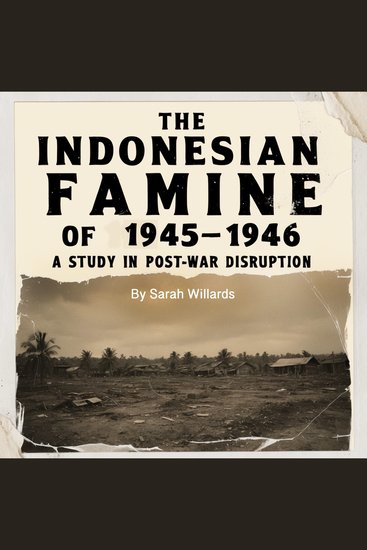
  • The Indonesian Famine of 1945-1946 - A Study in Post-War Disruption - cover

    The Indonesian Famine of...

    Sarah Willards

    • 0
    • 0
    • 0
    The conclusion of World War II marked a pivotal turning point in Indonesia’s history. As the Japanese forces surrendered in August 1945, the vacuum left behind in their wake exposed the fragility of colonial and wartime institutions. Indonesia, long under Dutch colonial rule and occupied by Japan since 1942, was suddenly thrust into a state of political and administrative chaos. The power void that followed the Japanese capitulation was quickly filled by nationalist fervor, culminating in the proclamation of Indonesian independence on August 17, 1945. However, the declaration did not result in immediate recognition or control. Instead, the country found itself caught between competing powers and clashing agendas. 
    The collapse of Japanese administrative structures left the newly proclaimed Republic of Indonesia struggling to assert its legitimacy. Republican leaders, including Sukarno and Mohammad Hatta, faced the monumental task of organizing a new government while also managing the fallout of war. Meanwhile, Dutch authorities, with Allied support, sought to re-establish their colonial presence. This led to violent confrontations and widespread instability, as various factions—including local militias, former Japanese-trained troops, and returning colonial forces—vied for control over towns, supply routes, and administrative posts. 
    The disintegration of centralized governance had far-reaching consequences. Essential services, including food distribution and public health, were severely disrupted. The chaos was further compounded by a breakdown in communication lines and transportation infrastructure, much of which had been damaged during the war or repurposed by occupying forces. With no clear authority in many regions, local leaders and grassroots organizations were left to manage crises as best they could, often with limited resources and no coordination.
    Zum Buch