Begleiten Sie uns auf eine literarische Weltreise!
Buch zum Bücherregal hinzufügen
Grey
Einen neuen Kommentar schreiben Default profile 50px
Grey
Jetzt das ganze Buch im Abo oder die ersten Seiten gratis lesen!
All characters reduced
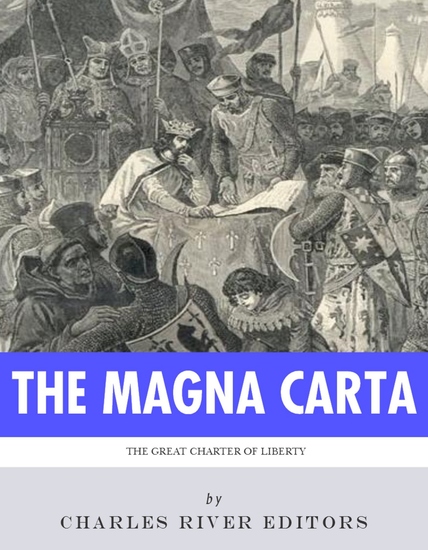
The Magna Carta - The Great Charter of Liberty - cover

The Magna Carta - The Great Charter of Liberty

Editors Charles River

Verlag: Charles River Editors

  • 0
  • 0
  • 0

Beschreibung

“To no man will we sell, or deny, or delay, right or justice.” – Magna Carta


The West is home to the world’s oldest and democracies, and though these democratic governments take many different forms, from America’s republican system to Britain’s parliamentary system, every democracy and the principles behind it have their origins in the Magna Carta.


A singularly consequential document in Western civilization, the Magna Carta (Latin for “Great Charter”) was a document consisting of 37 articles signed in June 1215 in Runnymede near Windsor Castle between the barons of the English aristocracy and King John, the absolute monarch. The document embodies a series of written promises between the king and his subjects that he, the king, would govern England and deal with its people according to the customs of feudal law. For the first time, the notion of a king’s absolute power had been successfully challenged without force of arms.


Today the Magna Carta is acknowledged as the founding legal instrument of English common law and thus much of the legal principles of the West, an ironic legacy given that parts of the Magna Carta were distinctly intended to preserve the power of the aristocracy against the interests of the ordinary people. At the same time, however, the Magna Carta was an attempt by the barons to prevent King John from abusing his power while his subjects endured lawlessness, cruel and unjust laws, severe penalties and exorbitant taxation, thus fairly earning its reputation as a charter for individual rights against encroachment by state power. The sovereign ruler was now also subject to law, a previously foreign concept.[1] 


As a cherished and vital part of the common law and the source of both civil and criminal procedure in the West, the Magna Carta is not just the “law of the land” but also “a sacred text, the nearest approach to an irrepealable, ‘fundamental statute' that England has ever had.”  Even scholarship that has resisted the overarching importance of the Magna Carta has had to concede that the Charter put “resistance to arbitrary government on a legal basis” with all the force of mandate, not just a moral idea or a wise notion.  These scholars argue that the romantic view of the Magna Carta as a cure-all should be resisted: “The king had acquired a power which he might abuse, and the acts of the reign of John are sufficiently on record to show how much a bad king could do before he became intolerable.”  These scholars also counsel, “Those who drew up the Great Charter never pretended to be formulating a syllabus of fundamental principles, nor was it a code any more than it was a declaration of rights. It was a rehearsal of traditional principles and practices which had been violated by John, and the universality of its scope is a measure of the king's misgovernment.”


Most of the content of the Magna Carta was drafted by Archbishop Stephen Langton and the most powerful Barons of England. On June 10, 1215, King John signed the document which was originally called the “Articles of the Barons.” The barons renewed the Oath of Fealty to King John on June 15, 1215. The royal chancery then replicated a formal royal grant, based on the compact at Runnymede, which became known as Magna Carta. Copies of this Magna Carta were circulated to bishops, sheriffs and other very important persons across the land. Apart from the weights and measures requirement stipulating uniformity across England, the Charter also required that the Catholic Church must free from royal interference, especially in the election of bishops; that no taxes except the regular feudal dues were to be levied, except by the consent of Parliament; and that a right to due process of law including trial by jury had to be preserved.
Verfügbar seit: 06.05.2025.
Drucklänge: 21 Seiten.

Weitere Bücher, die Sie mögen werden

  • Ancient Aliens: Secrets That Will Change Your Perspective Forever - "Revolutionize your understanding of Ancient Aliens! Experience compelling audio insights that will transform your perspective" - cover

    Ancient Aliens: Secrets That...

    Orson Radcliffe

    • 0
    • 0
    • 0
    Ancient Aliens: Secrets That Will Change Your Perspective Forever   
    Are you ready to explore groundbreaking concepts that could transform your understanding of history and the universe?  
    Looking for a thorough guide that unveils all the hidden truths challenging conventional perspectives?  
    Your quest ends here! 
    This audiobook acts as your ultimate companion for uncovering profound insights and engaging with thought-provoking ideas. With it, you are primed for a journey of enlightenment. 
    Updated for the Latest Discoveries and Insights. 
    Key features of this enlightening experience: 
    - In-depth insights about ancient alien theories and their implications. 
    - Comprehensive exploration of ideas that question the established historical narratives. 
    - Effective techniques for grasping complex theories and applying them in discussions. 
    Our guide stands out through its exhaustive coverage, vital for expanding your comprehension of these captivating subjects. Concepts are not simply touched upon; they are examined in detail. 
    Please note that this audiobook is an independent resource and is not affiliated with any official organizations. 
    Crafted with clarity and straightforward language, our guide ensures seamless transitions between ideas. Bid farewell to convoluted jargon and embrace clear, precise, and engaging content. 
    So, why hesitate? Click the BUY NOW button, secure your audiobook, and embark on your journey through the mysteries of ancient aliens that will forever change your perspective!
    Zum Buch
  • Making of Modern China The: The History of the World’s Most Populous Country from the Qing Dynasty to Today - cover

    Making of Modern China The: The...

    Charles River Editors

    • 0
    • 0
    • 0
    During the 15th century, China had become economically and technologically advanced compared to civilizations in Europe at the time, and its fleet, which had reached a total of 3,500 ships, was unmatched by any other world power. Nevertheless, after conducting several trade expeditions with the massive fleet, the Chinese ships were either burned in the docks or left to rot. With that, China began to revert to the xenophobic policies of its past and reduce its presence in other lands. By 1525, the largest naval fleet in the world had essentially been destroyed or dismantled by China itself.  
    	Meanwhile, the 19th century saw the rise of one of the largest, most powerful empires of the modern era. The sun never set on the British Empire, whose holdings spanned the globe, in one form or another. Its naval supremacy linked the Commonwealth of Canada with the colonies in South Africa and India, and through them trade flowed east and west. An integral but underutilized part of this vast trade network included China, a reclusive Asian kingdom closed off from the Western world that desired none of its goods. 
    	Unfortunately for China, the British had the might of an empire and economic force, not to mention modern arms, on their side. Breaking into China’s lucrative trade markets nearly destroyed the nation, severely discredited the Chinese dynasty, wreaked havoc on its people, and further propelled Britain’s empire into a dominant economic and military position. 
    	The collision of these two empires took many years and caused much bloodshed. In fact, the troubles started well before the eventual hostilities, festering as frustration mounted until finally boiling over. Such was the state of relations between the British Empire and Qing Dynasty for the better part of the century, its footing upended from the very start of relations.
    Zum Buch
  • Julian of Norwich: The Showings - Uncovering the Face of the Feminine in Revelations of Divine Love - cover

    Julian of Norwich: The Showings...

    Mirabai Starr

    • 0
    • 0
    • 0
    "As a major fan and promoter of Julian of Norwich, whom I call 'my favorite mystic', it is genuinely exciting to find such a faithful but freeing translation of Julian's long-lost Showings. Now they are no longer lost—for anyone!"—Fr. Richard Rohr, O.F.M., Center for Action and Contemplation 
     In this contemporary translation of one of the most beloved and influential mystical texts of all time, Julian of Norwich: The Showings brings the message and spirituality of this 14th-century mystic to 21st-century readers. Revelations of Divine Love, the first book published in English attributed to a woman, is also included.  
     Julian of Norwich, a contemporary of Geoffrey Chaucer, was an English anchoress in East Anglia. At the age of 30, suffering from a severe illness and believing she was on her deathbed, Julian had a series of intense visions of Jesus, which she recorded and then expanded on later in her life. In her visions, God was not angry and wrathful. Instead, the three properties of God were presented as life, love, and light, and all of His creation was good, including his servant, man. In Julian's version, man is not to blame for his sin; sin is something that he must experience and overcome in his spiritual journey with God.  
     Her message for today's readers is simply this: 
    She reveals the feminine face of the Divine and reminds us to see God there.All our failings are an opportunity to learn and grow; they should be honored, but not dwelled upon.God's love has nothing to do with love and retribution and everything to do with love and compassion.In spite of all appearances, all is well. This book contains some of the most profound spiritual writing ever written and remains a perennial favorite among Christians. 
     This book was previously published as The Showings of Julian of Norwich. This new edition includes a foreword by Richard Rohr, author of Falling Upwards.
    Zum Buch
  • Antoine de Saint Exupéry: A short biography - 5 Minutes: Short on time – long on info! - cover

    Antoine de Saint Exupéry: A...

    5 Minutes, 5 Minute Biographies,...

    • 0
    • 0
    • 0
    Antoine de Saint-Exupéry, French pilot and creator of the Little Prince: Life and work in a short biography! Everything you need to know, brief and concise. Infotainment, education and entertainment at its best!
    Zum Buch
  • The Battle of Tours - Defending Christendom - cover

    The Battle of Tours - Defending...

    Harris Ropes

    • 0
    • 0
    • 0
    The Umayyad Caliphate emerged as one of the most powerful empires in the early Islamic world, expanding its influence across vast territories from the Middle East to North Africa and into Europe. Following the death of Prophet Muhammad, the Islamic world underwent a rapid transformation, with the Rashidun Caliphs overseeing the initial expansion. However, it was under the Umayyads, beginning in 661 CE, that the Islamic empire reached unprecedented heights, establishing a vast and organized dominion. Their rule was characterized by military conquests, administrative advancements, and cultural integration, making them a formidable force in the medieval world. 
    One of the most defining aspects of Umayyad expansion was its push into Western Europe. After successfully conquering the Iberian Peninsula in 711 CE, the Muslim forces, primarily composed of Berbers and Arabs, established Al-Andalus under the leadership of governors appointed by the Umayyad Caliphate. The conquest of the Visigothic Kingdom was swift, with key victories such as the Battle of Guadalete opening the doors for further advances northward. By the early 8th century, the Umayyads had consolidated control over much of present-day Spain and Portugal, making their presence in Europe a significant political and military reality. 
    As the Umayyads strengthened their hold over Iberia, their attention turned toward the Frankish territories. The Islamic forces, seeking to expand their influence beyond the Pyrenees, launched several incursions into the southern regions of Gaul. These raids, initially aimed at securing wealth and resources, gradually evolved into more ambitious campaigns of territorial expansion. The city of Narbonne fell under Muslim control in 719 CE, serving as a critical stronghold for future campaigns. From there, the Umayyads pushed further into Aquitaine, where they encountered resistance from the local Christian rulers, most notably Duke Odo of Aquitaine.
    Zum Buch
  • The Cross and the Crucifixion - cover

    The Cross and the Crucifixion

    Manly Palmer Hall

    • 0
    • 0
    • 0
    The prevalent idea that the reverence for the cross is limited to the Christian world is disproved by even the most superficial investigation of its place in religious symbolism. The early Christians used every means possible to conceal the pagan origin of their symbols, doctrines, and rituals. They either destroyed the sacred books of other peoples among whom they settled, or made them inaccessible to students of comparative philosophy, apparently believing that in this way they could stamp out all record of the pre-Christian origin of their doctrines. In some cases the writings of various ancient authors were tampered with, passages of a compromising nature being removed or foreign material interpolated. 
    Zum Buch