Rejoignez-nous pour un voyage dans le monde des livres!
Ajouter ce livre à l'électronique
Grey
Ecrivez un nouveau commentaire Default profile 50px
Grey
Abonnez-vous pour lire le livre complet ou lisez les premières pages gratuitement!
All characters reduced
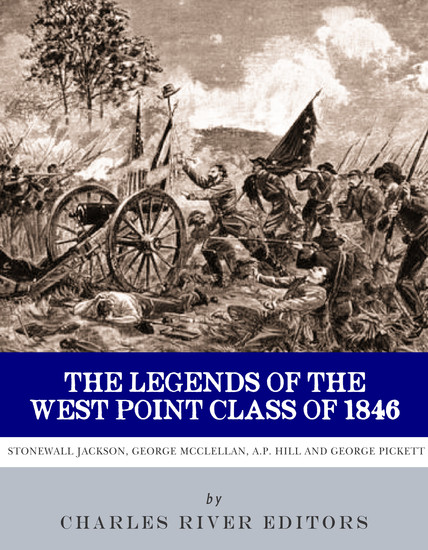
The Legends of the West Point Class of 1846 - Stonewall Jackson George McClellan AP Hill and George Pickett - cover

The Legends of the West Point Class of 1846 - Stonewall Jackson George McClellan AP Hill and George Pickett

Editors Charles River

Maison d'édition: Charles River Editors

  • 0
  • 0
  • 0

Synopsis

Thomas Jonathan Jackson is one of the most famous generals of the Civil War, but many of the people he continues to fascinate probably don’t remember his whole name. That’s because Jackson earned his famous “Stonewall” moniker at the First Battle of Manassas or Bull Run, when Brigadier-General Bee told his brigade to rally behind Jackson, whose men were standing like a stone wall. Ironically, it’s still unclear whether that was a compliment for standing strong or an insult for not moving his brigade, but the nickname stuck for the brigade and the general itself.
 
Jackson would only enhance his legend over the next two years, first leading his army on one of the most incredible campaigns of the war in the Shenandoah Valley in 1862.. Known as the Valley Campaign, Jackson kept 3 Union armies occupied north of Richmond with less than 1/3 of the men, marching his army up and down the Valley 650 miles in three months. The impressive feat helped his men earn the nickname “foot cavalry.”
 
He is equally known for his famous flank march and attack at Chancellorsville on May 2, 1863, which completely surprised the Army of the Potomac’s XI Corps and rolled the Union line up. The attack would end up winning the battle for the Confederates, who were outnumbered by nearly 50,000 men at Chancellorsville. As fate would have it, Jackson was mortally wounded at the height of what may have been his finest hour, depriving the Confederacy of one of its best generals. Many still wonder how the outcome of Gettysburg or the Civil War itself may have changed if Jackson had lived.
 
In 1861, McClellan was looked upon as a hero and even possibly a savior. Dubbed “The Young Napoleon”, the 35 year old had been a prodigy at West Point, finishing in second place in the Academy’s most famous class, the Class of 1846. After earning praise for his service in the Mexican-American War, McClellan had a short but successful career in the railroad industry and had been a foreign observer at the siege of Sevastopol during the Crimean War. At the outbreak of the Civil War, there was no question that McClellan was one of the brightest and most experienced of the North’s generals.
 
Ultimately, of course, McClellan went from hero to goat, at least in the eyes of President Lincoln, who famously wrote that McClellan “has the slows”. It was a sharp critique of McClellan’s cautious movements, but McClellan was also faulted for conservative battlefield leadership in the Peninsula Campaign and at Antietam. McClellan also constantly overestimated his opponent’s manpower, at times thinking the Confederates had double his Army of the Potomac when the exact opposite was the case. It was after Antietam and his bickering with the War Department over why he wasn’t chasing Lee’s battered Army of Northern Virginia that Lincoln finally sacked him, effectively ending his Civil War career.
 
Pickett’s reputation for bravery extended into the early years of the Civil War, to the extent that former West Point classmate George McClellan wrote, "Perhaps there is no doubt that he was the best infantry soldier developed on either side during the Civil War." A native Virginian, the impeccably styled Pickett represented all of the antebellum South’s most cherished traits, and as such he was a “beau-ideal” Confederate soldier.
 
 After proving himself a capable brigadier during the Peninsula Campaign, during which he was wounded and forced to recuperate, Pickett was given command of a division in Longstreet’s corps of the Confederate Army of Northern Virginia, putting him in position for a rendez-vous with destiny. Today Pickett is best remembered for the charge that has taken his name and is now remembered as the most famous assault of the Civil War. Pickett’s division was so decimated by the charge that when Lee asked him to reform his division in case of a Union counterattack, Pickett is alleged to have responded, “I have no division!”
Disponible depuis: 21/06/2025.
Longueur d'impression: 191 pages.

D'autres livres qui pourraient vous intéresser

  • Smart Leaders: Unlocking Potential Across Your Team - Revolutionize Leadership Skills! Engage in Audiobooks Perfectly Crafted for Team Success - cover

    Smart Leaders: Unlocking...

    Lewis Thorne

    • 0
    • 0
    • 0
    Smart Leaders: Unlocking Potential Across Your Team 
    ⭐⭐ Simplified Guide & Explanations Included ⭐⭐ 
    Are you aspiring to advance in your career and enhance your leadership skills to inspire and empower your team?  
    Searching for a comprehensive guide that provides all the necessary elements to become an effective leader? 
    Your search ends here! 
    This audiobook serves as your definitive companion for deepening your understanding, applying your skills, and engaging in hands-on exercises. With this, you're geared for success. 
    Updated for the latest leadership strategies. 
    Key features of this enriched guide: 
    - Profound insights about unlocking your team's full potential with leadership wisdom. 
    - Detailed explanation of essential leadership concepts. 
    - Fruitful strategies for effective team management and problem-solving. 
    Our guide distinguishes itself through comprehensive coverage, which is essential for your leadership journey. Concepts aren't merely skimmed; they are delved into with precision. 
    Please note that this guide is not affiliated with any official leadership entity and is purely an independent resource for your benefit. 
    Designed with a clear structure and easy-to-understand language, our "Smart Leaders" audiobook ensures smooth transitions between topics. Say goodbye to dense jargon and welcome clear, precise, and technically accurate content. 
    So, why wait? Click the BUY NOW button, secure your guide, and begin your journey to leadership success!
    Voir livre
  • Rome's Influence on Western Civilization - A Legacy of Empire - cover

    Rome's Influence on Western...

    Rogan Fish

    • 0
    • 0
    • 0
    The foundations of Roman culture are deeply rooted in the ancient traditions, myths, and social structures that shaped one of the most influential civilizations in history. Emerging from a small settlement on the banks of the Tiber River, Rome's development into a powerful republic and then an empire was significantly shaped by its cultural origins. The myths and legends that surrounded the birth of Rome, the establishment of the Roman Republic, and the codification of laws under the Twelve Tables all played crucial roles in shaping Roman identity and values. 
    The mythological origins of Rome are centered around the legendary figures of Romulus and Remus, twin brothers said to have been raised by a she-wolf. According to tradition, Romulus founded Rome after a violent conflict with Remus, establishing the city on April 21, 753 BCE. This foundational myth not only explained the city’s origin but also conveyed key themes of strength, resilience, and divine favor, which resonated throughout Roman culture. Other myths, such as the story of Aeneas, a Trojan hero who journeyed to Italy and became an ancestor of the Romans, linked Roman culture to the ancient and revered traditions of the Trojan War. These legends fostered a sense of pride and divine destiny among the Roman people, reinforcing their belief in their city’s exceptionalism. 
    The establishment of the Roman Republic in 509 BCE marked a turning point in Roman cultural development. Rejecting monarchy, the Romans developed a political system characterized by a complex balance of power among elected officials, the Senate, and the people. This republican model introduced concepts such as civic duty, shared governance, and public accountability, all of which became integral to Roman identity. The Republic’s values shaped the cultural ethos of Rome, emphasizing the importance of law, duty, and loyalty to the state.
    Voir livre
  • Mesoamerican Mythology - Learning All about Aztec and Maya Mythology (2 in 1) - cover

    Mesoamerican Mythology -...

    Matthew Fillard

    • 0
    • 0
    • 0
    This book contains three separate books, all related to myths on the North and South American Continents: 
    Aztec Mythology: The Aztec Empire, one of the most powerful and complex civilizations of Mesoamerica, was not only remarkable for its military conquests and grand architecture but also for its deeply spiritual and mythological worldview. At the heart of Aztec society was a profound belief in the gods and the sacredness of ritual, which governed everything from daily life to the empire's grandest ceremonies. Aztec mythology, rich with gods, cosmic battles, and creation stories, shaped the culture and practices of this ancient civilization. Understanding Aztec mythology is essential to understanding the values, actions, and worldview of the Aztec people, as it provided the framework within which they interpreted their world and their place within it. 
    Inca Mythology: The Inca Empire, at its zenith, spanned much of South America, including present-day Peru, Ecuador, Bolivia, and parts of Chile and Argentina. Known for its advanced architecture, agricultural systems, and administrative organization, the Inca civilization also possessed a deeply spiritual culture. Central to their worldview was a rich tapestry of mythology that explained the creation of the world, the origins of humankind, and the roles of the gods in the natural and spiritual realms.  
    Maya Mythology: Maya mythology stands as one of the most intricate and profound systems of stories and beliefs in the ancient world, reflecting the depth of a civilization that thrived for thousands of years. These myths, preserved through oral traditions and later written texts such as the Popol Vuh, reveal the Maya’s understanding of the cosmos, their relationship with nature, and their spiritual connection to the divine.
    Voir livre
  • History of Marathas EP01 - Deccan before Shivaji - cover

    History of Marathas EP01 -...

    Vikrant Pande

    • 0
    • 0
    • 0
    The story of the Marathas starts with Shivaji for most of us. The action happened in what is called the Deccan and its geography and politics plays an important role. We must understand what the Deccan means, who ruled there and what was the condition of the Deccan part of India before, and when, Shivaji was born.
    Voir livre
  • Ordinary Wonder Tales - cover

    Ordinary Wonder Tales

    Emily Urquhart

    • 0
    • 0
    • 0
    A journalist and folklorist explores the truths that underlie the stories we imagine—and reveals the magic in the everyday. 
    “I’ve always felt that the term fairy tale doesn’t quite capture the essence of these stories,” writes Emily Urquhart. “I prefer the term wonder tale, which is Irish in origin, for its suggestion of awe coupled with narrative. In a way, this is most of our stories.” In this startlingly original essay collection, Urquhart reveals the truths that underlie our imaginings: what we see in our heads when we read, how the sight of a ghost can heal, how the entrance to the underworld can be glimpsed in an oil painting or a winter storm—or the onset of a loved one’s dementia. In essays on death and dying, pregnancy and prenatal genetics, radioactivity, chimeras, cottagers, and plague, Ordinary Wonder Tales reveals the essential truth: if you let yourself look closely, there is magic in the everyday.
    Voir livre
  • The Life & Words Of Bhaktisiddhanta Sarasvati Thakura - King Of Bhakti Yoga Lion Of Devotion - cover

    The Life & Words Of...

    Sripad Jagannatha Dasa

    • 0
    • 0
    • 0
    Bhaktisiddhanta Sarasvati, also known as Srila Prabhupāda, was a prominent spiritual leader and revivalist of the Gaudīya Vaisnava tradition in early 20th-century India. He was born Bimala Prasad Datt on 6 February 1874 in the town of Jagannath Puri, in the present-day state of Odisha, India. As a child, Bhaktisiddhanta Sarasvati showed great intellectual potential, and he received a thorough education in Sanskrit, philosophy, and theology from his father, a renowned scholar, and Vaishnava monk. After completing his studies, Bhaktisiddhanta Sarasvati became a professor of Sanskrit and philosophy at Calcutta University. 
     
    In 1918, Bhaktisiddhanta Sarasvati founded the Gaudiya Math, a religious institution aimed at reviving and promoting the teachings of the Gaudīya Vaisnava tradition. He also initiated a series of reforms within the tradition, emphasizing the importance of scriptural study, the necessity of devotional service to Krishna, and the rejection of sectarianism and caste-based discrimination. Bhaktisiddhanta Sarasvati was a prolific writer and scholar who authored numerous books and articles on Vaisnava philosophy and theology. He also trained many disciples, including A. C. Bhaktivedanta Swami Prabhupada, who later founded the International Society for Krishna Consciousness (ISKCON) and became a major figure in the spread of the Hare Krishna movement in the West. Sarasvati passed away on 1 January 1937, but his legacy continues to inspire and guide followers of the Gaudīya Vaisnava tradition. He is remembered for his tireless efforts to revive and promote the teachings of Chaitanya Mahaprabhu, the founder of the Gaudīya Vaisnava tradition, and for his commitment to spreading the message of devotional service and love of God.
    Voir livre