Begleiten Sie uns auf eine literarische Weltreise!
Buch zum Bücherregal hinzufügen
Grey
Einen neuen Kommentar schreiben Default profile 50px
Grey
Jetzt das ganze Buch im Abo oder die ersten Seiten gratis lesen!
All characters reduced
The Leaders of the Confederacy - The Lives and Legacies of Jefferson Davis Robert E Lee and Stonewall Jackson - cover

The Leaders of the Confederacy - The Lives and Legacies of Jefferson Davis Robert E Lee and Stonewall Jackson

Editors Charles River

Verlag: Charles River Editors

  • 0
  • 0
  • 0

Beschreibung

Jefferson Davis (1808-1889) holds a unique place in American history, as the man best remembered for being the president of the Confederacy during the Civil War. While other famous Confederates like Robert E. Lee and Stonewall Jackson are still celebrated across the reunited country, Davis continues to be the object of scorn, derided over his attempt to flee after the Civil War and criticized as ineffective by historians. Among the Confederates still lauded by today’s Southerners, Davis is well down the list. 
 
Given his Civil War legacy, which often obscures his antebellum and postwar life, it’s easy to forget why Davis was made president in the first place. As a career civil servant in the United States government during much of his adult life, both as a Senator and Secretary of War, Jefferson Davis was a natural choice to be elected President of the seceding Southern states in early 1861.
 
History has accorded Abraham Lincoln a spot in the pantheon of American politics for the manner in which he steered the Union to victory and into the Reconstruction period after the war. In turn, Davis has been heavily criticized. Davis constantly clashed with Confederate generals like Joseph Johnston, the South’s diplomacy failed to obtain foreign intervention, and he was unable to keep the Southern states together cohesively as the Confederate economy began to collapse. Whether the Civil War would have ended any differently with someone else in charge of the Confederacy will never be known, but Davis had a tumultuous presidency.
 
With the exception of George Washington, perhaps the most famous general in American history is Robert E. Lee (January 19, 1807 – October 12, 1870), despite the fact he led the Confederate Army of Northern Virginia against the Union in the Civil War. As the son of U.S. Revolutionary War hero Henry "Light Horse Harry" Lee III, and a relative of Martha Custis Washington, Lee was imbued with a strong sense of honor and duty from the beginning. And as a top graduate of West Point, Lee had distinguished himself so well before the Civil War that President Lincoln asked him to command the entire Union Army. Lee famously declined, serving his home state of Virginia instead after it seceded.
 
Lee is remembered today for constantly defeating the Union’s Army of the Potomac in the Eastern theater from 1862-1865, considerably frustrating Lincoln and his generals. His leadership of his army led to him being deified after the war by some of his former subordinates, especially Virginians, and he came to personify the Lost Cause’s ideal Southern soldier. His reputation was secured in the decades after the war as a general who brilliantly led his men to amazing victories against all odds.
 
Thomas Jonathan Jackson is one of the most famous generals of the Civil War, but many of the people he continues to fascinate probably don’t remember his whole name. That’s because Jackson earned his famous “Stonewall” moniker at the First Battle of Manassas or Bull Run, when Brigadier-General Bee told his brigade to rally behind Jackson, whose men were standing like a stone wall. Ironically, it’s still unclear whether that was a compliment for standing strong or an insult for not moving his brigade, but the nickname stuck for the brigade and the general itself.
 
Jackson would only enhance his legend over the next two years, first leading his army on one of the most incredible campaigns of the war in the Shenandoah Valley in 1862. Known as the Valley Campaign, Jackson kept 3 Union armies occupied north of Richmond with less than 1/3 of the men, marching his army up and down the Valley 650 miles in three months. The impressive feat helped his men earn the nickname “foot cavalry.” He is equally known for his famous flank march and attack at Chancellorsville on May 2, 1863, which completely surprised the Army of the Potomac’s XI Corps and rolled the Union line up. 
Verfügbar seit: 04.05.2025.
Drucklänge: 140 Seiten.

Weitere Bücher, die Sie mögen werden

  • Postcards from Santiago - The George Robledo Story – The First Overseas Star of English Football - cover

    Postcards from Santiago - The...

    Spencer Vignes

    • 0
    • 0
    • 0
    Long before Erling Haaland, Thierry Henry and Eric Cantona, there was George Robledo, the first overseas star of English football. Abandoned by his father as a child in Chile, Robledo came to the UK, where he was raised in a Yorkshire mining village, serving underground as a 'Bevin Boy' during the Second World War prior to making his name with Barnsley. During the 1951–52 season, his thirty-three goals for Newcastle United in what is now the Premier League were the most goals scored in a single season by an overseas registered, foreign-born player, a record that has stood unbroken for over seventy years – despite what the record books might say.
    Postcards from Santiago is the poignant, inspiring story of Robledo's remarkable journey from the moon-like wastes of the Atacama Desert to the cover of John Lennon's 1974 album Walls and Bridges, via Wembley glory and the 1950 World Cup in Brazil. Where, in England's first ever World Cup match, Robledo became the first Football League player from outside the British Isles to face England in an official international.
    Featuring interviews with family, friends and admirers, this fascinating biography is the definitive account of a man who overcame immense hardship and heartache to become a sporting trailblazer in his adopted homeland and a national hero in his native Chile.
    Zum Buch
  • Dust and Light - On the Art of Fact in Fiction - cover

    Dust and Light - On the Art of...

    Andrea Barrett

    • 0
    • 0
    • 0
    The celebrated National Book Award–winning writer's intimate exploration of how fact is transformed into fiction. 


    In this thoughtful collection of essays, Andrea Barrett draws from her experiences writing some of the most acclaimed historical fiction of our time to explore the mysteries and delights of the genre. Inspiration found in the past, she argues, can illuminate fiction, just as dust scatters light and makes the unseen visible. Delving into some of the largest questions in the genre—How does a writer find meaningful subject matter beyond the confines of their life? How are scraps of history transformed into a fully formed narrative?—Barrett explores how she came to create some of her beloved works and explores lessons gleaned from the work of such masters of historical fiction as Toni Morrison, Leo Tolstoy, Hilary Mantel, and Colm Tóibín. Candid and elegant, Dust and Light is the perfect book for anyone who loves reading fiction set in the past, as well as for anyone aspiring to write it.
    Zum Buch
  • Dare to Matter: Lessons in Living a Large Life - A Memoir - cover

    Dare to Matter: Lessons in...

    Shifra Malka

    • 0
    • 0
    • 0
    Waiting for the world to tell you that you matter? In her unguarded, deeply affective, and witty memoir, Shifra shares the relatable story of being raised in an image-driven world into which she did not easily fit. Specifically, being told that she resembled her personality-disordered aunt—whose life didn't matter—she deeply feared that hers wouldn't either. Shifra writes to the core of this struggle to recover her beaten spirit and build the large life that matters to her. She explores the question of what mattering means, through the prism of how the question personally played out in her relationships with her family, her Orthodox Jewish religion, and the American culture focused on appearance, food, and money. She demonstrates that we cannot buy or borrow our individual mattering, but we can create it. Dare to Matter gives readers the will and courage to rebuild their collapsed inner space into the large life that makes getting out of bed every morning, and staying out of it, irresistible. This is a call to satisfACTION and a challenge to beat back the messages we get from family and society that shut us down. Renewing your energy to opt into your life, DARE TO MATTER will fuel you in meaningful and miraculous ways.
    Zum Buch
  • Cultured Bumpkin Presents The: Edgar Allan Poe's The Raven - cover

    Cultured Bumpkin Presents The:...

    Edgar Allan Poe

    • 0
    • 0
    • 0
    The American classic poem "The Raven" read by professional voice actor and host of The Cultured Bumpkin literature podcast, Jake Phillips
    Zum Buch
  • Great Gatsby The (Unabridged) - cover

    Great Gatsby The (Unabridged)

    F. Scott Fitzgerald

    • 0
    • 0
    • 0
    Enter the glamour and decadence of the Jazz Age with "The Great Gatsby (Unabridged Version)", F. Scott Fitzgerald's classic tale of love, aspiration, and disillusionment in 1920s America. Beautifully narrated, this audiobook presents a vivid and memorable picture of life during one of the most vibrant and tumultuous periods in American history.With exceptional clarity and precision, the narrator brings to life the novel's vibrant characters, each brimming with hopes, dreams, and haunting regrets. Every word is skillfully articulated, immersing you in the mysterious world of Jay Gatsby, a man who devoted everything to the pursuit of an ideal. The crisp, clear voice enhances Fitzgerald’s elegantly crafted prose, drawing you further into the glamorous, yet shallow world Gatsby inhabits.This unabridged version remains true to Fitzgerald's original text, allowing you to experience every twist and turn as it was meant to be. The exquisite narration gives a new depth to this timeless story, engaging listeners with its sincerity and authenticity.From the opulent parties on Long Island's North Shore to the desperate underbelly of New York City, this audio journey delivers the ultimate "Great Gatsby" experience. Rediscover the novel that defined a generation, painting a scathing critique of the American dream and the relentless pursuit of wealth and status.Indulge in "The Great Gatsby (Unabridged Version)" and explore the intoxicating allure of the American dream and its ultimate cost. This immersive audio experience is not just a journey into the past, but a mirror held up to our own time.
    Zum Buch
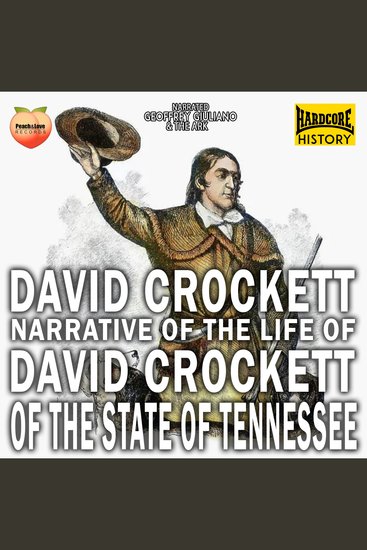
  • Narrative Of The Life David Crockett Of The State Of Tennessee - cover

    Narrative Of The Life David...

    David Crockett

    • 0
    • 0
    • 0
    “Davy Crockett buffs, Tennessee bibliophiles, genealogists, folklorists, historians, and the general reader should find this carefully researched and authoritative edition, which extricates the man from the myth, a valuable addition to the frontier history, biography, and literature of Tennessee and America.” 
    –Robert E. Dalton, Tennessee Historical Quarterly. 
     
    “This book. . . will go a long way toward separating the myths that grew up around Crockett and the actual facts. This will enable the reader to acquire a greater appreciation for this long-neglected Tennessean.” 
    –Sarah McMahon, Historical Review and Antique Digest 
     
    Authored in 1834 by David Crockett (1786–1836), with some editorial assistance from his congressional colleague from Kentucky, Thomas Chilton, the Narrative of the Life of David Crockett of the State of Tennessee is one of the most significant documents of the American pioneer experience in the first half of the nineteenth century. It describes the author's life from his first memories in eastern Tennessee through his progressive moves westward, his participation in the Creek War, his hunting experiences, and his political service in the Tennessee House of Representatives and the U.S. Congress. The book closes with Crockett's reelection to his final term in Congress (1833–1835), shortly before his fateful journey to Texas and his death at the Alamo in 1836.
    Zum Buch