Rejoignez-nous pour un voyage dans le monde des livres!
Ajouter ce livre à l'électronique
Grey
Ecrivez un nouveau commentaire Default profile 50px
Grey
Abonnez-vous pour lire le livre complet ou lisez les premières pages gratuitement!
All characters reduced
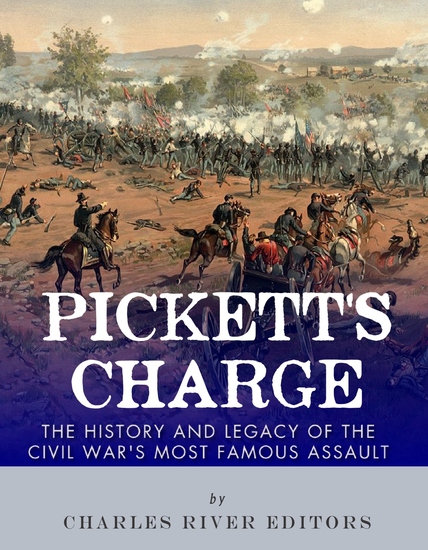
Pickett’s Charge - cover

Pickett’s Charge

Editors Charles River

Maison d'édition: Charles River Editors

  • 0
  • 0
  • 0

Synopsis

Despite the fact that the Civil War began over 150 years ago, it remains one of the most widely discussed topics in America today, with Americans arguing over its causes, reenacting its famous battles, and debating which general was better than others. Americans continue to be fascinated by the Civil War icons who made the difference between victory and defeat in the war's great battles.
 
The most famous attack of the Civil War was also one of its most fateful and fatal. Pickett’s Charge, the climactic assault on the final day of the Battle of Gettysburg, has become the American version of the Charge of the Light Brigade, and it is one of the most famous events of the entire Civil War.
 
Having been unable to break the Army of the Potomac’s lines on the left and right flank during Day 2 of the Battle of Gettysburg, Confederate Army of Northern Virginia commander Robert E. Lee decided to make a thrust at the center of the Union’s line with about 15,000 men spread out over three divisions. The charge required marching across an open field for about a mile, with the Union artillery holding high ground on all sides of the incoming Confederates.
 
Though it is now known as Pickett’s Charge, named after division commander George Pickett, the assignment for the charge was given to General James Longstreet, whose 1st Corps included Pickett’s division. Longstreet had serious misgivings about Lee’s plan and tried futilely to talk him out of it. Longstreet later wrote that he said to his commander, “General Lee, I have been a soldier all my life.  It is my opinion that no fifteen thousand men ever arrayed for battle can take that position.”
 
Aware of the insanity of sending 15,000 men hurtling into all the Union artillery, Lee planned to use the Confederate artillery to try to knock out the Union artillery ahead of time. Although old friend William Pendleton was the artillery chief, the artillery cannonade would be supervised by Edward Porter Alexander, Longstreet’s chief artillerist, who would have to give the go-ahead to the charging infantry because they were falling under Longstreet’s command. Alexander later noted that Longstreet was so disturbed and dejected about ordering the attack that at one point he tried to make Alexander order the infantry forward, essentially doing Longstreet’s dirty work for him.
 
Unfortunately for Porter Alexander and the Confederates, the sheer number of cannons belched so much smoke that they had trouble gauging how effective the shells were. As it turned out, most of the artillery was overshooting the target, landing in the rear of the Union line. Reluctant to order the charge, Longstreet commanded Porter Alexander to order the timing for the charge. As Longstreet and Alexander anticipated, the charge was an utter disaster, incurring a nearly 50% casualty rate and failing to break the Union line.
 
Pickett’s Charge: The History and Legacy of the Civil War’s Most Famous Assault profiles the history, context, and command decisions that all culminated in the most famous charge in American history. It also includes analysis of what went right and wrong, as well as what the major participants wrote about the charge. Along with maps and pictures of important people and places, you will learn about Pickett’s Charge like you never have before, in no time at all.
Disponible depuis: 02/05/2025.
Longueur d'impression: 69 pages.
D'autres livres qui pourraient vous intéresser

  • Mind Control - Techniques to Influence or Dominate Someone's Thoughts - cover

    Mind Control - Techniques to...

    Cito Harder

    • 0
    • 0
    • 0
    Mind control is the practice of influencing, manipulating, or dominating an individual’s thoughts, behaviors, or perceptions, often without their conscious awareness. Throughout history, different societies have employed various forms of psychological influence to control groups and individuals, from religious indoctrination to political propaganda and media conditioning. While some forms of persuasion are ethical and openly acknowledged, mind control often operates in subtle, deceptive ways, making it difficult for individuals to recognize or resist. 
    At its core, mind control exploits human cognitive vulnerabilities. The mind is naturally susceptible to suggestion, repetition, and emotional influence. When exposed to specific messages or ideas repeatedly, a person may begin to internalize them as truth, even in the absence of logical evidence. This principle is used in advertising, politics, religious movements, and personal relationships to shape opinions and behaviors. Whether through fear, guilt, reward, or isolation, those seeking control can manipulate their targets into conforming to specific beliefs or actions. 
    One of the most effective tools of mind control is misinformation. By distorting reality or presenting selective facts, individuals or institutions can shape perceptions to suit their own agendas. Governments have historically used propaganda to maintain control over populations, while corporations use psychological tactics to influence consumer behavior. In personal relationships, emotional abusers use manipulation techniques such as gaslighting to make their victims question their own perceptions and reality.
    Voir livre
  • America's War in Syria - Fighting with Kurdish Anti-ISIS Forces - cover

    America's War in Syria -...

    Till Paasche, John Foxx

    • 0
    • 0
    • 0
    This insider assessment of American military involvement in Syria offers “a fascinating and down-to-earth look at the war against [ISIS]” (Military Heritage Magazine). 
     
    The US military campaign in alliance with Kurdish forces in Syria remains a rare success story in the age of the War on Terror. Considering the military victory, the civilian government that followed the fighting, the light military footprint and the strong link to Kurdish partners, the intervention against ISIS in Syria is widely regarded as the nation’s most successful campaign since World War II.  
     
    In this volume, three authors who participated directly in the conflict offer a rare ground-level view of how it turned into a just war. Between the three of them, they participated in all the large Kurdish operations against the Islamic State between late 2014 and mid-2016. They endured muddy archaic trench warfare, witnessed the first waves of decisive US and British airstrikes against ISIS, and experienced the impact America had on the battlefield.  
     
    Later, when American, British and French Special Forces were deployed at the front lines, the authors worked closely with those teams, evacuating hundreds of wounded from the battlefield together. Based on their unique insights, they analyses America’s war in Syria, identifying its distinct phases from the secretive build up to the ultimate destruction of the ISIS Caliphate.
    Voir livre
  • News and Democratic Citizens in the Mobile Era - cover

    News and Democratic Citizens in...

    Johanna Dunaway, Kathleen Searles

    • 0
    • 0
    • 0
    Though people frequently use mobile technologies for news consumption, evidence from several fields shows that smaller screens and slower connection speeds pose major limitations for meaningful reading. In News and Democratic Citizens in the Mobile Era, Johanna Dunaway and Kathleen Searles demonstrate the effects of mobile devices on news attention, engagement, and recall, and identify a key cognitive mechanism underlying these effects: cognitive effort. They advance a theory that is both old and new: the costs of information-seeking curb participatory behaviors unless the benefits outweigh them. For news consumers in the mobile era, for example, mobile devices increase the time, economic, and cognitive costs associated with information-seeking. Only for a small few do the benefits of attending to the news on mobile devices outweigh the costs. 


    Dunaway and Searles argue that attention, engagement, and recall suffer when people consume news on mobile devices. They then investigate the implications of these effects for the news industry and for an informed democratic citizenry. Drawing on both laboratory and real-world studies, Dunaway and Searles bring the psychophysiology of news consumption to bear on the question of what we could lose in an information environment characterized by a dramatic shift in reliance on mobile devices.
    Voir livre
  • Marc Chagall: A short biography - 5 Minutes: Short on time - long on info! - cover

    Marc Chagall: A short biography...

    5 Minutes, 5 Minute Biographies,...

    • 0
    • 0
    • 0
    Marc Chagall, painter and cosmopolitan: Life and work in a short biography! Everything you need to know, brief and concise. Infotainment, education and entertainment at its best!
    Voir livre
  • Showbusiness with Blood - A Golden Age of Irish Boxing - cover

    Showbusiness with Blood - A...

    Eamon Carr

    • 0
    • 0
    • 0
    In Showbusiness with Blood, Eamon Carr beguiles the reader with an insightful account of the world's greatest boxers, from Steve Collins to Mike Tyson to Tyson Fury and Katie Taylor.
    
    
    Boxing, Ireland's most successful Olympic sport, became turbo-charged in the mid-90s. A golden age followed as Irish boxers excelled in the harsh, violent and sometimes tragic business that is professional boxing. Having become enamoured of the sport during a period of serious illness as a child, Eamon Carr was on hand to witness the victories and disasters.
    
    
    The core principle of prize-fighting – striking and defence – demands enormous courage each time the boxer steps forward. Surrounded by enthusiastic fans, the ring can yet be the loneliest place in the world. Ireland embodies this tradition with renewed focus over the past three decades in a golden age of boxing.
    
    Showbusiness with Blood takes the reader on an intimate journey through Irish boxing's years of triumph and desolation. Carr's enthusiasm for the sport illuminates the dark corners of the fight game with stories from gruelling training camps, noisy press conferences, behind-the-scenes hustling and the savage brutality of championship fights.
    
    
    These are stories of aspiration and devastation. Yet amid the chaos and destruction of the boxing ring are inspirational tales of courage, resilience and personal redemption: boxing's enduring saving grace
    Featured boxers include: Steve Collins, Wayne McCullough, Bernard Dunne, Darren Sutherland, Tyson Fury, Jamie Conlan, Andy Lee, John Joe Nevin, Katie Taylor, Willie Casey, Carl Frampton, Michael Conlan, Mike Tyson, Seamus McDonagh, Conor McGregor, Martin Rogan, Michael Carruth, Francis Barrett, Matthew Macklin and Gary 'Spike' O'Sullivan.
    Voir livre
  • Speed Reading - A Little-Known Time-Saving Superpower - cover

    Speed Reading - A Little-Known...

    Abby Marks Beale

    • 0
    • 1
    • 0
    Got reading?  Who doesn't!  Speed Reading: A Little-Known Time-Saving Superpower, written by speed reading expert Abby Marks Beale with Pam Mullan, provides you with active, mindful, and conscious strategies to not only boost reading speed and comprehension, but overall reading enjoyment. Whether you’re reading for fun, on your educational journey, or as a profession, this book equips you to power through your reading material efficiently and effectively (leaving more time for productivity!)
    
    The smart strategies included through the engaging 15 chapters are surprisingly simple and immediately applicable to any reading material.  With practice, you will not only speed through and understand books, articles, and professional journals but will also build your personal reading confidence and competence.  You may even find yourself testing your limits and pushing yourself to clock better time (all while still comprehending everything you read).
    
    Originally published as The Complete Idiot's Guide to Speed Reading, this revised digital version includes nine interesting articles to experiment and test your newly learned skills. Whether you take it one page at a time or one chapter at a time, there are useful nuggets to glean from every second you spend with this book. 
    
    If you’ve hadn’t had any reading training since elementary school, or just want to update your skills, then this book is for you!
    Voir livre