Rejoignez-nous pour un voyage dans le monde des livres!
Ajouter ce livre à l'électronique
Grey
Ecrivez un nouveau commentaire Default profile 50px
Grey
Abonnez-vous pour lire le livre complet ou lisez les premières pages gratuitement!
All characters reduced
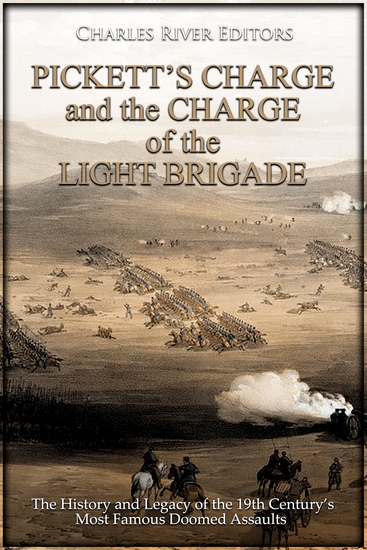
Pickett’s Charge and the Charge of the Light Brigade - The History and Legacy of the 19th Century’s Most Famous Doomed Assaults - cover

Pickett’s Charge and the Charge of the Light Brigade - The History and Legacy of the 19th Century’s Most Famous Doomed Assaults

Editors Charles River

Maison d'édition: Charles River Editors

  • 0
  • 0
  • 0

Synopsis

Despite the fact that the Civil War began over 150 years ago, it remains one of the most widely discussed topics in America today, with Americans arguing over its causes, reenacting its famous battles, and debating which general was better than others. Americans continue to be fascinated by the Civil War icons who made the difference between victory and defeat in the war's great battles.
 
The most famous attack of the Civil War was also one of its most fateful and fatal. Pickett’s Charge, the climactic assault on the final day of the Battle of Gettysburg, has become the American version of the Charge of the Light Brigade, and it is one of the most famous events of the entire Civil War.
 
Having been unable to break the Army of the Potomac’s lines on the left and right flank during Day 2 of the Battle of Gettysburg, Confederate Army of Northern Virginia commander Robert E. Lee decided to make a thrust at the center of the Union’s line with about 15,000 men spread out over three divisions. The charge required marching across an open field for about a mile, with the Union artillery holding high ground on all sides of the incoming Confederates.
 
Though it is now known as Pickett’s Charge, named after division commander George Pickett, the assignment for the charge was given to General James Longstreet, whose 1st Corps included Pickett’s division. Longstreet had serious misgivings about Lee’s plan and tried futilely to talk him out of it. Longstreet later wrote that he said to his commander, “General Lee, I have been a soldier all my life.  It is my opinion that no fifteen thousand men ever arrayed for battle can take that position.”
 
Aware of the insanity of sending 15,000 men hurtling into all the Union artillery, Lee planned to use the Confederate artillery to try to knock out the Union artillery ahead of time. Although old friend William Pendleton was the artillery chief, the artillery cannonade would be supervised by Edward Porter Alexander, Longstreet’s chief artillerist, who would have to give the go-ahead to the charging infantry because they were falling under Longstreet’s command. Alexander later noted that Longstreet was so disturbed and dejected about ordering the attack that at one point he tried to make Alexander order the infantry forward, essentially doing Longstreet’s dirty work for him.
 
Unfortunately for Porter Alexander and the Confederates, the sheer number of cannons belched so much smoke that they had trouble gauging how effective the shells were. As it turned out, most of the artillery was overshooting the target, landing in the rear of the Union line. Reluctant to order the charge, Longstreet commanded Porter Alexander to order the timing for the charge. As Longstreet and Alexander anticipated, the charge was an utter disaster, incurring a nearly 50% casualty rate and failing to break the Union line.
 
The Charge of the Light Brigade is the most famous British cavalry charge in history, possibly also eclipsing the renown of any other mounted attack conducted by the armed forces of other nations in the general imagination. This cavalry action is certainly remembered far more vividly than the 1854 Battle of Balaclava during which it occurred, and even the wider Crimean War that led to the battle.
 
Of course, the prominence of the Charge in popular and historical memory is due primarily to Alfred, Lord Tennyson's poem describing the events of that distant late October afternoon. The bearded Poet Laureate crafted a powerful, gripping poetic narrative that fixed the encounter firmly in both the popular imagination and in the English literary oeuvre. Millions of people who know nothing else of the Crimean War between Great Britain and the Russian Empire are familiar with Tennyson's memorable verses.
Disponible depuis: 01/05/2025.
Longueur d'impression: 116 pages.
D'autres livres qui pourraient vous intéresser

  • Beyond Racial Division - A Unifying Alternative to Colorblindness and Antiracism - cover

    Beyond Racial Division - A...

    George A. Yancey

    • 0
    • 0
    • 0
    Efforts at colorblindness and antiracism have not been very effective in addressing racial tensions in the United States. 


    Colorblindness ignores the realities of race and the history of injustice. On the other hand, antiracism centers racial concerns and in so doing often alienates people who need to be involved in the process. Sociologist George Yancey offers an alternative approach to racial relations where all parties contribute and are mutually accountable to one another for societal well-being. He provides empirical rationale for how collaborative conversations in a mutual accountability model can reduce racial division. History and societal complexity mean that different participants may have different kinds of responsibility, but all are involved in seeking the common good for all to thrive. Avoiding unilateral decisions that close off dialogue, Yancey casts a vision for moving beyond racial alienation toward a lifestyle and movement of collaborative conversation and mutuality.
    Voir livre
  • The Whigs and the Know Nothings - The History of the Influential Political Parties that Collapsed Before the Civil War - cover

    The Whigs and the Know Nothings...

    Editors Charles River

    • 0
    • 0
    • 0
    It was in the wake of the election of Andrew Jackson that the Whigs emerged as opponents to the Jacksonian Democrats during a period of American history known as the Second Party System (1828-1854). Initially, the conflict was rooted not only in different visions for the United States – the Whigs believed in a strong central bank and federally funded infrastructure projects (known as “internal improvements”) – but also in opposition to one man: Andrew Jackson. When it first formed, the Democratic Party coalesced around Jackson, and his beliefs and actions became Democratic Party dogma, which left the diverse group of people who opposed Jackson to become the Whigs.  
    The problem with this arrangement is that while the Whigs scored some notable successes as an opposition party, they found governing more difficult. The two Whigs elected president, William Henry Harrison and Zachary Taylor, died in office, raising to the presidency their respective vice-presidents, John Tyler and Millard Fillmore. Neither man succeeded in uniting the Whig Party behind him (a gargantuan task, to be sure), and neither was ever elected president in his own right. The increasing rancor over slavery is what finally killed the Whig Party.  
    	In the wake of contemporary debates over immigration, the “Know-Nothings” have been regularly cited as an example of how dangerous nativist attitudes can become and, indeed, have proven to be in America’s history. Several columnists, for instance, have striven to make comparisons between the Know-Nothings of antebellum America and the country’s recent immigration policies, helping in part to generate modern interest in a political party that many Americans have heard of but tend to know little about. The Know-Nothing movement can actually be tied to a number of violent episodes and ethnically charged riots that occurred during the late 1850s.
    Voir livre
  • Tits Up - What Sex Workers Milk Bankers Plastic Surgeons Bra Designers and Witches Tell Us about Breasts - cover

    Tits Up - What Sex Workers Milk...

    Sarah Thornton

    • 0
    • 0
    • 0
    AN INNOVATIVE INVESTIGATION OF THE FIVE STRANGE WORLDS THAT WORSHIP WOMEN’S CHESTS. 
     
    After years of biopsies, best-selling author Sarah Thornton made the difficult decision to have a double mastectomy. But, after her reconstructive surgery, she was perplexed: What had she lost? And gained? An experienced sleuth, she resolved to venture behind the scenes to uncover the social and cultural significance of breasts.  
     
    Riotous and galvanizing, Tits Up excavates the diverse truths of mammary glands from the strip club to the operating room, from the nation’s oldest human milk bank to the fit rooms of bra designers. Thornton draws insights from plastic surgeons, lactation consultants, body-positive witches, lingerie models, and “free the nipple” activists to explore the status of breasts as emblems of femininity. She examines how women’s chests have become a billion-dollar business, as well as a stage for debates about race, class, gender, and desire.  
     
    Everywhere she turns, Thornton encounters chauvinistic myths about this elemental body part that quietly justify deficits in women’s bodily autonomy and endorse shortfalls in their political status. Blending sociology, reportage, and personal narrative with refreshing optimism and wit, Thornton has one overriding ambition—to liberate breasts from centuries of patriarchal prejudice. 
     
    “With a sociologist’s eye, a reporter’s nose, and a double-D brain, Sarah Thornton explores the contradictions, power, and fundamental formidability of breasts. … Exquisitely written and consistently illuminating.”—Mary Roach, New York Times best-selling author
    Voir livre
  • The Homefront Heroes - Everyday Lives during World War II and the Role of Civilians - cover

    The Homefront Heroes - Everyday...

    Sage Winters

    • 0
    • 0
    • 0
    The term "homefront" often evokes images of soldiers in trenches or aircraft soaring across the skies, but it is also a powerful representation of the unseen sacrifices and contributions made by civilians during times of war. During World War II, the homefront became an essential element in the overall war effort, with civilians across the world playing critical roles in supporting the troops and maintaining the stability of their countries. The efforts of everyday people—often invisible and uncelebrated—were foundational to both the immediate success of the war and the longer-term impact on society. This chapter delves into the importance of the homefront during WWII, exploring the diverse contributions of civilians, and highlighting how they collectively displayed a resilience that was vital for the war’s outcome. 
      
    World War II was not just fought on foreign battlefields—it was waged in factories, schools, hospitals, and even neighborhoods. The efforts of civilians extended well beyond the provision of material goods. They also contributed by keeping national spirits high through solidarity and patriotism, showing an unyielding dedication to the cause despite the challenges at home. The mobilization of the homefront became a key factor in the Allied victory, and it transformed daily life in ways that would endure long after the war ended. 
      
    Women, for instance, took on roles that had traditionally been reserved for men, stepping into factories, shipyards, and offices, proving their capacity to contribute to industries critical to the war effort. At the same time, families managed with rationing and shortages while simultaneously participating in drives for scrap metal, rubber, and other materials that could be recycled for wartime use. Even children contributed in their own ways, collecting tin cans and engaging in other activities designed to support the war effort.
    Voir livre
  • Current Trends in Open Science - Will Open Science Change The World? - cover

    Current Trends in Open Science -...

    Nicola Cavalli

    • 0
    • 0
    • 0
    In an era where the dissemination of knowledge is both an ethical imperative and a contested space, Current Trends in Open Science offers a critical examination of the evolving landscape of academic publishing. Edited by Nicola Cavalli, this volume brings together leading voices to explore the promises and challenges of Open Science, from the transformative potential of Diamond Open Access to the structural reforms necessary for a more equitable and transparent research ecosystem.
    Through rigorous analysis, contributors dissect the tensions between commercial publishing interests and the scholarly community's push for greater autonomy, shedding light on policy frameworks, infrastructure needs, and cultural shifts required for meaningful change. Whether interrogating Italy's stalled progress on Open Science or advocating for a publishing model driven by academic values rather than profit motives, this book is an essential resource for researchers, policymakers, and advocates committed to the future of knowledge as a public good.
    Voir livre
  • Military Gazette Box Set - A fascinating foray into British Military history A full-cast audio - cover

    Military Gazette Box Set - A...

    Mr Punch

    • 0
    • 0
    • 0
    A fascinating foray into British military history in two volumes, told entirely in the words of those who were there, as we join the men and women who took part. 
      
    The ARMY Gazette 
    From the Roman invasion of Britain to the retreat from Dunkirk, from the horrors of Culloden to the courage of Rourke’s Drift, we hear first-hand the stories behind the triumphs and tragedies that make up the history of the British Army.  
      
    The NAVY Gazette 
    Experience the reality of life in the British Navy as we sail from the Viking invasion of Anglo Saxon England to a young sailor’s grief at the death of Lord Nelson, from the Spanish Armada to the Battle of Jutland and from organised press gangs to murderous mutinies.  
      
    Performed by an outstanding company of award-winning actors including Dame Eileen Atkins, Cheryl Campbell, Nigel Davenport, Alex Jennings, Richard Johnson OBE, Hugh Laurie CBE, Michael Maloney, Geoffrey Palmer OBE, Michael Pennington, Prunella Scales CBE, Samuel West, John Wood CBE & full supporting cast. 
        
    Also available as part of The Gazettes Box Set, a six-volume edition (Military, Sport & Travel) creating a vivid portrait of British life through the centuries. 
      
    It is a highly enjoyable collection. Some pieces are just dazzling. Independent on Sunday 
      
    An extraordinary series... deserves a medal. The readers are all excellent and many of them distinguished. The Spectator 
      
    From the same stable that produced The Chronicle, my favourite audio this year, I've just listened equally spellbound to a compilation of travellers' tales at home. The Guardian 
      
    ©2022 Mr Punch Audiobooks Ltd. (P)2022 Mr Punch Audiobooks Ltd
    Voir livre