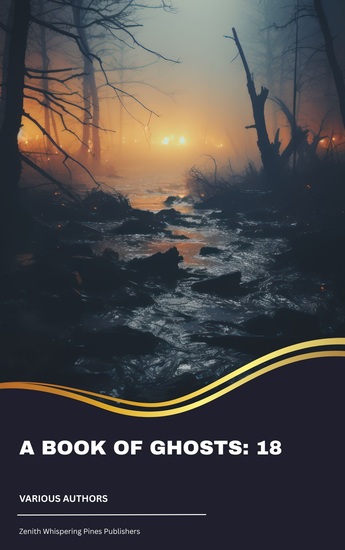
"Unearthing the Final Shadows of a Victorian Master."
For the true connoisseur of the macabre, the journey does not end with the well-known classics. Volume 18 of the A Book of Ghosts series represents the deep-strata of Sabine Baring-Gould's supernatural imagination. This volume is dedicated to the rare, the obscure, and the previously uncollected—stories that bridge the gap between his work as a folklorist, a priest, and a pioneer of English horror.
The Scholar of the Supernatural: In this advanced volume, we see Baring-Gould at his most experimental. These selections move beyond the standard haunting to explore "The Archaeology of Terror"—where the horror is found in ancient artifacts, forgotten church records, and the dark corners of regional history. The prose here is steeped in the "Antiquarian Realism" that would later inspire the likes of M.R. James, focusing on the danger of intellectual curiosity and the physical weight of the past.
A Collector's Essential: This volume is designed for those who seek to complete the definitive portrait of a Victorian polymath. It highlights Baring-Gould's unique ability to find the "unholy" within the "holy," using his deep knowledge of ecclesiastical history to craft scares that feel grounded in ancient truth.
This archival edition is a must-have for scholars of Gothic literature, bibliophiles of the strange, and anyone dedicated to the preservation of classic British weird fiction.
Complete the legacy. Buy "A Book of Ghosts: Volume 18" today and own a piece of supernatural history.
Herbert George Wells (21 September 1866 - 13 August 1946) was an English writer. Prolific in many genres, he wrote dozens of novels, short stories, and works of social commentary, history, satire, biography and autobiography. His work also included two books on recreational war games. Wells is now best remembered for his science fiction novels and is often called the "father of science fiction", along with Jules Verne and the publisher Hugo Gernsback.
THE CONTEMPORARY NOVEL: Circumstances have made me think a good deal at different times about the business of writing novels, and what it means, and is, and may be; and I was a professional critic of novels long before I wrote them.
"Oliver Twist; or, The Parish Boy's Progress" is a novel by Charles Dickens, first published as a serialized work between 1837 and 1839. The story follows Oliver Twist, an orphan who escapes from a workhouse to seek his fortune in London. Oliver is naive and innocent, contrasting sharply with the corrupt and exploitative adults he encounters. He becomes involved with a group of juvenile criminals led by the cunning Fagin. The book explores social inequality and is an early example of the social-protest novel.
Short story written by Jack London The Son of the Wolf consists of a single man who is known as Mckenzie or "Scruff". The story tells of the hardships of what single men had to endure on the frontier. Often men would venture on journeys that may consist of months or even years just in order to find the right suitor. Scruff had been the toughest of the tough and had lasted the longest on the frontier without the company of a woman.
This story connects with naturalism by showing that nature can be just as cruel as it can be forgiving if someone is alone on the frontier.
"Eleonora" is a short story by Edgar Allan Poe about a deep and transcendental love between the narrator and his cousin Eleonora, set in an isolated mystical valley. After Eleonora's death, the narrator swears eternal fidelity, but eventually finds love again, reflecting on the changing nature of the human heart.
Ghosts is a controversial three-act play by Henrik Ibsen that confronts taboo subjects such as inherited sin, illness, hypocrisy, and moral decay. Mrs. Alving, the central character, faces the tragic consequences of concealing the truth about her late husband from their son.Shocking for its time, Ghosts challenged the foundations of 19th-century morality and social convention. Its unflinching look at family, duty, and repression continues to provoke and move audiences more than a century later.
Stephen Crane was born 1st November, 1871 in Newark, New Jersey and was the eighth surviving child out of fourteen. Incredibly he began writing at the age of four and was published several times by the age of sixteen.
Crane only began a full-time education when he was nine but quickly mastered the grades needed to catch up and move forward. Although educated at Lafayette and Syracuse he had little interest in completing university and was keener to move on to a career, declaring college to be ‘a waste of time’. By twenty he was a reporter and two years later had published his debut novel ‘Maggie: A Girl of the Streets’. In literary circles this was hailed as the first work of American literary Naturalism.
Two years later, in 1895, he was the subject of worldwide acclaim for his Civil War novel, written without the benefit of any actual war experiences, ‘The Red Badge of Courage’. It was indeed a masterpiece and his finest hour. A year later life began its downwards descent when he became embroiled in a scandal which was to doom his career. In attempting to help a suspected prostitute being falsely charged by a policeman he became the target of the authorities.
Later the same year en-route to Cuba as a War Correspondent he met the hotel madam Cora Taylor in Jacksonville, Florida. This was to become the defining relationship of his life. Continuing his journey, somewhere between Florida and Cuba his ship sank, and he was cast adrift for several days. Rescued, he returned to cover conflicts wherever they were situated, some as far away as Greece. For a time he lived in England with Cora, usually beyond their means, befriending fellow writers such as H G Wells and Joseph Conrad.
In declining health and beset by money problems, Stephen Crane died of tuberculosis, aged a mere 28 on 5th June 5, 1900, at Badenweiler, Germany. He is buried in New Jersey.
Ihr Account wird momentan auf einem anderen Gerät benutzt.
Es ist bereits eine Sitzung auf einem anderen Gerät geöffnet.
Abmelden
Erneut verbinden
Ihr Account wird momentan auf einem anderen Gerät benutzt.
Um darauf zugreifen zu können, müssen die Berechtigungen und obligatorischen Richtlinien (markiert mit *) überprüft und akzeptiert werden.
Wenn Sie Hilfe oder weitere Informationen benötigen, schreiben Sie an support@24symbols.com
Akzeptieren
Ihr Account wird momentan auf einem anderen Gerät benutzt.
OK
Bestätigungs-E-Mail noch einmal schicken
Ihr Account wird momentan auf einem anderen Gerät benutzt.
Wir haben versucht, Ihr Abo abzubuchen, aber es ist uns nicht gelungen. Das teilt uns Ihre Bank/Karte mit:
Wenn Sie weiterlesen möchten, müssen Sie sich möglicherweise an Ihre Bank wenden oder Ihre Zahlungsinformationen hier ändern:
Ich möchte meine Karte aktualisieren!
Haben Sie Fragen? Schreiben Sie uns an support@24symbols.com und wir werden Ihnen weiterhelfen.
Cookies helfen uns bei der Bereitstellung unserer Dienste. Durch die Nutzung unserer Dienste erklären Sie sich damit einverstanden, dass wir Cookies setzen.Mehr erfahren