Rejoignez-nous pour un voyage dans le monde des livres!
Ajouter ce livre à l'électronique
Grey
Ecrivez un nouveau commentaire Default profile 50px
Grey
Abonnez-vous pour lire le livre complet ou lisez les premières pages gratuitement!
All characters reduced
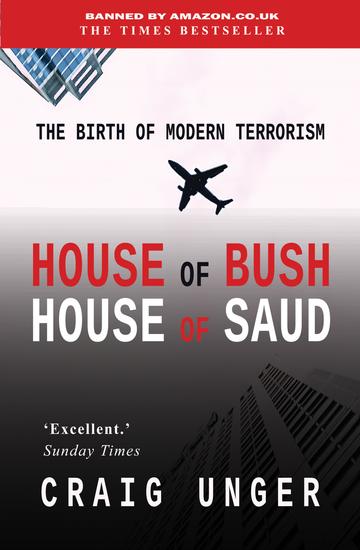
House of Bush House of Saud - The Birth of Modern Terrorism - cover

House of Bush House of Saud - The Birth of Modern Terrorism

Craig Unger

Maison d'édition: Gibson Square

  • 0
  • 0
  • 0

Synopsis

In 2001, the 9/11 attacks awoke the world to the military-style threat of Islamism. Due to the White House, the nationality of fifteen Saudis among the nineteen suicide bombers remained cast in shadows. In this exceptional tour-de-force, Craig Unger meticulously pieces together the US role in the birth of modern terrorism by relying on research and interviews with those who would prefer to deny the truth.The acclaimed account of the link between modern terrorism and Saudi and corporate greed whose first UK publisher cancelled for fear of libel, and which several online retailers dared not stock.'Excellent.'—Sunday Times'A notably intelligent piece of investigative reporting which lights the blue touch-paper.'—Observer'A forensic examination.'—Daily Telegraph'Very powerful.'—Guardian, book of the week'Hard-hitting.'—Independent on Sunday'An explosive book.'—Scotland on Sunday'None can match this.'—Irish Times'Well-sourced... cool, calm and collected.'—Times Higher Education Supplement'As chilling as it is gripping.'—Belfast Telegraph'Craig Unger has done America and the world a huge favor.'—Michael Moore, Director of Fahrenheit 9/11, the movie inspired by House of Bush House of Saud'Unger's meticulously researched book raises troubling questions about the ties between the Bush family and the Saudi royal family, especially in the aftermath of 9/11. It's a provocative read that challenges conventional narratives.'—The Washington Post'Craig Unger's House of Bush, House of Saud is a compelling and disturbing account of the intertwining interests of two powerful families. While some may dismiss it as conspiracy theory, the depth of research demands attention.'—The Washington Post'Unger's book is a gripping and unsettling exploration of the Bush-Saudi nexus. It's a damning indictment of how personal and financial interests can overshadow national security.'—The Guardian'Craig Unger's House of Bush, House of Saud is a meticulously documented account of the symbiotic relationship between two of the world's most powerful families. It's a chilling read that raises more questions than it answers.'—The Independent'Unger's book is a riveting and deeply researched exposé that sheds light on the shadowy connections between the Bush family and the Saudi elite. It's a sobering reminder of the complexities of global power dynamics.'—The Sydney Morning Herald'Craig Unger's House of Bush, House of Saud is a provocative and eye-opening investigation into the ties that bind American politics and Saudi wealth. It's a must-read for anyone interested in the hidden forces behind global events.'—Le Monde'Unger's book is a meticulously researched and deeply unsettling account of the Bush-Saudi relationship. It's a powerful critique of the intersection of politics, oil, and terrorism.'—Der Spiegel'Craig Unger's House of Bush, House of Saud is a provocative and deeply researched account of the intricate ties between the Bush family and the Saudi royal family. While some of its claims are controversial, the book provides valuable insights into the intersection of oil, politics, and terrorism.'—Foreign Affairs'Unger's book is a bold and controversial examination of the ties between the Bush family and the Saudi royal family. While some may question its conclusions, the depth of research and the questions it raises make it a valuable contribution to the field.'—International Affairs
Disponible depuis: 14/02/2025.
Longueur d'impression: 356 pages.

D'autres livres qui pourraient vous intéresser

  • Unequal - How extreme inequality is damaging democracy and what we can do about it - cover

    Unequal - How extreme inequality...

    David Buckham, Robyn Wilkinson,...

    • 0
    • 0
    • 0
    ‘Twenty-first-century capitalism and the democracies that enabled it are self-destructing... a sobering ― and impeccably researched ― warning of what is likely to come next’ Bruce Whitfield  
    The leading lights of the tech revolution – Gates, Bezos, Zuckerberg, Musk – have been hailed as savants and saviours of the modern age. And yet they are at the forefront of wealth inequality not seen since the heyday of the robber barons in the late 19th century, part of the slide to the First World War. Today, rampant inequality is inciting social unrest and undermining faith in the institutions of the democratic state. Citizens have been left at the mercy of unfettered capitalism – mere data subjects, endlessly surveilled, marshalled and increasingly angry and polarised. 
    The decoupling of capitalism from democracy has fostered an economic system seemingly powered by greed alone, with the marginalisation of democratic principles facilitating the rise of authoritarians and populists like Putin, Xi Jinping, Trump and Boris Johnson. 
    How has it come to this? And does the unanticipated fightback in Ukraine, with support from the West, show us the way to reclaiming the lost spirit of freedom inherent in liberal democracy?
    Voir livre
  • Simple Sabotage Field Manual - cover

    Simple Sabotage Field Manual

    The Office of Strategic Services...

    • 0
    • 0
    • 0
    Originally written in 1944 by the Office of Strategic Services (O.S.S.), the wartime predecessor to the CIA, the Simple Sabotage Field Manual is a fascinating and often startling guide to subtle disruption during World War II. Designed to be used by ordinary citizens behind enemy lines, this manual offered clever, low-risk ways to undermine operations—from misfiling paperwork to tampering with machinery and stalling meetings. 
    Both a historical curiosity and a chillingly relevant study in passive resistance, the manual outlines how small acts of obstruction—carried out consistently and quietly—could grind an enemy’s war machine to a halt. With its dryly practical tone and surprising creativity, Simple Sabotage Field Manual reveals the hidden tactics of psychological warfare, bureaucratic interference, and grassroots defiance. 
    Narrated with gripping precision by Russ Jankovitz, this audiobook brings the shadowy ingenuity of World War II espionage to life, offering listeners a window into how everyday people were weaponized to fight tyranny from within.
    Voir livre
  • Is Ireland Neutral? - The Many Myths of Irish Neutrality - cover

    Is Ireland Neutral? - The Many...

    Conor Gallagher

    • 0
    • 0
    • 0
    Neutrality has, supposedly, long been a pillar of the Irish national identity – a policy that the country has proudly presented on the world stage. But, examining the concept reveals it to be a vague and elastic notion – one that, throughout history, various governments have been happy to stretch or, in some cases, abandon entirely.
    Today, warfare has expanded to include cyberattacks, environmental concerns, election interference and disinformation. If our traditional idea of warfare is changing, should our idea of neutrality change too?
    In this timely and thought-provoking examination of a core tenet of Irish society, Conor Gallagher explores the practical and ethical implications of choosing a side, asking: in the face of aggression, is it right to sit back and do nothing?
    Voir livre
  • PowerNomics - The National Plan to Empower Black America - cover

    PowerNomics - The National Plan...

    Dr. Claud Anderson

    • 0
    • 0
    • 0
    In PowerNomics: The National Plan to Empower Black America, Dr. Claud Anderson dismantles the myths and illusions surrounding Black progress. He exposes how racial monopolies and an unending influx of self-proclaimed minorities threaten to relegate Black Americans to a permanent underclass within a decade. The choice to prevent this looming crisis is yours: the cure or the placebo. 
    PowerNomics is a transformative, mind-altering guide that, for the first time, offers actionable solutions to turn impoverished and powerless Black communities into a truly competitive group. It teaches a revolutionary way to see, think, and act in racial matters. 
    The decision is clear: Will you take the "all-is-well" placebo and remain complacent, or will you embrace the PowerNomics cure, confront the truth, and take action to solve the nation's race problem? The choice is yours.
    Voir livre
  • Voting in a Time of Change - cover

    Voting in a Time of Change

    Kevin YL Tan, Terrence Lee

    • 0
    • 0
    • 0
    GE2020: an election that should not be forgotten for yielding startling outcomes, including the appointment of the first Leader of the Opposition. 
     
     
    Voting in a Time of Change is part of a longitudinal study by editors Kevin YL Tan and Terence Lee, who have been assembling trenchant analyses of each General Election by leading academics and commentators since GE2011. Their long game makes possible specific and unique insights. Of GE2020, this is what they have to say: 
     
     
    “The major political shift in Singapore that started in 2011 is marching on, even amidst a Covid-19 pandemic that was to have been a great disrupter. Whether we call this a ‘New Normal’ – as many did back in 2011 – or otherwise is not as important as the momentum for change that has built up since then. Covid-19 thus became a political backdrop to a social and political shift that was merely searching for a catalyst.” 
     
     
    What insights and lessons can we carry forward to the next General Elections? This is an indispensable milestone publication for citizens who wish to commit to even more informed choices, and for political observers who are keeping close tabs on the evolution of our political landscape.
    Voir livre
  • Macron’s defeat - The Story of the French Fall in Africa - cover

    Macron’s defeat - The Story of...

    Leslie Varenne

    • 0
    • 0
    • 0
    Emmanuel Macron lands for the first time in Africa at the Barkhane base in Gao, Mali, on May 14, 2017. His determination is complete: “Operation Barkhane will only end the day there are no more Islamist terrorists in the region and the full sovereignty of the Sahel states is restored. Not before.” 
    Seven years on, jihadists are on the rise, and the French army has been forced to leave Mali, Burkina Faso, Niger, and Chad may follow… This debacle is not a military one, it’s a political one. With the end of its influence in Africa, France has weakened its army, lost its allies at the United Nations and bid farewell to its singular voice on the international stage.
    Leslie Varenne retraces Emmanuel Macron’s itinerary in Africa since 2017. She recounts a long sequence of lack of strategy, vision, ignorance of African realities, technocratic approaches, mistakes and setbacks that have led to this defeat. To this inventory must be added the problem posed by Emmanuel Macron’s personality and his relations with his peers.
    Voir livre