¡Acompáñanos a viajar por el mundo de los libros!
Añadir este libro a la estantería
Grey
Escribe un nuevo comentario Default profile 50px
Grey
Suscríbete para leer el libro completo o lee las primeras páginas gratis.
All characters reduced
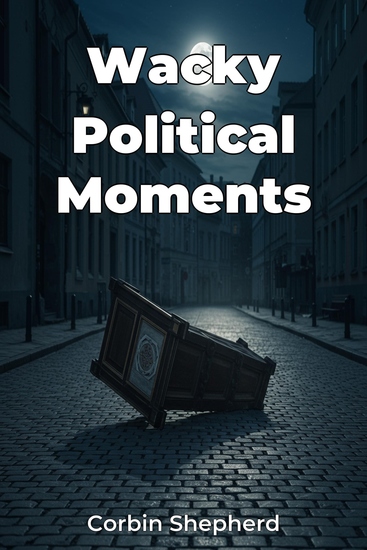
Wacky Political Moments - cover

Wacky Political Moments

Corbin Shepherd

Traductor A AI

Editorial: Publifye

  • 0
  • 0
  • 0

Sinopsis

Wacky Political Moments explores history's most bizarre political episodes, revealing how seemingly minor missteps can trigger major consequences. It's not just about funny stories; it’s an examination of the fragility of power and the chaos that can lie beneath political order. For instance, a speech about turnips once nearly caused a constitutional crisis, highlighting how easily things can go awry. The book uses these political absurdities as a lens to understand critical moments often overlooked.

 
This book delves into the psychology behind political decision-making, especially during times of stress. It examines how leaders react to the unexpected and what cognitive biases influence their choices, providing insights into decisions that seem irrational in hindsight.

 
Beginning with a definition of "wacky" in politics, the book moves through history, focusing on rhetorical gaffes, unusual leadership decisions, and international incidents caused by miscommunication. By studying these moments, readers gain a deeper understanding of power dynamics and the impact of human error on political stability.
Disponible desde: 31/03/2025.
Longitud de impresión: 67 páginas.

Otros libros que te pueden interesar

  • The Birth of Anarchism - 1849-1887 - cover

    The Birth of Anarchism - 1849-1887

    Pierre-Joseph Proudhon, Mikhail...

    • 0
    • 0
    • 0
    Mankind can rule itself without the force of top-down authority, and freedom is more than just choosing how to meet the needs and demands of capital. Inequality is structural and intentional, not inevitable and necessary.  
    It does not have to be this way. In solidarity, we are better. 
    Think for yourself, and question authority. 
    This is the essence of anarchism, which has a bad name and reputation because it attacks the necessity of centralised power and authority. The media archetype is Tyler Durden, filled with violence and nihilism – yet anarchism is the most positive of political philosophies, one that Jesus and Buddha both preached, stating that empathy and a rejection of authority were key to human flourishing. Neither would disagree with most early anarchists. 
    Proudhon, whose “property is robbery” is perhaps the most well-known anarchist slogan, lays out the conceptual foundation for key anarchist ideas. He argues that usury (charging interest) is a fundamental harm to society, that there is enough for everyone if we simply take other values to be higher than capital gain, that mutualism is inevitable, and that all governments and ideologies make the same mistake, in trying to change society from the top. Positive change must arise from the great masses of humanity, not from their rulers. 
    Bakunin's speeches are about solidarity arising from the masses, and the ground for a global reconfiguration. 
    Louis Lingg was convicted to death with six others, for being one of the ‘Chicago Anarchists’. They were executed to make a political point, based on corrupted evidence and perjury. His statement is one of contempt for the powers that be, and his belief that mankind should be free and should fight until it is. 
    We end with Kropotkin, who firmly believed in decentralized society. He believed that the greatest strength of mankind lies in the masses, not their rulers, and exhorts us to “Act for Yourselves”.
    Ver libro
  • Ghost signs - cover

    Ghost signs

    Stu Hennigan

    • 0
    • 0
    • 0
    GHOST SIGNS is a blistering portrait, an eyewitness account of delivering essential food and medicines to the most deprived communities during the first months of the pandemic. This visceral piece of reportage is an essential document into the effects of COVID-19 and how it ripped apart the social fabric of this country after ten years of Austerity
    Ver libro
  • Java Hill - An African Journey: A Nation's Evolution Through Ten Generations of a Family Linking Four Continents - cover

    Java Hill - An African Journey:...

    T.P. Manus Ulzen

    • 0
    • 0
    • 0
    Born in the gold mining hot bed of Tarkwa, Ghana, T. P. Manus Ulzen is the oldest of 5 children. His parents were both educators. He grew up in Bolgatanga, Wa, Wenchi, Accra, Kumasi and Takoradi in Ghana until he was 12 years old. He started high school at the age of 10 at St. Augustine's College, Cape Coast and continued his education at Kabulonga School for Boys in Lusaka, Zambia after his family left Ghana following the 1966 coup which ended Nkrumah's first republic. He returned to Ghana to complete his high school education at Ghana Secondary Technical School, Takoradi. 
    Though, greatly interested in liberal arts pursuits, he chose medicine as a career and graduated from the University of Ghana Medical School at the age of 22, becoming the youngest physician in his country at the time. After working as a general physician in Cape Coast, he left Ghana in 1980 for Canada to begin his specialist training. 
    He completed his postgraduate studies in Psychiatry at the University of Toronto in 1985 and has since had a successful career as an academic psychiatrist. He has been on the faculty at the University of Toronto, Brody School of Medicine at East Carolina University and is now Professor and Chair of Psychiatry and Behavioral Medicine in the College of Community Health Sciences at the University of Alabama, Tuscaloosa, Alabama where he is also Associate Dean for Academic Affairs. He is married to Ekua Mensah, a musician and they have 3 children, Adwoa, Kweku and Kofi.
    Ver libro
  • Argentina and Peronism: The History and Legacy of Argentina’s Transition from Juan Perón to Democracy - cover

    Argentina and Peronism: The...

    Charles River Editors

    • 0
    • 0
    • 0
    Until the 1930s, nationalism had always tended to be a phenomenon of the right-wing or the immigrant anarchists and Bolsheviks. Now, however, the emphasis shifted to the middle ground, and ironically, one of the issues driving Argentine nationalism was the outsized British presence in Argentine affairs, stoked recently by the preferential trade agreement. Perhaps most importantly, the seizure by the British in 1833 of the Islas Malvinas (or as the British termed them, the Falkland Islands) remained a sore point. 
    This wave of cultural nationalism was very different to the more visceral, political nationalism that came before it, and it gathered a considerable following in Buenos Aires among liberal intellectuals and the middle classes. The movement was given further impetus by the outbreak of World War II and the freezing of European markets, along with the British emphasis on the imperial preference as a means of saving foreign currency. Calls began to be heard for industries to be nationalized, for goods no longer imported to be manufactured at home, and for a greater degree of protectionism and self-sufficiency. At the same time, Argentina’s neutrality during the war was punished by the United States, which excluded Argentina from a program of arming several Latin American countries. This struck the Argentine armed forces with a bout of the jitters in case they fell behind in matters of military preparedness. 
    After the tensions had mounted for over a year, matters played out precisely as Perón’s opponents had feared. By the final months of 1945, his popularity had soared, and it seemed inevitable that he would seize control of the military government if permitted to remain in power.
    Ver libro
  • Modern Jungles - cover

    Modern Jungles

    Pao Lor

    • 0
    • 0
    • 0
    As a five-year-old boy, Pao Lor joined thousands of Hmong who fled for their lives through the jungles of Laos in the aftermath of war. After a difficult and perilous journey that neither of his parents survived, he reached the safety of Thailand, but the young refugee boy’s challenges were only just beginning.Born in a small farming village, Pao was destined to be a Hmong clan leader, wedding negotiator, or shaman. But the course of his life changed dramatically in the 1970s, when the Hmong faced persecution for their role in helping US forces fighting communism in the region. After more than two years in Thai refugee camps, Pao and his surviving family members boarded the belly of an “iron eagle” bound for the United States, where he pictured a new life of comfort and happiness. Instead, Pao found himself navigating a frightening and unfamiliar world, adjusting to a string of new schools and living situations while struggling to fulfill the hopes his parents had once held for his future. Now in Modern Jungles, Pao Lor shares his inspiring coming-of-age tale about perseverance, grit, and hope.
    Ver libro
  • William Powell and Myrna Loy: The Lives and Careers of One of Classical Hollywood’s Most Iconic Duos - cover

    William Powell and Myrna Loy:...

    Editors Charles River

    • 0
    • 0
    • 0
    It is something of a cliché to say that an actor’s life was like a movie he or she might have starred in, but in the case of Myrna Loy, the cliché is true. It is easy to picture her as a little girl, riding the range with her rancher father, sitting around the table and participating charmingly in family discussions of current events. It is not hard to imagine the camera panning to her first and then second visits to Hollywood, her backlot tour, and starry-eyed decision to become an actress. There would have to be some drama, which the story of her father’s untimely death would provide, along with some sort of deathbed promise made to him to care for the rest of the family. Her mother would be brave but resolute as she moved her young family to California. The lighting on set would brighten and the tempo of the background would pick up as she walked down the Los Angeles streets. Then, her big break would come. The camera would show her first comical meeting with William Powell and then a spinning scene of ticket after ticket being sold to their new picture, The Thin Man.  
    While older silent film stars like Charlie Chaplin and Buster Keaton reached the peak of Hollywood, some actors born near the beginning of the 20th century were ready to capitalize. Though actors like Humphrey Bogart and Cary Grant remain household names, and actresses like Greta Garbo are still widely remembered, few had careers that enjoyed the success of William Powell. In a career spanning several decades, Powell would receive three Oscar nominations for Best Actor for critically acclaimed movies, so it is somewhat ironic that he is mostly remembered today for his association with the more famous Myrna Loy. One thing that helped Powell’s career along in the old days when Hollywood would only cast white actors in major roles, no matter what the nationality of the character was supposed to be, were his dark good looks.
    Ver libro