Begleiten Sie uns auf eine literarische Weltreise!
Buch zum Bücherregal hinzufügen
Grey
Einen neuen Kommentar schreiben Default profile 50px
Grey
Jetzt das ganze Buch im Abo oder die ersten Seiten gratis lesen!
All characters reduced
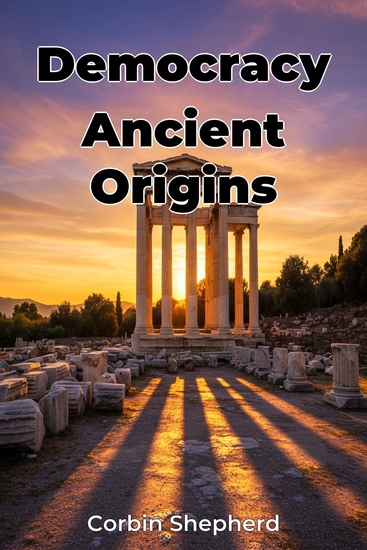
Democracy Ancient Origins - cover

Democracy Ancient Origins

Corbin Shepherd

Übersetzer A AI

Verlag: Publifye

  • 0
  • 0
  • 0

Beschreibung

Democracy: Ancient Origins traces democracy's path from its beginnings in ancient Greece to its modern forms, exploring how core principles like voting systems and political equality have evolved. The book examines the successes and failures of past democratic experiments, offering insights into present-day strengths and weaknesses.

 
Did you know Athenian democracy utilized ostracism to prevent tyranny? Or that the Roman Republic contributed significantly to the concept of representative government?

 
This historical analysis emphasizes the constant adaptation of democratic ideals in response to changing social, economic, and political contexts. It navigates inherent tensions between popular will and minority rights, individual liberty and collective responsibility.

 
Beginning with direct democracy in Athens, the book progresses through the Roman Republic, the Enlightenment, and revolutionary movements. By providing a chronological account of democracy's evolution, drawing from historical sources and contemporary scholarship, the book offers a balanced view of different democratic experiments.

 
It sheds light on the challenges facing contemporary democracies, such as declining voter turnout and political polarization, making it valuable to anyone interested in understanding democracy's history and future.
Verfügbar seit: 02.05.2025.
Drucklänge: 69 Seiten.

Weitere Bücher, die Sie mögen werden

  • Kings of Babylon The: The History of the Different Dynasties that Ruled Ancient Mesopotamia’s Greatest City - cover

    Kings of Babylon The: The...

    Charles River Editors

    • 0
    • 0
    • 0
    The ancient world was full of many fantastic cities and places, and like today’s major cities, the great ancient cities were hubs of trade, religion, and science. Writing was first invented in ancient cities, and many important scientific discoveries were also made in them, some of which are still used in the modern world. Among the many cities of the ancient world, Rome and Athens may come to mind first, but the city of Babylon in the land of Mesopotamia was already an ancient, venerated city when the others were still inconsequential settlements.  
    	Today, Babylon has become a byword for greed, excess, and licentiousness, mostly due to its mention in the Bible, but a closer examination reveals that Babylon was so much more, and even perhaps the most important city in the ancient world. Ancient Babylon was home to great dynasties that produced some of the world’s most influential leaders, most notably Hammurabi and Nebuchadnezzar, and these rulers invoked their wills on the entire ancient Near East and have been remembered as both progressive and cruel all at the same time. Babylon was also the seat of culture in ancient Mesopotamia and the place where scholars made amazing scientific advances that would not be eclipsed for several centuries. An examination of ancient Babylon demonstrates that it was truly the first great city in the ancient world. 
    	Of course, the sheer span of history between Babylon’s power and today has produced plenty of historical questions and controversy. One of the things people most closely associate Babylon with is the Hanging Gardens, which, like the Great Pyramid of Giza, were considered both a technological marvel and an aesthetic masterpiece. Ancient historians believed that the Hanging Gardens were constructed around the 7th century B.C. after the second rise of Babylon.
    Zum Buch
  • History of Machu Picchu - The Greatest Symbol of the Inca Empire - cover

    History of Machu Picchu - The...

    Kelly Mass

    • 0
    • 0
    • 0
    Machu Picchu, one of the most iconic symbols of Inca civilization, is a 15th-century fortress perched high on a mountain crest in southern Peru's Eastern Cordillera. Sitting at an altitude of 2,430 meters (7,970 feet), it is located 80 kilometers (50 miles) northwest of Cusco, within the Machupicchu District of Urubamba Province. The fortress overlooks the Sacred Valley, and the Urubamba River winds through the valley below, cutting through the Cordillera and forming a tropical mountain canyon. This stunning geographical setting has made Machu Picchu one of the most visited and revered archaeological sites in the world. 
    Unlike the Mayans, the Incas had no written language, and thus, no records of the site existed during its operation. The first Europeans to visit Machu Picchu did so only in the 19th century, and as a result, much of its history remained shrouded in mystery. Modern archaeologists, relying on tangible evidence such as graves and structural remains, have attributed names and proposed functions for the buildings, but much of the site’s exact purpose remains speculative. 
    Most contemporary archaeologists believe that Machu Picchu was built as a royal estate for the Inca emperor Pachacuti, who ruled from 1438 to 1472. Constructed in 1450, the site functioned as a private residence for the emperor and his court. Over time, Machu Picchu became the most well-known image of Inca civilization and is often referred to as the "Lost City of the Incas." However, the estate was abandoned in the early 16th century, following the Spanish conquest of the Inca Empire. Recent radiocarbon dating indicates that the site was occupied from around 1420 to 1532.
    Zum Buch
  • Bones of Belonging - Finding Wholeness in a White World - cover

    Bones of Belonging - Finding...

    Annahid Dashtgard

    • 0
    • 0
    • 0
    In this exceptional book, inclusion leader Annahid Dashtgard shares her experiences looking for and teaching about belonging in our divided world. Through moving and deft interlocking stories, Dashtgard examines what it means to belong—to a country, in a marriage, and in our skin—and the price we pay when that belonging is absent.
    Zum Buch
  • Keep Left - Red Paper on Scotland 2025 - cover

    Keep Left - Red Paper on...

    Pauline Bryan

    • 0
    • 0
    • 0
    This book has a message for everyone concerned about the direction of politics in Scotland, the UK and beyond: do not despair. There are realistic, left alternatives to being stuck in a political 'doom loop'. 
    In 1975 the Red Paper on Scotland, edited by the young, radical Gordon Brown was a seminal publication; it helped create, not just catch, the mood of the day.  
    Fifty years later a new group of writers have come together to write about what we can learn from the past and how we can shape what lies ahead. 
    The authors of this book believe only a radical redistribution of wealth and power within a democratic economy will engage Scottish voters. It calls on us to Keep Left.
    Zum Buch
  • Information Science - The Basics - cover

    Information Science - The Basics

    Judith Pintar, David Hopping

    • 0
    • 0
    • 0
    Information Science: The Basics provides an accessible introduction to the multifaceted field of Information Science (IS). 


    Inviting listeners to explore a modern field of study with deep historical foundations, the book begins by considering the complexities of the term "information" and the information life cycle from classification to preservation. Each chapter examines a different area within IS, surveying its history, technologies, and practices with a critical eye. This interdisciplinary field incorporates a wide range of approaches which it shares with humanities, social science, and technology fields. What makes IS unique is its emphasis on the connections between information, technology, and society. The need to share information more effectively in response to social, environmental, and biomedical challenges has never been so urgent; the volume discusses the risks as well as benefits that come with the emerging technologies that make it possible. The book also explores how IS, with its long-standing commitment to intellectual freedom and digital inclusion, and its keen attention to the protection of privacy, data ethics, and algorithmic transparency, can contribute to the creation of a more open and equitable society.
    Zum Buch
  • Gender History - A Very Short Introduction - cover

    Gender History - A Very Short...

    Antoinette Burton

    • 0
    • 0
    • 0
    This volume introduces the field of gender history—its origins, development, reception, recalibrations, and frictions. It offers a set of working definitions of gender as a descriptive category and as a category of historical analysis, tracing the emergence, usage, and applicability of these entwined subjects. 


    Inevitably political, gender history has taken aim at the broader field of historical narrative by asking who counts as a historical subject, what difference gender makes, and how attention to it subverts reigning assumptions of what power, culture, economics, and identity have been in the past—and what they are today. The book explores how gender analysis has changed interpretations of the histories of slavery, capitalism, migration, and empire. 


    As a field, gender history has been extraordinarily influential in shaping several generations of scholars and students. And, as part of the movement toward gender equality that is key to modern western progress, gender history has been caught up in the culture wars that continue to shape post-global society. The practice of gender history has always run up against the forces of race, class, and sexuality that challenge the singularity of gender itself as an explanatory category of historical analysis. That powerful, unruly tension is at the heart of this Very Short Introduction.
    Zum Buch