Join us on a literary world trip!
Add this book to bookshelf
Grey
Write a new comment Default profile 50px
Grey
Subscribe to read the full book or read the first pages for free!
All characters reduced
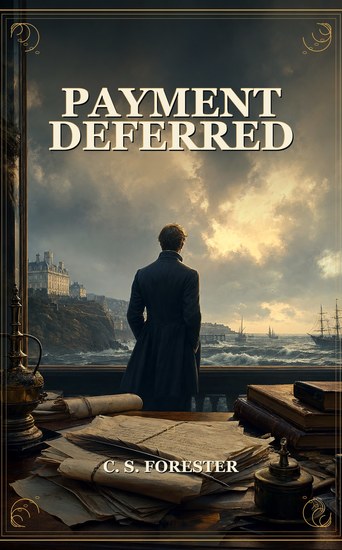
Payment Deferred - cover

Payment Deferred

C. S. Forester

Publisher: Caelwick Press

  • 0
  • 0
  • 0

Summary

William Marble is a spendthrift banker living in suburban London with his wife and children. He's hard up for money, as his wife spends indiscriminately, he has a growing interest in whiskey, and rent will soon be due. But one night, a visitor calls: James Medland, William's nephew from Australia, is visiting to inform them of a death in the family. Medland is very wealthy, and very alone here at the other end of the world—and Marble, desperate for cash, quickly decides that he must do the unthinkable to get his hands on Medland's bulging wallet. Payment Deferred is an unusual crime novel in the sense that the murder happens at the outset, and there's no mystery as to who did it or why. Rather, taking cues from " The Telltale Heart ", the novel focuses on the state of mind of a guilty criminal. Marble's increasingly elaborate attempts to keep his crime secret from both his family and the authorities become a study of the damage that guilt can do to a person's psyche. Marble soon finds himself wealthy beyond necessity, but his fixation on his money problems is quickly replaced by an all-consuming obsession over this much, much darker problem. C. S. Forester (died 1966) was a significant literary figure of the 20th century. Their work has endured across generations and continues to be read and studied worldwide. As a work of classic literary fiction, Payment Deferred exemplifies the narrative craft and social insight that defined great storytelling of its era. Literary fiction of this period was characterized by careful attention to character psychology, social milieu, and the moral questions that animated public discourse.
Available since: 05/19/2026.
Print length: 206 pages.
Other books that might interest you

  • Five Children and It - cover

    Five Children and It

    Edith Nesbit

    • 0
    • 0
    • 0
    After moving into a house in kent, five children go exploring and in a gravel pit, find a Sand Fairy, known as a "Psammead" who says he will give them one wish each day. What follows are eleven misadventures where it is discovered that making a good wish is actually much harder than it first appears... The first in E.Nesbit's "The Psammead" trilogy, published in the Strand Magazine from 1902.  
    Narrated by Michael
    Show book
  • Dubliners - cover

    Dubliners

    James Joyce

    • 0
    • 0
    • 0
    "Dubliners" is a collection of 15 short stories by James Joyce, chronicling the lives of various characters in Dublin, Ireland, at the turn of the 20th century. Each story offers a snapshot of life, capturing moments of realization, epiphany, and the struggles of everyday Dubliners. Themes of paralysis, the search for meaning, the constraints of society, and the tensions between the desire for escape and the pull of home are recurrent. The stories culminate with "The Dead," considered one of the greatest short stories in the English language.
    Show book
  • Dracula – Chapter 8: Letter from Mina Harker to Lucy Westenra - A Chapter-by-Chapter Reading of Bram Stoker’s Classic - cover

    Dracula – Chapter 8: Letter from...

    Bram Stoker

    • 0
    • 0
    • 0
    In this chapter, the narrative returns to Mina Harker, who writes a letter to her dear friend Lucy Westenra. Mina recounts her reunion with Jonathan, now safely returned from his terrifying ordeal in Transylvania, and the relief she feels at his homecoming. Yet, the shadow of his experiences lingers — his strange behavior and troubled memories hint at horrors that are far from over. 
    Through her affectionate and observant voice, we glimpse Victorian domestic life and the intimate bonds of friendship and love. However, the letter carries an undercurrent of unease, as hints of Dracula’s growing influence begin to surface. Mina’s intelligence and resourcefulness continue to stand out, providing a calm counterpoint to the looming supernatural threat. 
    This is Chapter 8 of Bram Stoker’s Dracula, narrated by Amazon bestselling horror author Jonathan Dunne — part of a complete chapter-by-chapter audiobook series that brings the Gothic classic to life with haunting atmosphere, rich characterization, and cinematic storytelling. 
    Experience Mina’s warmth and concern, the tension of Jonathan’s lingering trauma, and the subtle dread that signals the dark forces gathering beyond their awareness. 
    📖 Public domain text. Original publication: 1897.
    Show book
  • The Way We Live Now - cover

    The Way We Live Now

    Anthony Trollope

    • 0
    • 0
    • 0
    The Way We Live Now is Anthony Trollope's longest novel, published in two volumes in 1875 after first appearing in serial form. After an extended visit to Australia and New Zealand in 1872, Trollope was outraged on his return to England by a number of financial scandals, and was determined to expose the dishonesty, corruption, and greed they embodied. The Way We Live Now centers around a foreign businessman, Augustus Melmotte, who has come to prominence in London despite rumors about his past dealings on the Continent. He is immensely rich, and his daughter Marie is considered to be a desirable catch for several aristocratic young men in search of a fortune. Melmotte gains substantial influence because of his wealth. He rises in society and is even put up as a candidate for Parliament, despite a general feeling that he must be a fraudster and liar. A variety of sub-plots are woven around this central idea. The Way We Live Now is generally considered to be one of Trollope's best novels and is often included in lists of the best novels written in English. Anthony Trollope (died 1882) was one of the most distinguished authors of the Victorian age. Their work has endured across generations and continues to be read and studied worldwide. As a work of classic literary fiction, The Way We Live Now exemplifies the narrative craft and social insight that defined great storytelling of its era. Literary fiction of this period was characterized by careful attention to character psychology, social milieu, and the moral questions that animated public discourse.
    Show book
  • Richard Bruce - Burglar - Former soldier and journalist that became a revered author and screenwriter - cover

    Richard Bruce - Burglar - Former...

    Edgar Wallace

    • 0
    • 0
    • 0
    Richard Horatio Edgar Wallace was born on the 1st April 1875 in Greenwich, London.  Leaving school at 12 because of truancy, by the age of fifteen he had experience; selling newspapers, as a worker in a rubber factory, as a shoe shop assistant, as a milk delivery boy and as a ship’s cook.  
     
    By 1894 he was engaged but broke it off to join the Infantry being posted to South Africa. He also changed his name to Edgar Wallace which he took from Lew Wallace, the author of Ben-Hur.  
     
    In Cape Town in 1898 he met Rudyard Kipling and was inspired to begin writing. His first collection of ballads, The Mission that Failed! was enough of a success that in 1899 he paid his way out of the armed forces in order to turn to writing full time.  
     
    By 1904 he had completed his first thriller, The Four Just Men. Since nobody would publish it he resorted to setting up his own publishing company which he called Tallis Press. 
      
    In 1911 his Congolese stories were published in a collection called Sanders of the River, which became a bestseller. He also started his own racing papers, Bibury’s and R. E. Walton’s Weekly, eventually buying his own racehorses and losing thousands gambling.  A life of exceptionally high income was also mirrored with exceptionally large spending and debts.  
     
    Wallace now began to take his career as a fiction writer more seriously, signing with Hodder and Stoughton in 1921. He was marketed as the ‘King of Thrillers’ and they gave him the trademark image of a trilby, a cigarette holder and a yellow Rolls Royce. He was truly prolific, capable not only of producing a 70,000 word novel in three days but of doing three novels in a row in such a manner. It was estimated that by 1928 one in four books being read was written by Wallace, for alongside his famous thrillers he wrote variously in other genres, including science fiction, non-fiction accounts of WWI which amounted to ten volumes and screen plays. Eventually he would reach the remarkable total of 170 novels, 18 stage plays and 957 short stories. 
     
    Wallace became chairman of the Press Club which to this day holds an annual Edgar Wallace Award, rewarding ‘excellence in writing’.  
     
    Diagnosed with diabetes his health deteriorated and he soon entered a coma and died of his condition and double pneumonia on the 7th of February 1932 in North Maple Drive, Beverly Hills. He was buried near his home in England at Chalklands, Bourne End, in Buckinghamshire.
    Show book
  • The Acquittal - From their pens to your ears genius in every story - cover

    The Acquittal - From their pens...

    A M Burrage

    • 0
    • 0
    • 0
    Alfred McLelland Burrage was born in Hillingdon, Middlesex on 1st July, 1889. His father and uncle were both writers, primarily of boy’s fiction, and by age 16 AM Burrage had joined them.  The young man had ambitions to write for the adult market too.  The money was better and so was his writing. 
    From 1890 to 1914, prior to the mainstream appeal of cinema and radio the printed word, mainly in magazines, was the foremost mass entertainment.  AM Burrage quickly became a master of the market publishing his stories regularly across a number of publications. 
    By the start of the Great War Burrage was well established but in 1916 he was conscripted to fight on the Western Front. He continued to write during these years documenting his experiences in the classic book War is War by Ex-Private X. 
    For the remainder of his life Burrage was rarely printed in book form but continued to write and be published on a prodigious scale in magazines and newspapers.  In this volume we concentrate on his supernatural stories which are, by common consent, some of the best ever written.  Succinct yet full of character each reveals a twist and a flavour that is unsettling…..sometimes menacing….always disturbing.
    Show book